 Guide On Map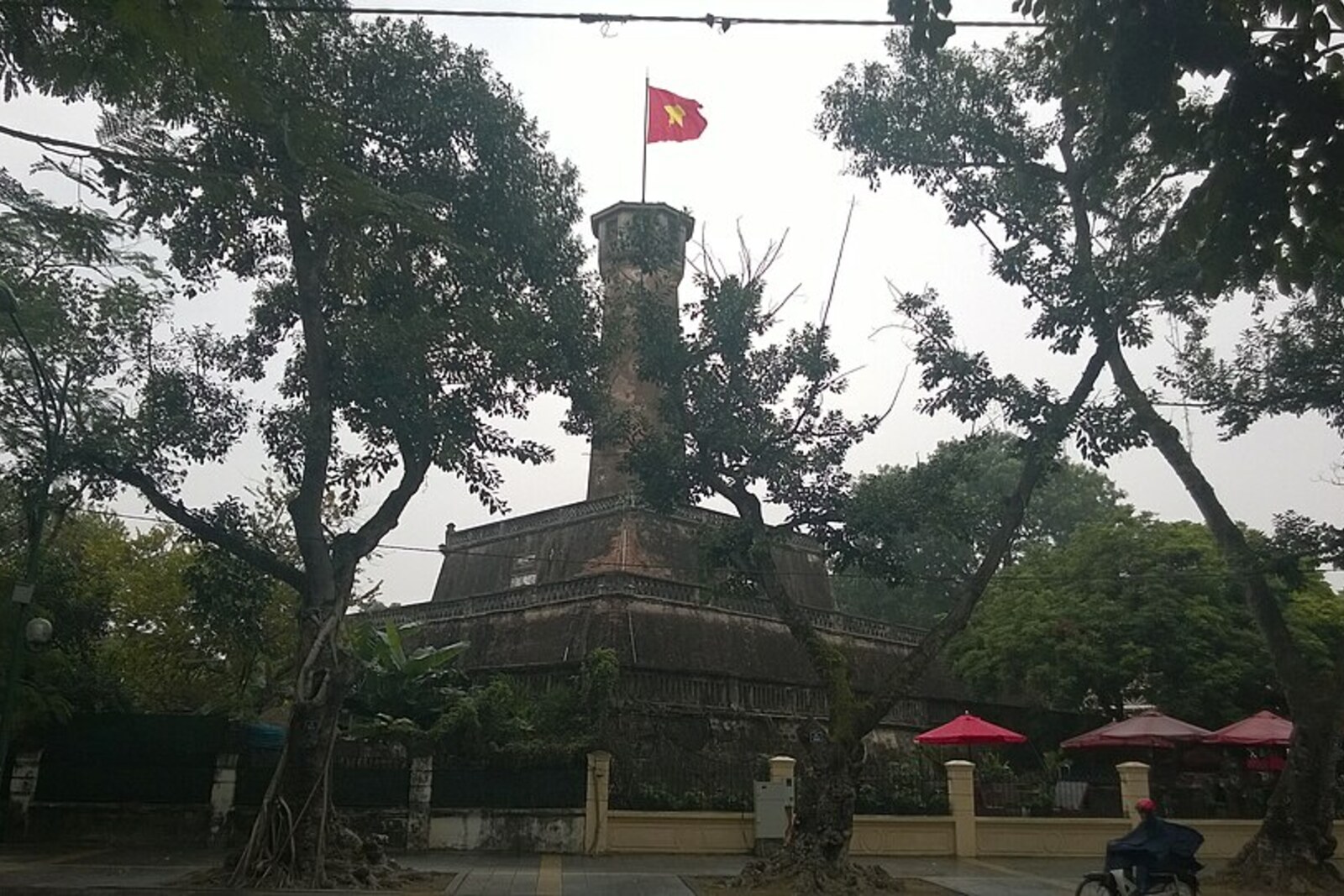
Look around first
What to notice
- Three brick terraces
- Octagonal shaft
- Viewing pavilion
- Flagpole
The story of the place
Inside this brick tower, fifty-four steps wind in a spiral to the platform beneath the roof; outside, it is formed by three receding terraces and a faceted shaft. When most of the citadel disappeared, the surviving height served the military as an observation point. A large red flag with a yellow star is now kept permanently above the pavilion, and the flagpole rises above the roof.
The tower was erected at the southern edge of the Hanoi Citadel by order of Emperor Gia Long. Construction began in eighteen oh five and ended in eighteen twelve. Three tapering brick terraces raise an octagonal shaft with a spiral staircase and a viewing pavilion. From here, a straight line ran through Doan Mon Gate to the citadel’s palaces. When the French administration dismantled almost all the fortifications at the end of the nineteenth century, it preserved the tower and adapted it for military observation.
The red flag with a yellow star appeared above it after another war. The Geneva Accords of nineteen fifty-four provided for the withdrawal of French troops from North Vietnam. On October tenth, units of the Vietnam People's Army were to enter Hanoi. A ceremony was scheduled for three in the afternoon: Nguyen Quoc Tri, commander of the Capital Regiment, would raise the flag over the old citadel.
The day before, it became clear that there was nothing on which to raise it. The sappers were issued two flags, each with an area of thirty square meters, and ordered to install a twelve-meter flagpole on the roof in a single night. The tied bamboo trunks swayed even without a flag. Then railway workers from Hang Co Railway Station made a steel pipe with a pulley and provided a cart to deliver it to the tower.
Inside the shaft, fifty-four steps wind in a spiral, so the long pipe could not be carried in by the stairs. The sappers ran a cable through the windows and hauled it up from outside. At the top, they removed part of the roof tiles, pulled the pipe through the opening, and secured it to the lightning rod. The first flag tore during a test hoisting. The second reached the top, but during the inspection the thin cable slipped off the pulley. The flag was stuck: it could neither be raised nor lowered.
It was about two in the morning. Tran Van Giai, commander of the sapper squad, volunteered to reach the pulley. Before joining the army, he had earned a living by climbing tall areca palms for fruit; now that skill proved to be the only suitable trade. Giai took off his uniform, took pliers and a coil of wire, and climbed the smooth steel pipe above the tiled roof. Two sappers held the flagpole and prepared to catch him, although a fall from that height would hardly have made that possible.
Giai put the cable back into the groove of the pulley. From below, they raised the flag all the way up, after which he secured the cable with wire and began climbing down, adding fastenings. Having tied the last knot, the sapper collapsed unconscious into his comrades’ arms, covered in abrasions and bruises. His toes were bleeding, and his nails had been torn off.
Raising the flag during the ceremony was now impossible: it had been secured fast before dawn. The command changed the order of the celebration. On October tenth, troops and residents gathered by the tower, the band played the anthem, and above the square already hung the flag that the railway workers and sappers had raised during the night. Since nineteen eighty-six, a flag with an area of twenty-four square meters has been kept permanently at the top.
Useful on site
The citadel is open daily 08:00–17:00; the general adult ticket costs 100 000 dong. The flag tower can be viewed at its base and from outside; its interior spaces officially remain temporarily closed pending inspection and restoration.
Checked: July 1, 2026. Check the official source before visiting.If the climb or the interior levels are closed, view the tower from the ground: its role can be read from its height and position in the city.