 Guide On Map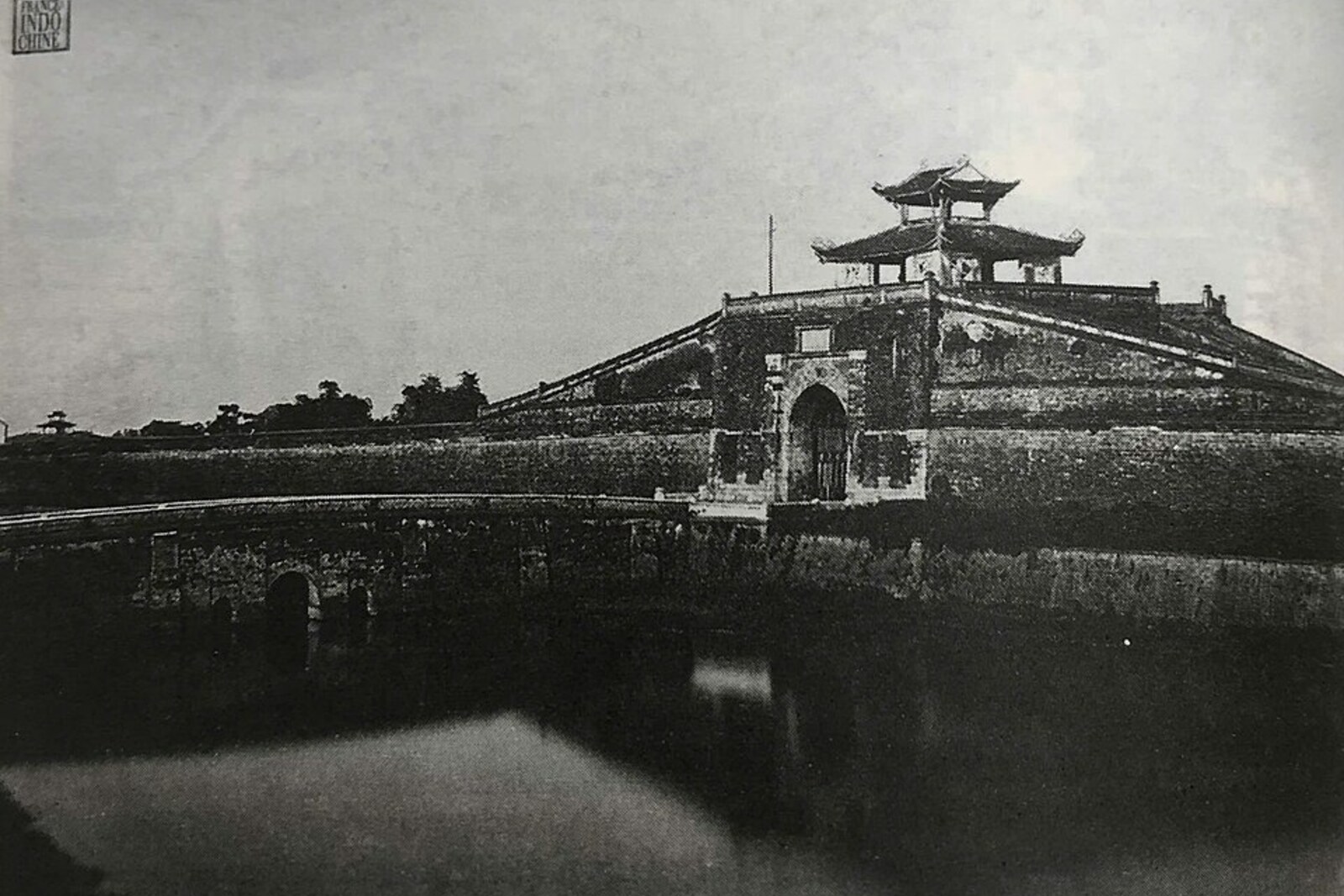
Look around first
What to notice
- Two deep pockmarks
- White stone plaques
- Arched passageway
- Watch pavilion
The story of the place
The North Gate of the Hanoi Citadel opened into the citadel through an arched passageway. Above it stands a guard pavilion, from which the garrison watched the roads leading to the fortress. Emperor Gia Long ordered the gate built in eighteen oh five on the site of an earlier entrance, beyond a wide moat. Later, the walls and other gates were dismantled, the moat became a lawn, a sidewalk, and part of a street, and statues of Hanoi’s defenders appeared in the pavilion.
Two deep pockmarks remain on the outer façade. After the French captured the Hanoi Citadel, they did not fill them with brick; instead, they mounted white stone plaques beside them. These are traces of shells fired from ships on the Red River on April twenty-fifth, eighteen eighty-two.
Above the arch is carved: “Main North Gate.” Emperor Gia Long ordered it built in eighteen oh five on the site of an older entrance. A watch pavilion stood above, from which the garrison watched the approaches to the fortress. In front of the gate was a wide moat; now its place is occupied by a lawn, a sidewalk, and part of Phan Dinh Phung Street. In the eighteen nineties, the French administration demolished the walls and the other four gates. The North Gate of the Hanoi Citadel remained standing alone.
Hoang Dieu, the imperial governor-general of Hanoi and neighboring provinces, was responsible for its defense. He sought to ensure that the garrison kept the fortress for the court of Emperor Tu Duc. French naval captain Henri Rivière, who arrived in the city, was officially supposed to protect French subjects and survey the Red River. His instructions required him to limit the use of force and did not require him to occupy the citadel. But Hoang Dieu was repairing the fortifications in expectation of an attack, and Rivière decided to take the fortress.
At five o’clock in the morning, the captain sent an ultimatum. Within three hours, the defenders were to dismantle the fortifications and lay down their weapons, while the officials were to report to the French camp. Hoang Dieu sent a negotiator, hoping to buy time and avoid a battle. The negotiations broke down. At eight o’clock, the ship’s guns began firing on the northern wall, and two of their hits are still visible on the gate.
Hoang Dieu was ill that morning, but he went up onto the wall to join the soldiers and personally directed the defense. Around noon, a gunpowder store inside the citadel caught fire. The garrison fell into confusion, and French infantry burst inside. Realizing that it was impossible to continue the fight, the governor-general dismissed the remaining soldiers so that they would not die with him.
He went to the imperial residence near Kinh Thien Palace, bowed toward the capital of Hue, and wrote his final report to Tu Duc. Then he went to the Temple of Warriors, tied his head cloth to a tree, and hanged himself. The people of Hanoi collected money for a coffin and a funeral. Three years later, his family moved his remains to his native village.
Two statues stand in the watch pavilion above the gate. Beside Hoang Dieu is Nguyen Tri Phuong, the governor-general who defended this same citadel nine years earlier. At that time, the French detachment was commanded by Francis Garnier, who sought Hanoi’s handover. His soldiers took the fortress in about an hour. Nguyen Tri Phuong’s son was killed in battle; the commander himself was badly wounded and captured. The French offered him treatment and hoped to persuade the senior commander to cooperate. He refused to have his wound dressed, stopped taking food, and died.
Now, in the former guard pavilion, residents burn incense before both governor-generals. Below, the French plaques remain beside the two hits; above them stand Nguyen Tri Phuong and Hoang Dieu.
Useful on site
Visible from the street outside at any time; the citadel grounds are officially open daily 08:00–17:00, general admission 100 000 dong.
Checked: July 1, 2026. Check the official source before visiting.Do not touch the masonry or block the roadway; the traces of the bombardment are easier to make out when you examine the façade quietly.