 Guide On Map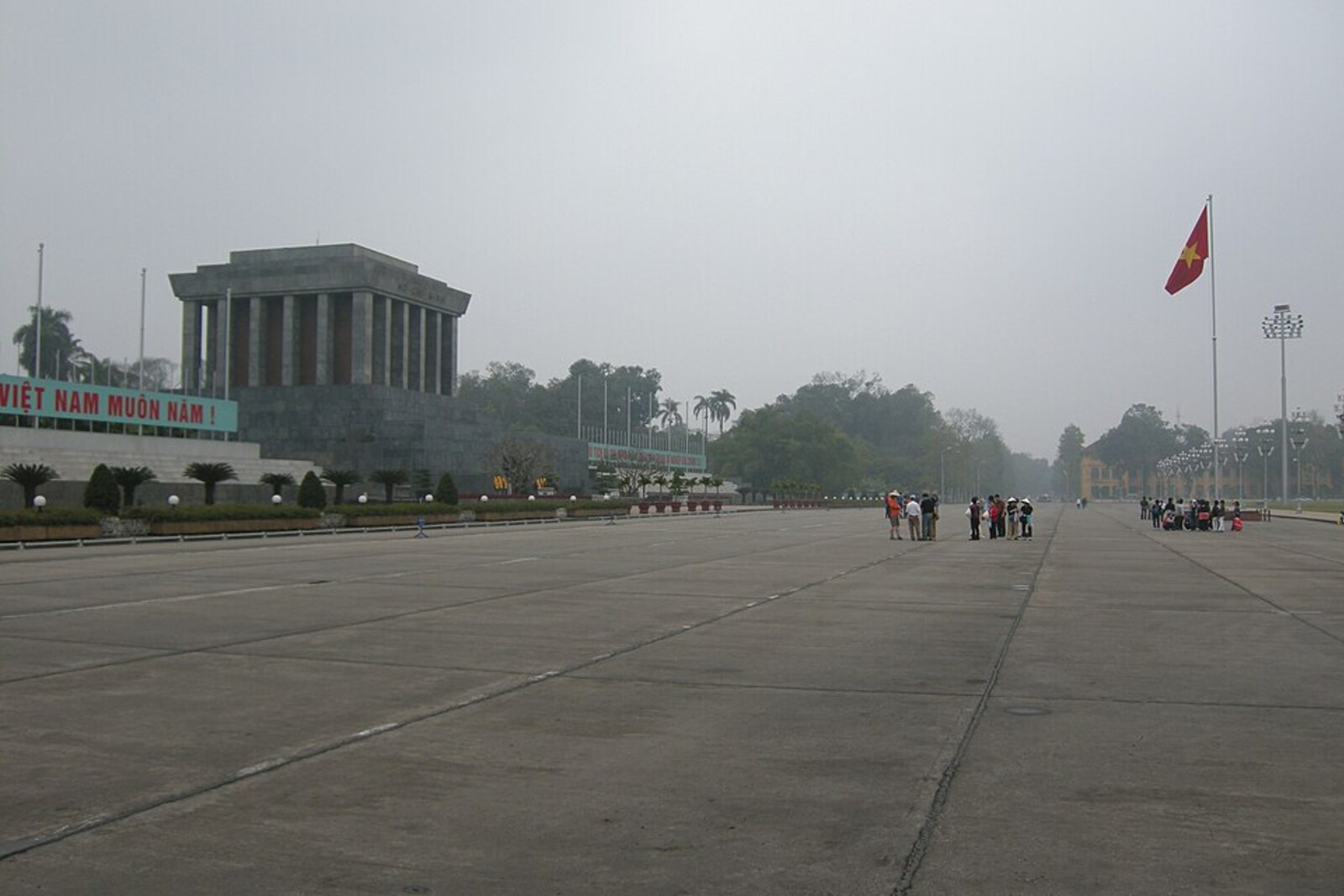
Look around first
What to notice
- Lawn strips
- Flagpole
- Mausoleum facade
- National Assembly Building
The story of the place
The broad rectangle with strips of lawn was left open among the governor-general’s palace, barracks, and offices of the French colonial administration. It was not later built over: state ceremonies are held here in front of the mausoleum facade, and the flag is raised and lowered daily at the tall flagpole. The name came from Thanh Hoa, from three village communal houses that stood within sight of one another. Not a single structure was moved from them to Hanoi; only their shared name remained.
On September first, nineteen forty-five, twenty-five-year-old architect Ngo Huy Quynh was assigned to build a platform for thirty people here in one day. By the following morning, there was no longer any way to put off the work: that afternoon, the provisional government was to appear before the country’s residents for the first time.
Quynh proposed a wooden frame nailed together. Hanoi residents provided boards and silk; carpenters covered the platform with yellow and red fabric and erected a flagpole. By three o’clock in the morning, the platform was ready. It stood on a round flower bed in the middle of a garden called Ba Dinh Square.
The organizers chose this garden for its size. They needed a central place where hundreds of thousands of people could gather. The present rectangular square did not yet exist. On the site of the citadel’s western gate, the French administration laid out Rond Point Puginier, named after a French bishop, and built the governor-general’s palace, barracks, and offices around it. The empty space lay within the colonial administrative quarter.
At two in the afternoon on September second, Ho Chi Minh stepped onto the platform—the chairman of the provisional government and leader of the Viet Minh, a movement seeking Vietnam’s independence. Japan had surrendered only a few weeks earlier. Viet Minh supporters had taken over Hanoi’s offices, yet no foreign country had recognized the new state, and France intended to reclaim the colony.
Ho Chi Minh began with the statement on the equality of people from the United States Declaration of Independence, then referred to the Declaration of the Rights of Man and of the Citizen. In this way, he addressed the Allies in the language of documents to which they themselves attached universal significance. In the middle of the reading, he stopped and asked whether he could be heard clearly. The gathered crowd answered in chorus.
Ho Chi Minh then proclaimed the creation of the Democratic Republic of Vietnam, and the ministers took the oath. September second became a national holiday. The republic did not receive immediate international recognition; by the end of the following year, war with France had begun. The wooden platform was dismantled, but the open space was preserved for state ceremonies. Now the flag is raised and lowered daily in front of the mausoleum, and on commemorative dates parade formations march across the square.
The name Ba Dinh appeared here only a few weeks before that ceremony. It was chosen by the physician Tran Van Lai, Hanoi’s first Vietnamese mayor. For his anti-French views, he had previously passed through Son La Prison and Hoa Lo Prison, then returned to medical practice. In the summer of nineteen forty-five, he had only one month as mayor, and he replaced French street and garden names with Vietnamese ones. Rond Point Puginier became Ba Dinh Square.
“Ba Dinh” means “three dinh.” A dinh is a communal house where a village held meetings and rituals. In Thanh Hoa Province, three such houses in the villages of Mau Thinh, Thuong Tho, and My Khe were visible from one another. In eighteen eighty-six, former local headman Dinh Cong Trang joined the villages with fortifications and led a detachment that sought to drive out the French and restore Emperor Ham Nghi to the throne.
French troops surrounded the fortifications, cut off supplies, set fire to the oil-soaked bamboo barricades, and opened artillery fire. On the night of January twentieth, eighteen eighty-seven, the defenders broke out of the siege. Dinh Cong Trang tried to join another rebel detachment, but in October he was surrounded and killed. Not a single stone from the three village dinh, the communal houses, was moved here. Their shared name remained on the square; nothing has survived either from the platform erected here fifty-eight years later.
Useful on site
Open space; access may be restricted by ceremonies, visits, and security. Official pages list the flag raising at 06:00 in the hot season and 06:30 in the cold season, with the flag lowered at 21:00.
Checked: July 1, 2026. Check the official source before visiting.Respect the barriers and the guards’ work; the square may be used for state ceremonies with temporary restrictions on access.