 Guide On Map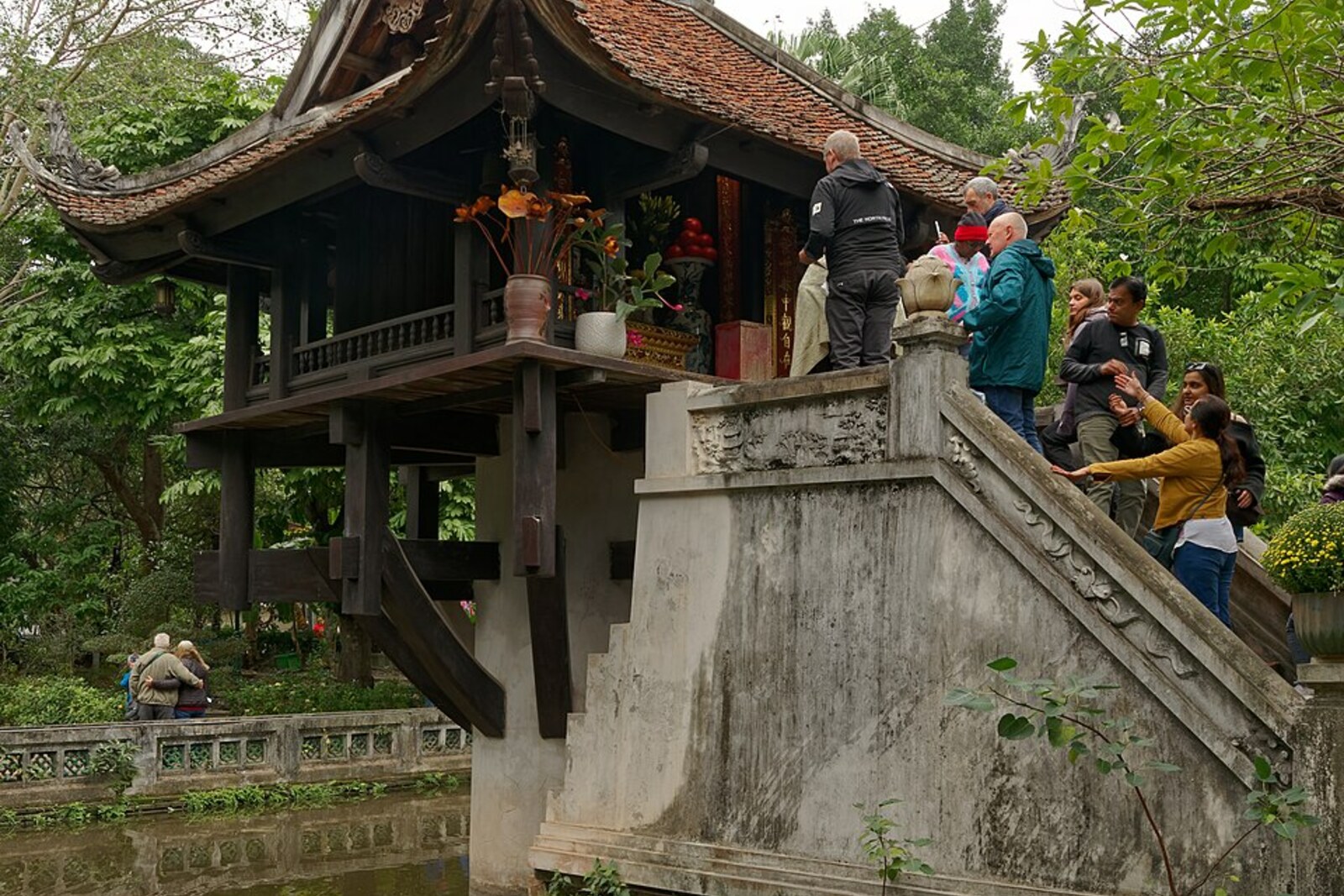
Look around first
What to notice
- The stone facade of the mausoleum
- The glass sarcophagus
- The stone pillar of the pagoda
- The wooden pavilion above the pond
The story of the place
On Ba Dinh Square, a stone facade with a military guard stands beside a small wooden pavilion above a square pond. Soviet and Vietnamese specialists designed the large building, and beneath its burial hall operate the systems needed for the body's permanent preservation. The stone pillar by the pond was intended as a stem, while the wooden shrine above it recalls a lotus flower.
Inside the mausoleum, under glass, lies Ho Chi Minh, president of the Democratic Republic of Vietnam, who asked to be cremated after his death. In May nineteen sixty-eight, he ordered that his ashes be divided among the north, center, and south of the country. The urns were to be buried on hills, with no stone stelae or bronze statues erected above them, and simple houses were to be built nearby where visitors could rest. In this way, he wrote, the funeral would not take people's time, money, or land.
Preparations for a different decision had begun even before he wrote those lines. In nineteen sixty-seven, when the president's health worsened, the Politburo—a narrow circle of party leaders—sent Vietnamese doctors to the Soviet Union to learn how to preserve a body by the method developed for Lenin. After Ho Chi Minh's death, the leaders explained their choice as a wish to allow people throughout the country, still divided by war, to bid him farewell. The lines about cremation were not included in the first published will. Later, the Politburo acknowledged that it had deliberately acted against his request.
The mausoleum did not yet exist. Doctors and fighters of Special Unit 69 received the body, which had to be preserved amid bombardments and floods. Over six years, they moved it six times. In December nineteen sixty-nine, the body was secretly taken from Hanoi to a forest complex in Ba Vi, about seventy kilometers to the west. After a military raid nearby, the shelter was considered unsafe, and the body was returned to the capital. In the summer of nineteen seventy-one, Hanoi was threatened by a major flood, so the route had to be taken in reverse. In July of the following year, during particularly heavy air raids, the body was transported by river to another shelter. The final journey ended here on July eighteenth, nineteen seventy-five.
Construction of the mausoleum began two years earlier. The site was chosen on Ba Dinh Square, where Ho Chi Minh read the Declaration of Independence. Soviet and Vietnamese specialists designed the building together; systems needed for the body's permanent preservation were installed beneath the burial hall. The mausoleum opened on August twenty-ninth, nineteen seventy-five. Visitors now pass the glass sarcophagus under military guard: the country's leaders' burial choice became the continuous work of doctors, engineers, and soldiers.
Nearby, above a square pond, stands a small wooden pavilion on a stone pillar. Its form is explained by a legend about Emperor Ly Thai Tong, ruler of Thang Long, as Hanoi was then called. Supposedly, the emperor saw the bodhisattva Avalokiteshvara, a Buddhist saint, in a dream, standing on a lotus flower. Courtiers considered the dream a bad omen, but the monk Thien Tue advised recreating what the emperor had seen: setting a stone pillar in the middle of the water and raising a lotus pavilion above it. In ten forty-nine, the emperor ordered it built in the western garden of the capital. The pillar represented a stem, and the wooden shrine a flower; hence the literal name, “One Pillar Pagoda.”
The wooden structure above the water appeared much later. Before leaving Hanoi in nineteen fifty-four, French troops planted mines in the pagoda. After the explosion, the stone pillar and several wooden parts remained. The Ministry of Culture assigned the restoration to architect Nguyen Ba Lang, and in April nineteen fifty-five he completed the present pavilion in the form of a pagoda from the Nguyen era. The stone pillar remained in place; everything wooden above it had to be rebuilt.
Useful on site
Mausoleum: Tuesday, Wednesday, Thursday, Saturday, and Sunday mornings; 01.04–31.10 — 07:30–10:30, until 11:00 on weekends and holidays; 01.11–31.03 — 08:00–11:00, until 11:30 on weekends and holidays. Monday and Friday are usually closed to visitors. In 2026, scheduled closure: 04.09–02.11, reopening from 03.11. No current official schedule for the pagoda was found during this survey; check on site.
Checked: July 1, 2026. Check the official source before visiting.Entry to the mausoleum is a separate controlled visit with screening and rules of conduct; both structures can be meaningfully compared from outside.