 Guide On Map
Silla Capital: Daereungwon Tomb Complex, Wolseong, and Muncheon Stream
From the tumuli of Daereungwon Tomb Complex through palace grounds to Woljeonggyo Bridge
Guide On Map on your phone
Open the walk like a regular app
It takes about 10 seconds to install. No app store needed.
The whole path
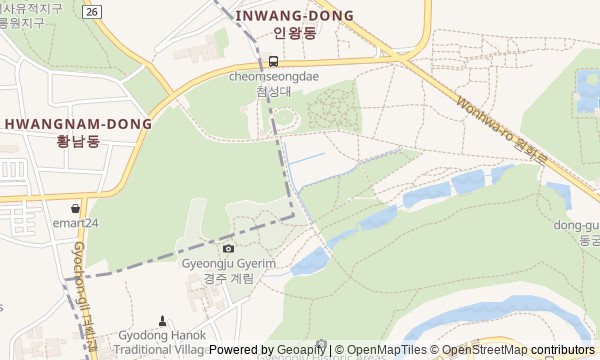
Route map
About the walk
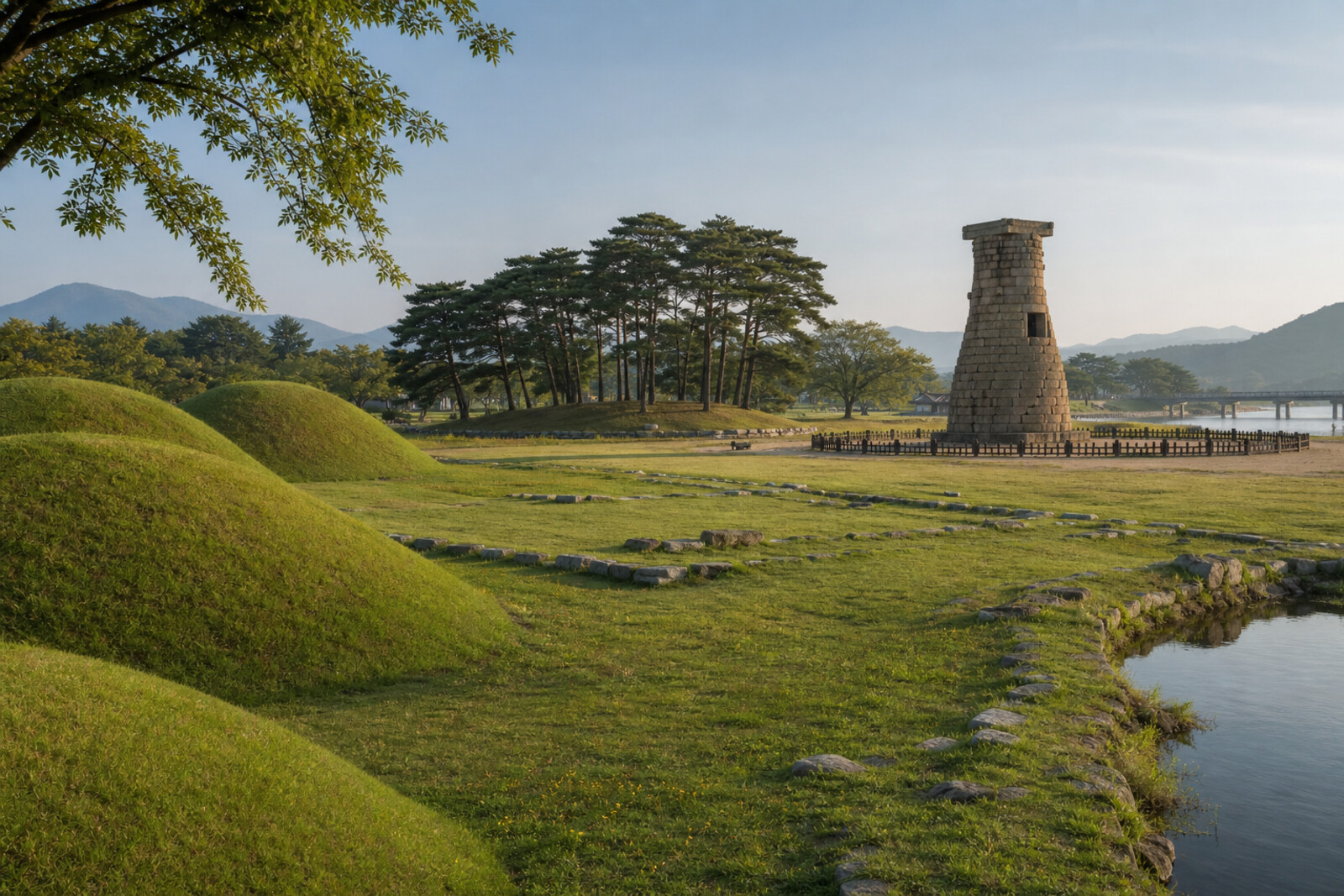
You will begin among the grassy tumuli of Daereungwon Tomb Complex and finish on a covered bridge above Muncheon Stream. Between them, the route crosses the royal center of Silla: past the stone tower of Cheomseongdae, Gyerim Forest, the earthen rampart of Wolseong, a palace pond, and the hanok houses of Gyochon Traditional Village.
What lies ahead are not surviving palaces, but their traces: joined mounds, the curve of a fortification, water, trees, and restored galleries. Within these outlines, you will hear stories of decisions that shaped a throne, a kingdom, or one human life. You will learn why an archaeologist would tremble over birch bark, why engineers left an ancient tower leaning, and how familiar handwriting led a person home.
The story will calmly distinguish among an archaeological find, a chronicle entry, and a later legend. By the end, you will be able to trace Silla's path from its royal cemetery to its southern crossing—and you will not mistake modern pavilions and a bridge for surviving buildings.
Why this order
Daereungwon Tomb Complex and Cheonmachong Tomb go together: first, a double mound establishes the scale of the royal cemetery, then an accessible tomb within the same complex reveals what lay beneath such hills. After the burial ground, the route reaches Cheomseongdae, a structure of the royal court where power turned not to the dead, but to the sky. Nearby Gyerim Forest introduces the legend of the Kim clan's origin, followed by Wolseong, the palace fortress where that clan held the throne. From its rampart, the route continues to Donggung and Wolji Pond: from the main palace to the heir's residence and a place for state receptions. Returning along the palace grounds leads to Gyochon Traditional Village, where the history of dynasties gives way to the fate of one later family. Woljeonggyo Bridge completes this line at Muncheon Stream: here the palace city ended at the road south, and surviving terrain meets a modern reconstruction.
Those encountering the history of Silla for the first time People who enjoy archaeology and human decisions with major consequences Those more interested in a coherent city route than a set of separate monuments
Those looking for a walk among Buddhist temples and mountains Those mainly seeking preserved palace interiors Those who prefer short, unconnected stops
Before you go
Much of the route is outdoors, so prepare for sun, rain, and a long walk. Check access to Cheonmachong Tomb and the Donggung and Wolji Pond grounds in advance: these sites may require separate admission, and the route does not assume you will automatically be able to enter. Open sections and barriers at Wolseong change as work progresses, so do not count on seeing one particular excavation and do not go beyond the barriers. In daylight, it is easier to read the shapes of the tumuli, the tower, the forest, and the palace traces; lighting by the water and bridge is a lovely addition, not the foundation of the whole walk.
When to go
Start early enough to see Daereungwon Tomb Complex, Gyerim Forest, and Wolseong in natural light and without rushing. If you would like to catch reflections at Wolji Pond or the evening appearance of Woljeonggyo Bridge, save twilight for the final stops, but do not leave everything that needs to be examined on the ground until dark.
Backup plan
If Cheonmachong Tomb is closed, spend more time around its exterior and turn your attention to the neighboring mounds: the explanation of the burial's layout will still deepen what you have already seen in the necropolis. If access at Wolseong is restricted, look at the available ground sections, the line of the fortification, and the marked outlines without trying to approach the work area. If you cannot enter Donggung and Wolji Pond, take in the pond and complex from accessible viewpoints, then continue to Gyochon Traditional Village and the bridge. These final 2 stops preserve the route's main transition—from ancient power to the modern treatment of its heritage.
Route conditions
Surface. Paved — 1.5 km; unpaved — 459 m (data covers 49% of the route)
Stairs. Flights: 2, 31 m in total
Access. Wheelchair — no; stroller — limited (stairs)
Facilities. Toilets — 8; drinking water — 4
Elevation. Ascent — 22 m; descent — 24 m
OpenStreetMap extract of July 3, 2026: database data, not a check on the ground. Data © OpenStreetMap contributors, ODbL licence
Walk plan
Open in maps ↗- 1
Daereungwon Tomb Complex
Two joined hills show how the sequence of royal ceremonies has been preserved in the shape of the mound. - 2
Cheonmachong Tomb
A fragile find will turn a training excavation into a test for Korean conservators. - 3
Cheomseongdae
The cautious decision made after the earthquake shows how ancient masonry can be preserved without straightening it. - 4
Gyerim Forest
The legend of a found child explains why the forest became associated with the future royal clan. - 5
Wolseong
The curved embankment connects the palace landscape with the struggle over a woman's right to occupy the throne. - 6
Donggung and Wolji Pond
A feast by the pond begins the story of the last Silla king’s final decision. - 7
Gyochon Traditional Village
Two neighboring family homes preserve the trail of a handwriting turned into a trap. - 8
Woljeonggyo Bridge
The finale by the river will distinguish the old crossing and the later legend from the modern reconstruction.
Route features
Everything you need stays in the browser
Progress, saves and your trip plan are stored on this device.
Add Guide On Map to your home screen so the walk opens outside the browser.
How we handle sources, maps and corrections: our editorial standards