 Guide On Map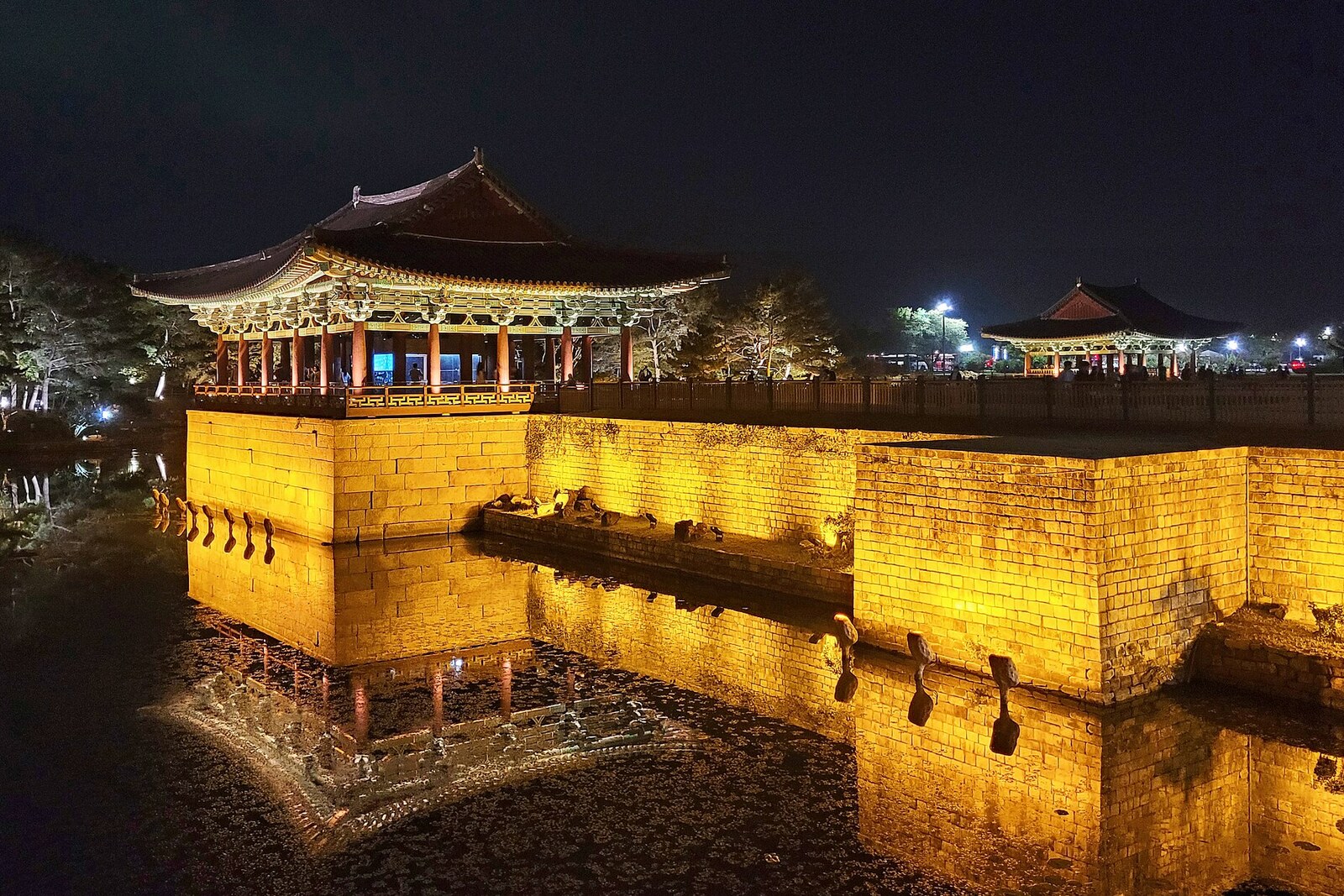
Look around first
What to notice
- The pond’s curved shores
- Reconstructed wooden pavilions
- The still surface of Wolji Pond
The story of the place
Donggung appeared on the shore of Wolji Pond as the palace of the heir: future rulers were raised here, but people on whom the dynasty depended were also received here. King Munmu himself ordered the pond dug; its curved shores hid the far edge of the water, making the palace reservoir seem much more extensive. The wooden buildings have not survived to the present day; the current pavilions by the water were reconstructed after excavations of the palace foundations. The finds helped restore the pond’s old name.
In nine thirty-one, King Gyeongsun held a reception here for Wang Geon, a military commander who founded the kingdom of Goryeo and was gathering the peninsula’s fragmented lands under his rule. Gyeongsun needed an ally: of the former Silla, all he had left was the capital and a small surrounding district.
Four years before this meeting, Gyeon Hwon, the ruler of Later Baekje, captured Gyeongju, killed Gyeongsun’s predecessor, and personally appointed a new king. Gyeongsun received the throne from the man whose troops had just ravaged his city. He could not openly challenge Gyeon Hwon, and he no longer hoped to preserve Silla without outside military support.
Wang Geon was received in Imhaejeon, a pavilion for state banquets and distinguished guests. Its name means “hall facing the sea”: the curved shores of Wolji Pond hid the pond’s far end, making the water seem far more extensive. King Munmu himself ordered the pond dug in six seventy-four. Five years later, Donggung—the Eastern Palace, intended for the heir—appeared beside it. Future rulers were raised here, and people on whom the dynasty’s fate depended were received here as well.
Wang Geon spent several dozen days in the Silla capital and forbade his warriors from mistreating its inhabitants. A chronicle written under Goryeo places particular emphasis on their discipline and claims that the townspeople welcomed Wang Geon almost as a beloved father. The victorious side was clearly trying to present its founder as a welcome guest. Yet the order not to plunder was a very concrete promise to Gyeongsun: this was a commander one could negotiate with and remain alive.
The feast in Imhaejeon did not yet mean capitulation. The resolution came four years later. Gyeon Hwon’s sons overthrew their father, and Silla’s former patron fled to Wang Geon. Gyeongsun convened a council and proposed handing the kingdom over to Goryeo. The heir objected: for him, it meant losing his future throne, and, he said, a thousand-year dynasty could not be surrendered while strength remained. Gyeongsun replied that no strength remained and that continuing the struggle would destroy the innocent. He sent Wang Geon a letter of surrender.
Silla ceased to exist in nine thirty-five. Wang Geon spared King Gyeongsun’s life, gave him high rank, income from Gyeongju, and married him to Wang Geon’s eldest daughter. The heir left his father; according to tradition, he spent the rest of his life as a hermit in Mount Kumgang, wearing rough hemp clothing and eating plants. The following year, Wang Geon defeated Later Baekje and completed the unification of the Three Kingdoms under Goryeo.
The wooden Imhaejeon has not survived to the present day. The pavilions by the water were reconstructed in nineteen eighty after excavations of the palace foundations. Archaeologists found a lock with an inscription linking it to the administration of the Eastern Palace, as well as pottery fragments bearing the pond’s old name. Thanks to these finds, in two thousand eleven the former name Anapji—“Pond of Geese and Ducks”—was removed from official signs. Donggung, the palace of the heir, and Wolji Pond, the Moon Pond where the last king of Silla once entertained the man to whom he later gave his kingdom, returned.
Useful on site
Usually daily 09:00–22:00; last entry and ticket sales until 21:30. Ticket: adults 3 000 won, teenagers 2 000 won, children 1 000 won.
Checked: date not specified. Check the official source before visiting.Check the conditions for separate admission. Remember that the pavilions have been reconstructed in modern times, while the shape of the site and the archaeological evidence are older.