 Guide On Map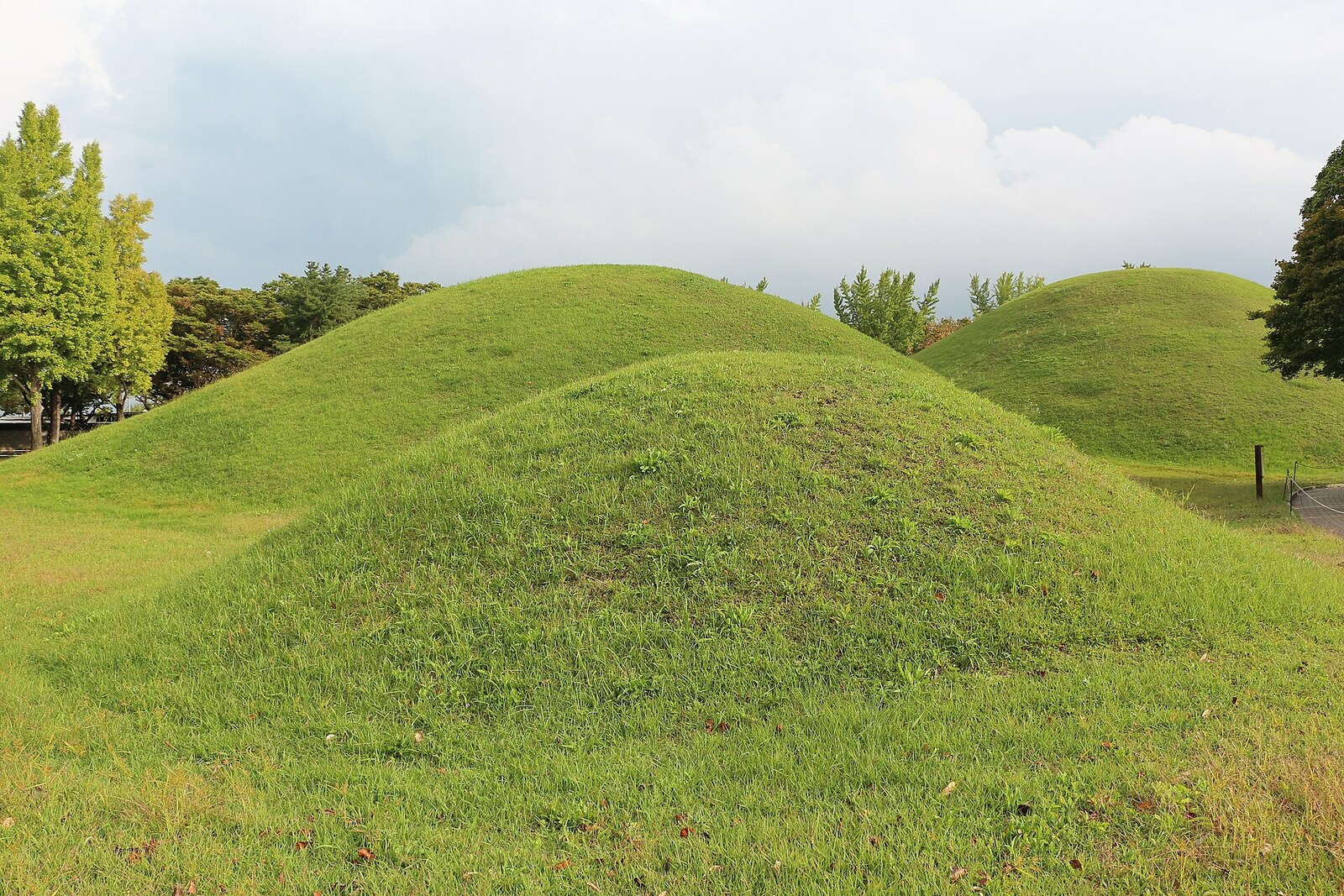
Look around first
What to notice
- Two joined grassy hills
- The connecting ridge between the mounds
The story of the place
The largest tumulus in Daereungwon Tomb Complex consists of two joined hills. It is Hwangnamdaechong—the Great Tomb of Hwangnam-dong. Its construction preserved the sequence of two deaths, but the names of those buried there have disappeared.
In the fifth century, a maripkan died here—the term Silla used for its supreme ruler. His successors were to take his place. According to the ideas of the time, the deceased ruler's status continued after death, and a successor received it only after a fitting funeral. The family therefore committed immense wealth to the grave and showed the assembled nobility who was now entitled to dispose of what remained.
The site was chosen on the plain north of Wolseong Palace, within the capital. The royal cemetery remained near the court: the funeral procession did not go into the mountains, but moved through the city, where everyone could see how many people and how much property the new ruler was able to gather.
Craftsmen built a wooden burial chamber on the ground. They carried into it a coffin, weapons, iron ingots, vessels, food, and glassware brought from far away. They piled stones above and around it, then covered everything with earth. They left no corridor for returning inside. The successors gave up gold and valuable goods, but completed the rite after which they could declare themselves the deceased ruler's successors.
The mass of stone had a consequence the builders could hardly have foreseen. When the wood rotted, the boulders settled and permanently blocked access to the chamber. Looters found it difficult to reach the objects, so archaeologists discovered them a thousand five hundred years later almost intact. But the people of Silla left no inscription bearing the king's name. The gold outlived its owner, but the owner's name did not.
Some time later, his wife died. For her, the court built a second chamber to the north and piled a new hill directly against the first. The woman was buried wearing a gold crown, with a gold belt, bracelets, rings, and necklaces. The man's crown in the southern section was bronze covered with gold. There is no explanation for this difference. But a small silver piece from the northern chamber bore two words: “the wife's belt.” From it and from the jewelry, archaeologists understood to whom the second half of the tomb belonged.
Scholars dispute exactly who lies here: several fifth-century maripkans are named among the possible owners. The tumulus was therefore named not after a king, but after the Hwangnam-dong district where it was excavated.
The name Daereungwon Tomb Complex itself means “Garden of the Great Tomb.” It derives from an old chronicle line about King Michu, the thirteenth king of Silla and the first ruler of the Kim lineage: he was buried in Daereung—the Great Tomb. It has not been reliably established which hill belonged to King Michu.
At Hwangnamdaechong, the southern half marks the king's death, and the northern half marks the death of his wife, who outlived him. There is no passage or shared chamber between them. The two burials are connected only by the mound, which people of the royal court built up after the second death.
Useful on site
Daereungwon Tomb Complex is usually open daily 09:00–22:00; the grounds themselves are free, and a separate ticket office is for Cheonmachong Tomb.
Checked: date not specified. Check the official source before visiting.Stay only on the paths and do not climb the mounds: their form is best understood from a distance.