 Guide On Map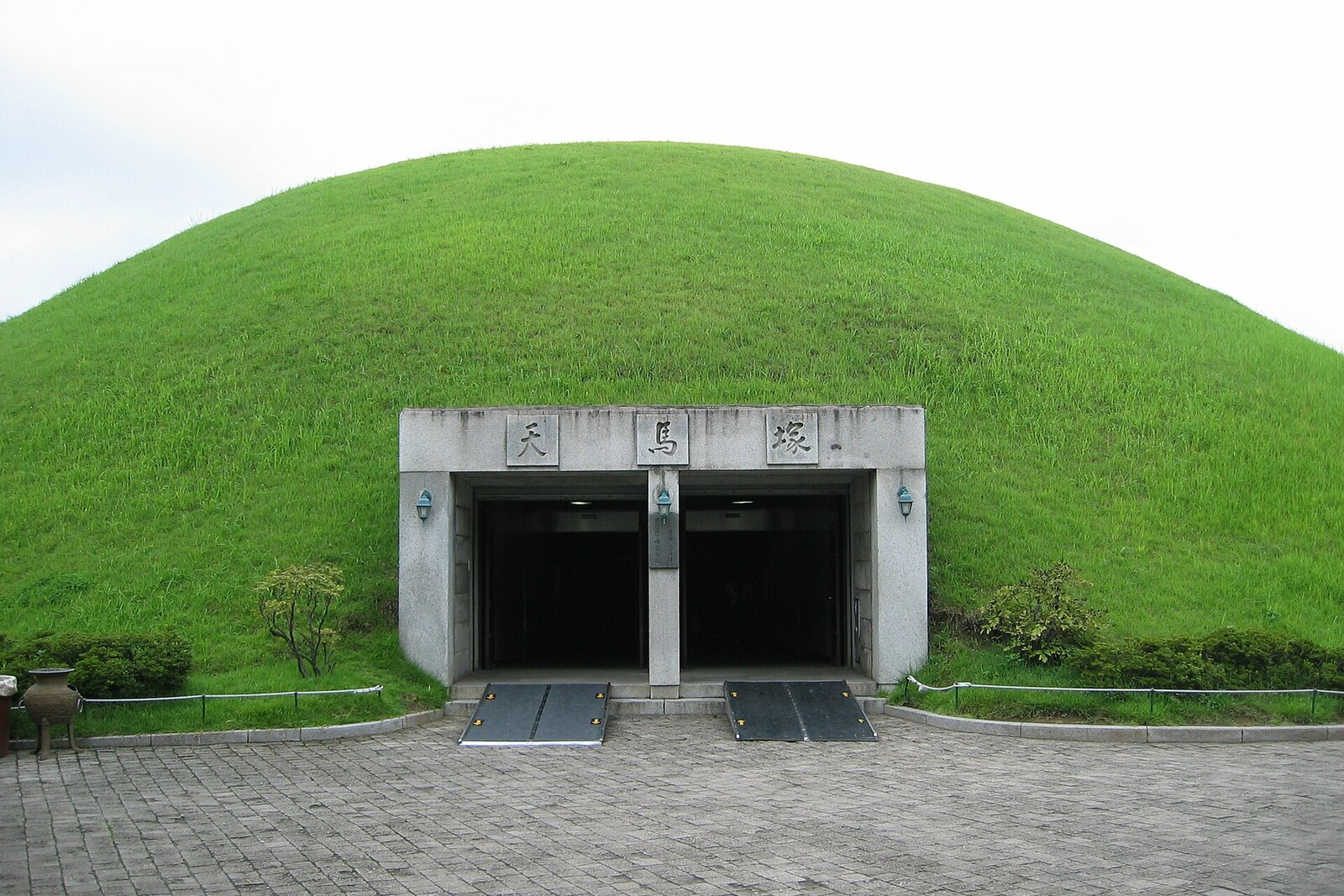
Look around first
What to notice
- Entrance into the grassy mound
- Reconstructed wooden chamber
- Layers of stones above the chamber
The story of the place
The grassy mound of Cheonmachong Tomb conceals a wooden burial chamber reconstructed inside the tumulus. Above the chamber lie the layers of stone that once covered and protected it. A person was buried here together with objects intended to accompany them after death.
Until nineteen seventy-three, this mound had a dry name: Tomb Number One Hundred Fifty-Five. Archaeologist Kim Jeong-gi, the excavation director and the group's most experienced field specialist, pushed to have it opened first. Nearby stood the much larger twin mound of Hwangnamdaechong. Kim did not want to begin with it until the researchers had learned to dismantle a Silla stone-and-wood tomb without damaging its structure or contents. The smaller mound was meant to be a training ground.
They trained in the literal sense. The field team had seven researchers. One of them, recent graduate Choe Byeong-hyeon, had previously taken part in only two student excavations. He accepted the job for the pay: one thousand two hundred twenty won a day was considered good money for a young specialist, and permanent positions were hard to find.
Beneath the stones, the researchers found a decayed wooden chamber where the deceased and burial offerings had once lain. There were a gold crown, a belt, weapons, vessels—more than ten thousand objects in all. When the crown was lifted, Kim Jeong-gi remained calm. In August, among the horse harness, two rectangular plates were uncovered, laid one on top of the other. They were made of several layers of birch bark and hung on either side of a saddle to keep mud flung up by hooves from striking the rider.
Each plate showed a white horse with its tail raised. Its mane streamed backward, its legs stretched out in a run, and tongues of sacred flame fanned out around its muzzle and hooves. Over fifteen hundred years, the birch bark had become so brittle that it could crumble at a touch.
Choe recalled that this was when Kim first began to tremble. He kept saying, “This should not have appeared now.” Korean conservators already knew how to handle metal and ceramics, but had almost no experience preserving ancient wood and bark. Kim was preparing the group for the large mound, but instead got an object they risked destroying simply by extracting it.
The plates were nevertheless lifted intact. After this discovery, museum directors sent Korean specialists to study conservation in Japan and Italy, and three years later a separate department of conservation science appeared at the National Museum of Korea. Specialists stopped calling the tomb Number One Hundred Fifty-Five and named it after the painting: Cheonmachong Tomb, the tomb of the Heavenly Horse.
Inside the mound, the wooden burial chamber that Kim Jeong-gi wanted to understand before excavating the neighboring giant has now been reconstructed. The original plates are not displayed here: Gyeongju National Museum keeps them and shows them only rarely, because the birch bark and pigments are sensitive to light. The tomb retains the horse's name; the horse itself once again spends almost all its time in darkness.
Useful on site
Usually daily 09:00–22:00; tickets: adults 3 000 won, teenagers 2 000 won, children 1 000 won.
Checked: date not specified. Check the official source before visiting.Check access inside in advance; if the entrance is closed, the mound's exterior volume still helps convey the scale of the structure.