 Guide On Map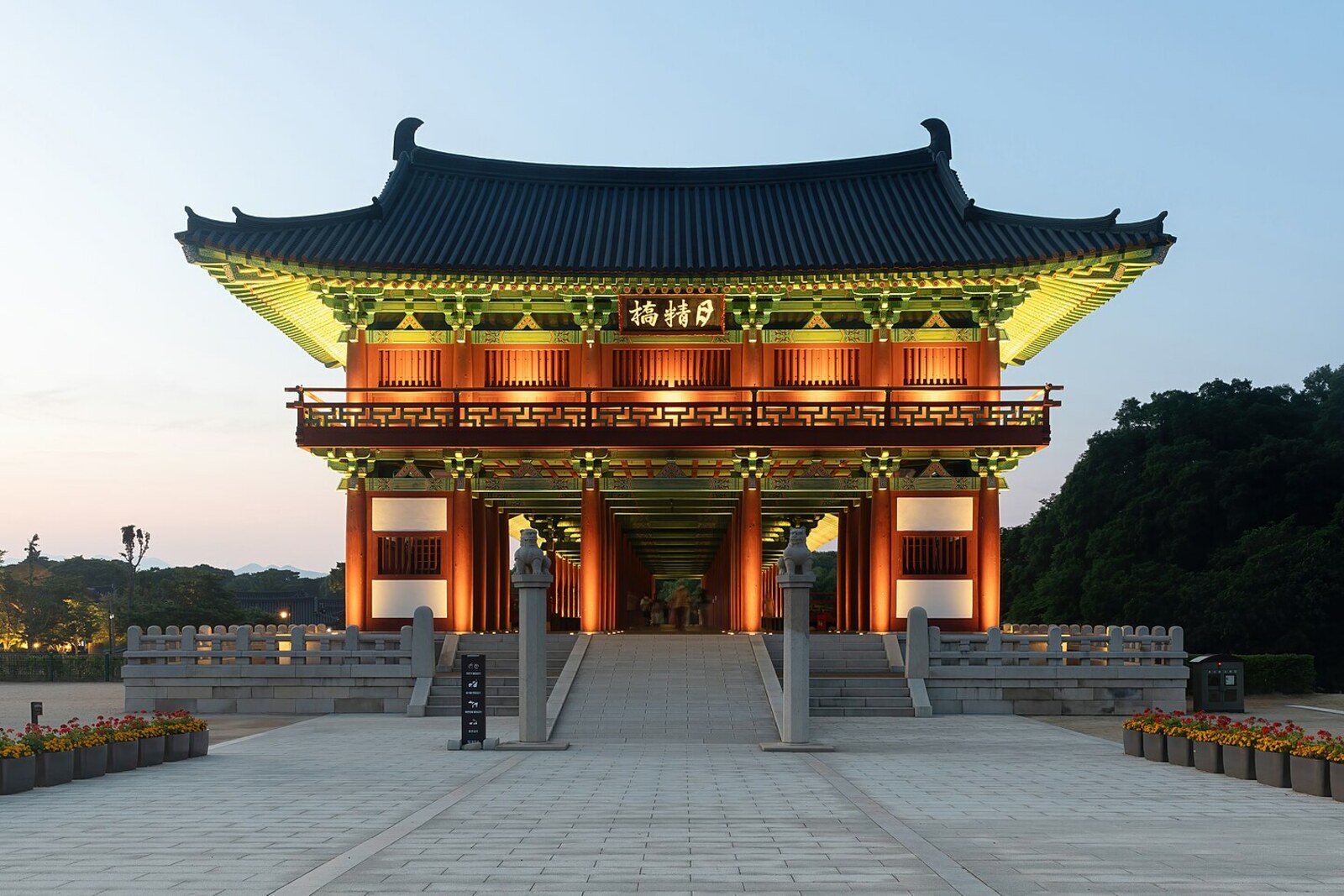
Look around first
What to notice
- Covered wooden galleries
- Towers at both ends of the bridge
- Muncheon Stream
- Stone piers
The story of the place
Stone piers in the bed of Muncheon Stream support covered wooden galleries, while towers rise at both ends of the bridge. This crossing continues the road between palace Wolseong and the southern part of the capital, from where the ascent to Namsan Mountain began. By order of King Gyeongdeok, a crossing was built here to connect the two banks along this route. Traces of wood and tiled roofing from earlier structures were found at the site; they explain why the bridge looks like a long covered passage rather than an open stone crossing.
According to legend, the monk Wonhyo leapt from a bridge into the water himself. It looked like an accident only to those who had not heard his recent song.
Wonhyo was a celebrated Buddhist scholar, but he was now seeking a meeting with a noblewoman who could bear a gifted son. He walked through the capital of Silla, singing a riddle: who would give him an axe without a handle so that he could carve a pillar capable of propping up the heavens? King Taejong Muyeol understood the hint in his own way: the monk wanted to leave behind a great person, and such a person would be useful to the state.
The king had a widowed daughter, Princess Yoseok. She lived alone at Yoseokgung. The later account says nothing about her own wishes. The king sent a palace official to find Wonhyo and bring him to her.
The official met the monk here, by Muncheon Stream, as Wonhyo was coming down from Namsan Mountain to the city. The text names Muncheon Bridge, also known as Yugyo Bridge—the Elm Bridge. Wonhyo deliberately fell into the water and soaked his clothes. The official took him to the palace, where the monk was given a change of clothes and allowed to stay the night. The princess became pregnant and gave birth to a son, Seol Chong.
The monk Iryeon recorded this story in Samguk Yusa almost six centuries after the events. Its ambiguous song, the king's instant insight, and the convenient fall into the water fit together too neatly, so this is a legend, not a court report. But it states the consequences quite clearly. Wonhyo broke his monastic vow of celibacy, took off his monastic robes, and began calling himself a layman. After that, he preached not only to learned monks: he went from village to village, singing and dancing with a gourd rattle, explaining Buddhism to people who could not read the sacred books.
The son for whom it had all been arranged became one of Silla's leading scholars. Seol Chong explained the meaning of Chinese classical texts in language Koreans could understand and taught others to do the same. He rose to a court post and advised the next king. The legend carries King Taejong Muyeol's calculation through to its result: the person the king intended to obtain for the country did indeed grow up.
But Wonhyo did not leap from the bridge standing here now. The first Woljeonggyo Bridge was built by order of King Gyeongdeok in seven hundred sixty—seventy-four years after Wonhyo's death. It carried a road across Muncheon Stream between Wolseong and the southern part of the capital, from where the ascent to Namsan Mountain began. The old Yugyo Bridge mentioned in the legend was located near this crossing, but its exact site has not been established.
Woljeonggyo Bridge disappeared during the Joseon dynasty. In the twentieth century, archaeologists found four stone piers, charred wooden parts, and roof tiles in the riverbed: a covered wooden bridge had once stood over the water. Using these remains, builders reconstructed the crossing from two thousand eight to two thousand eighteen. The wooden galleries and towers before us are modern. Of Wonhyo's crossing, only the river and the direction of the route remain: Namsan Mountain on one bank, palace Wolseong on the other. Yugyo Bridge and Yoseokgung no longer exist.
Useful on site
Usually daily 09:00–22:00; free admission.
Checked: date not specified. Check the official source before visiting.Do not mistake the fresh wood for a surviving bridge from the VIII century. If the interior is accessible, look for materials about the excavations and reconstruction.