 Guide On Map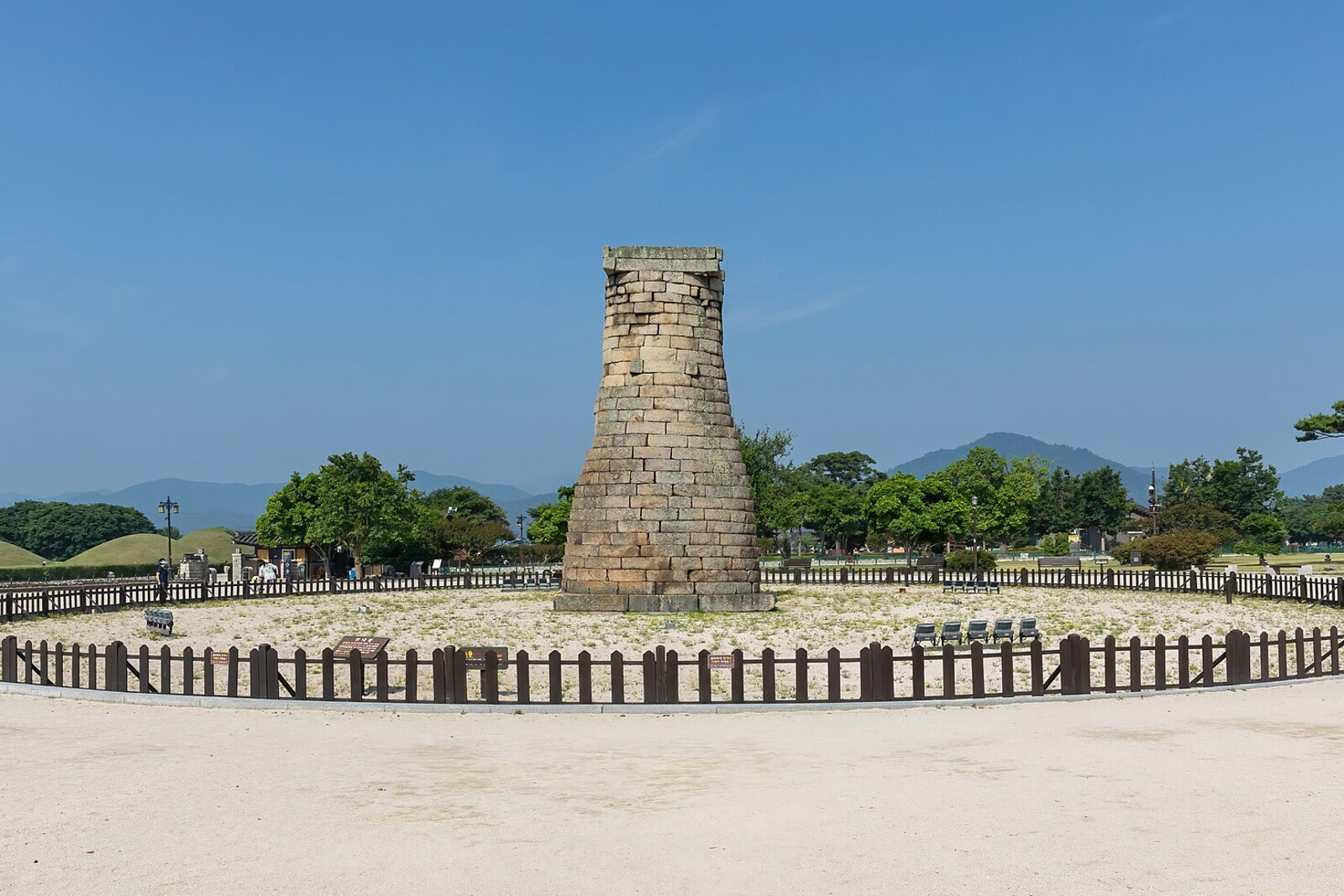
Look around first
What to notice
- The square opening
- The leaning stone body
- Eight long stones of the upper crown
The story of the place
On September twelfth, two thousand sixteen, an earthquake of magnitude five point eight shifted the stones of Cheomseongdae. The tower acquired an additional northward lean of about two centimeters, and the blocks of the square crown at the top came apart. Repeated tremors followed.
The next morning, specialists from the Cultural Heritage Administration arrived. They had to decide whether the masonry could withstand new tremors and whether it could be left without dismantling. An error in one direction threatened collapse; in the other, the loss of the ancient arrangement of the stones through unnecessary repairs. On September twentieth and twenty-first, engineers examined the tower, and on September twenty-second the commission concluded that there was no immediate threat of collapse. They did not dismantle or straighten Cheomseongdae. Specialists were assigned to monitor its movement, investigate the ground, and secure the upper blocks in case of new tremors. This monitoring continues: sensors record movements in the masonry.
They were preserving a structure whose origins are known only in broad outline. In the seventh century, it was built by the court of Queen Seondeok—the first woman to rule Silla in her own right. Cheomseongdae means “a platform for observing the stars.” The earliest surviving record appeared about six centuries after its construction: it says only that, under Queen Seondeok, a tower of dressed stone was built. Its author did not report the names of the builders or observers, or the names of their instruments.
For the royal court, the movement of celestial bodies was the basis of the calendar and a way to interpret the fate of the state. The timing of agricultural work and rituals depended on the calendar, and decisions at court depended on heavenly omens. That is why the tower was built on the plain beside Wolseong Palace, rather than on a distant summit.
The accepted reconstruction of how Cheomseongdae functioned is as follows: a court observer climbed an external staircase to the square opening between the thirteenth and fifteenth rows of stones, then took an internal staircase to the upper platform. The lower part of the tower is filled with earth and rubble; above, it is hollow. Long transverse stones may have supported a platform. However, no staircases, instruments, or records of observations were found here. Researchers therefore debate whether Cheomseongdae was an observatory, an altar, or a commemorative structure connected with the queen.
Eight long blocks still lie in the upper square crown, and the tower itself retains a slight lean to the north. Sensors measure its shifts; there are no old staircases or instruments at the top.
Useful on site
Usually open year-round; in summer 09:00–22:00, in winter 09:00–21:00; viewing is free.
Checked: date not specified. Check the official source before visiting.View the tower from several sides while staying behind the barriers; treat calendar interpretations of its numbers as theories, not as an exact decoding.