 Guide On Map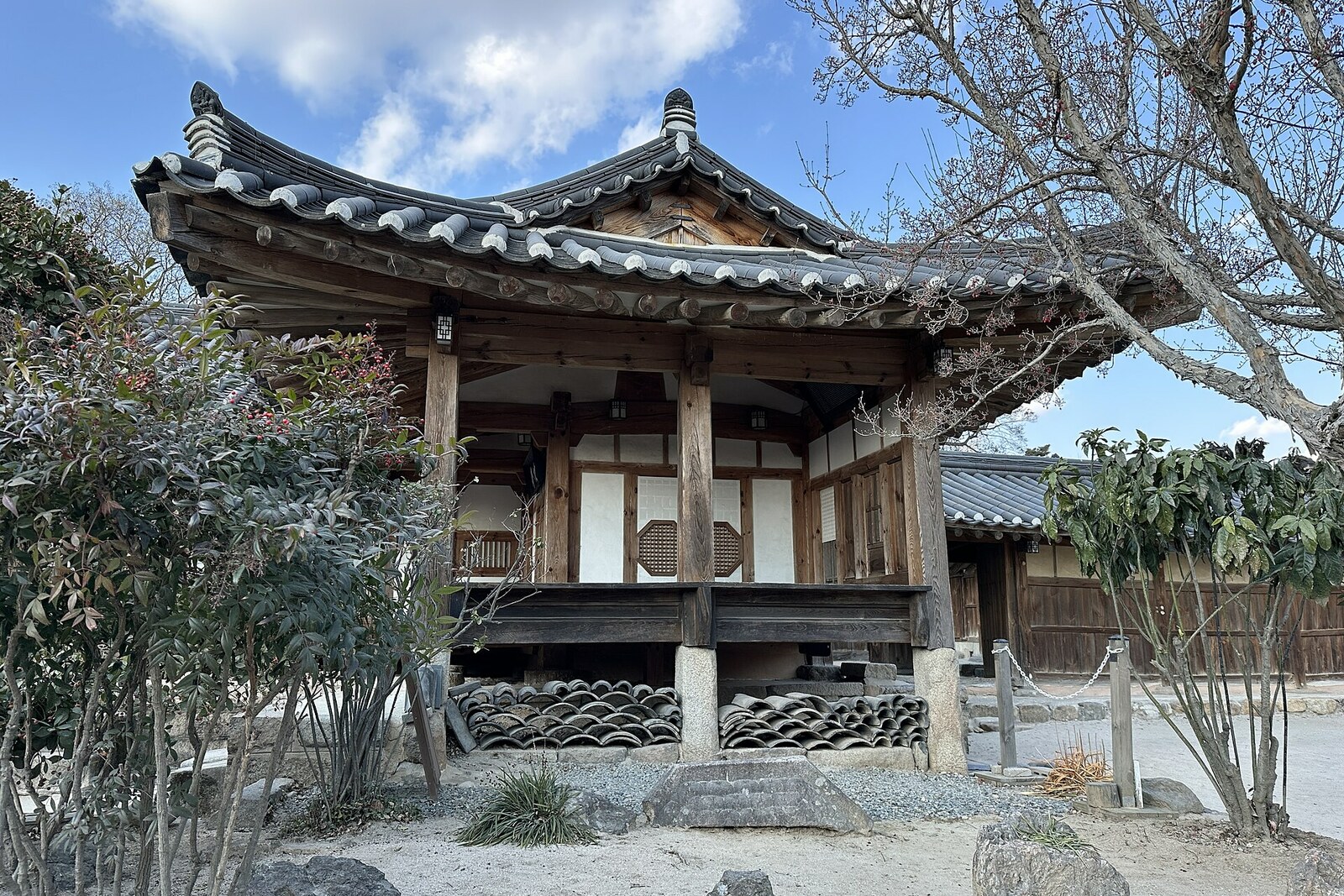
Look around first
What to notice
- The roof of Gyeongju Hyanggyo
- The main estate of the Choe family
- Choe Wan’s separate house
- Rows of hanok houses
The story of the place
Gyochon means “village by the school.” It refers to Gyeongju Hyanggyo, a county Confucian school of the Joseon dynasty, near which teachers and students settled. In spring and autumn, a rite in honor of Confucian sages is still performed here. At the end of the eighteenth century, the Choe family dismantled its country estate, moved it here, and set it up west of the school. Later, while building the main house, the owners ordered about a meter of earth to be removed so that its roof would remain lower than the roof of Gyeongju Hyanggyo.
Houses of the younger branches of the clan appeared after the main estate. On this family foundation, the city later restored Gyochon Traditional Village as a district of traditional culture: some hanok houses were adapted for craft activities, performances, lodging, and restaurants. Old and reconstructed buildings stand mixed together here, but the Choe homes retain their former family relationship: the main house, followed by the dwellings of the younger brothers and their families.
At the beginning of the twentieth century, the main estate was managed by Choe Jun, heir to a large holding that lived on a share of the harvest from land leased to peasants. His younger brother, Choe Wan, worked for the independence of Korea, which at that time had been annexed by Japan. He left for China and joined the Provisional Government of the Republic of Korea in Shanghai. A Japanese report from nineteen nineteen noted that Choe Wan arrived there with twenty thousand won in cash. The government’s annual budget at that time only slightly exceeded sixty thousand. Choe Wan became a member of its finance commission: the police were looking for a man who carried not proclamations but money across the border.
In Gyochon Traditional Village, the story is told this way. The head of the Gyeongju colonial police decided to lure Choe Wan home and, for three years, visited Choe Jun on the pretext of calligraphy lessons. He learned to reproduce the elder brother’s handwriting. When the resemblance became convincing, a forged letter was sent to Shanghai: their father was seriously ill, and Choe Wan had to return immediately.
Choe Wan recognized his brother’s hand and believed the letter. In nineteen twenty-six, he came to Korea, where he was arrested at once. He was tortured in Daegu prison; illnesses acquired during his years in exile worsened. Soon after his release, in nineteen twenty-seven, he died.
The men’s quarters of the main estate, where the supposed calligraphy student could come, burned down in nineteen seventy and were rebuilt thirty-six years later, so the exact room of this story no longer exists. A separate house of Choe Wan survives behind the main estate. In the present layout of Gyochon Traditional Village, the two houses still stand one behind the other: the home of the man whose handwriting was forged, and the home of the man brought back from Shanghai by that handwriting.
Useful on site
The village is accessible 24 hours and free of charge; workshops, shops, and individual houses keep their own schedules.
Checked: date not specified. Check the official source before visiting.This is not merely historical scenery: do not enter closed courtyards, and respect the boundaries of residential and service spaces.