 Guide On Map
Realejo: the Jewish quarter, squares, and gardens
From Plaza Isabel la Católica through Realejo to Carmen de los Mártires
Guide On Map on your phone
Open the walk like a regular app
It takes about 10 seconds to install. No app store needed.
The whole path
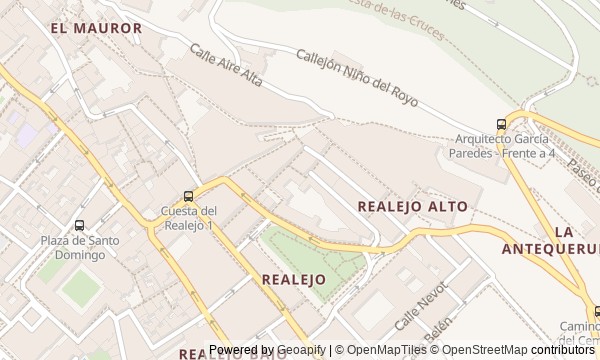
Route map
About the walk
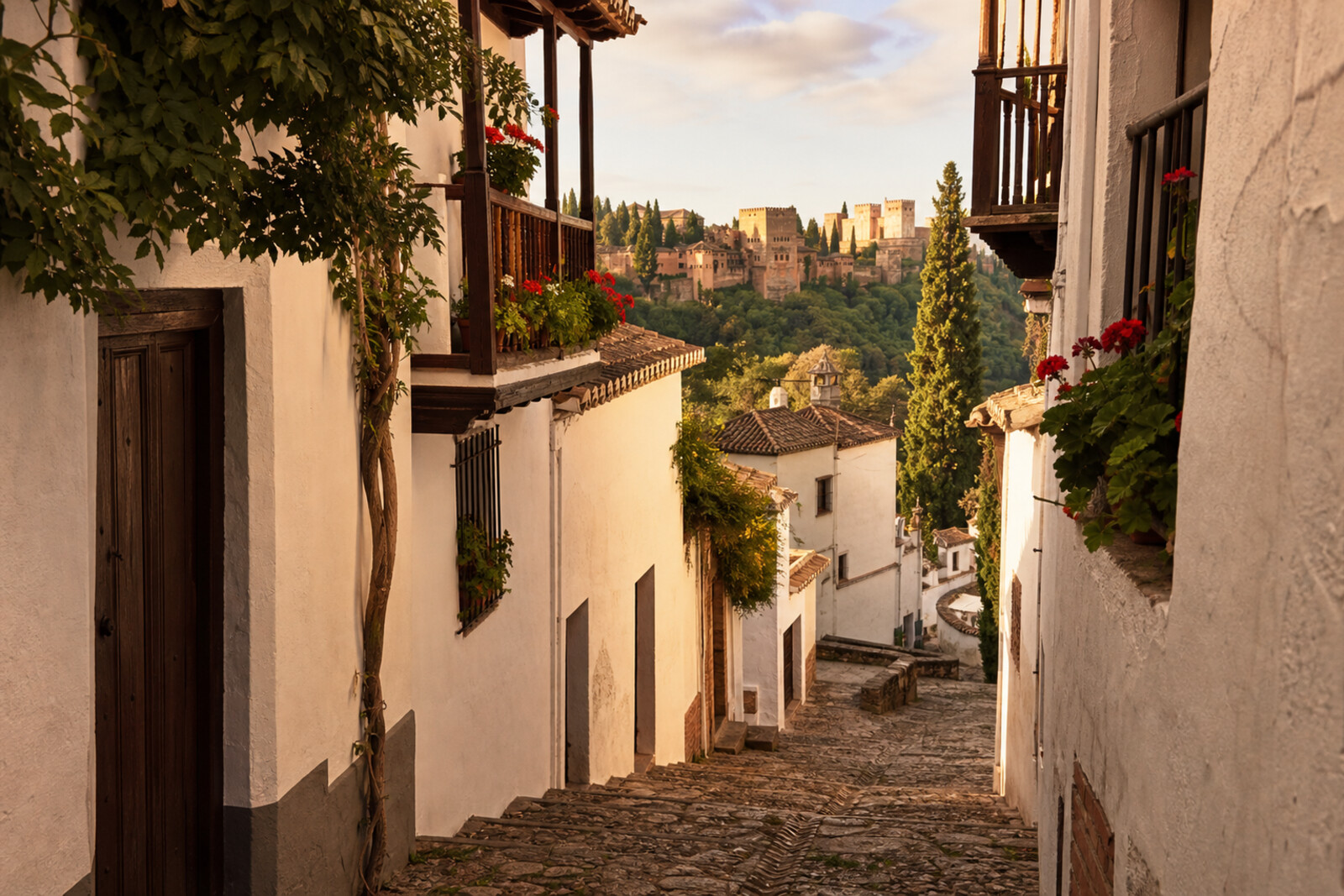
From the Monument to Isabella the Catholic and Christopher Columbus, you will enter Realejo and climb toward the gardens above the neighborhood. First come the city streets: a bronze exile at a fork in the road, a palace with muskets above its battlements, a washhouse beneath a tiled roof. Then the route leads through a shared courtyard, a monastery square, and the broad Campo del Príncipe. It ends at Carmen de los Mártires beside the Alhambra: a white palace, a lake, and a garden that had to be pieced back together.
There will be no grand official version of Granada here. You will hear how a state celebration unraveled, why washerwomen had to argue over a flow of water, and what happened to a woman resettled from a home built around a shared patch of sky. The answers appear only on site. Facts will be separated from city legend, and dramatic events brought back to human choices and their cost.
After this walk, Realejo will stay with you not as “the former Jewish quarter,” but as a precise map of losses, resettlements, and the things its residents still managed to hold on to.
Why this order
At the Monument to Isabella the Catholic and Christopher Columbus, you begin with the official image of a year that changed Granada. A few steps later, a bronze exile marks the entrance to the vanished Jewish quarter and shows who was absent from the city’s celebratory version of itself. Along Calle Pavaneras, you enter Realejo and reach the palace of a family that secured its position after the conquest. From Casa de los Tiros, you climb to a washhouse supplied with water from a pipe belonging to that same palace: family power turns into an everyday dispute over the city’s flow. The descent to Corrala de Santiago continues the story of shared life, shifting it from a working basin to the courtyard of a residential building. Nearby, Santo Domingo Church (Santa Escolástica Parish) shows how the rebuilding reached an entire monastery. From the surviving church, you emerge onto Campo del Príncipe, where city residents once won change for themselves. The final climb leads to Carmen de los Mártires: after a square that witnessed a brief victory for the residents, you see a garden the city recovered after part of it had already disappeared.
Those who want to see Granada beyond the Alhambra Those interested in the human consequences of major historical decisions Those who love courtyards, squares, and gardens with a documented history
Those looking for a route limited to Granada’s main monuments Those who dislike climbs and detailed historical storytelling Those wanting a walk without themes of expulsion, loss, and urban conflict
Before you go
Wear shoes suitable for cobblestones, slopes, and the final climb. You can complete the route using the exterior stops, so do not plan your whole day around access to Casa de los Tiros, Corrala de Santiago, the church, or the gardens. Before setting out, check the visiting rules for any interiors you want to enter. Corrala remains a residential university space, and Santo Domingo Church (Santa Escolástica Parish) is an active church: do not go beyond closed passageways or disturb residents and services. At the old washhouse, use the accessible part of the square and take note of the structure’s current condition; the stop’s story does not require going inside.
When to go
The route is about 2.5 km and usually takes 2–3 hours without extended interior visits. Allow extra time for the climb, pauses in courtyards and squares, and separate visits to the museum, church, or gardens if they are open.
Backup plan
If an interior is closed, stay by the facade and use the specific details in the lookFor field: every stop works from the outside, too. If the washhouse is inaccessible, read the square as former water infrastructure and a workplace, without trying to get closer through barriers. Do not replace Corrala with an intrusion into its courtyard: its layout can only be understood with permitted access. If you do not have the energy for the final climb or the gardens are closed, end the walk at Campo del Príncipe; Carmen de los Mártires is better saved for a separate visit than rushed through.
Route conditions
Surface. Paved — 2.1 km; unpaved — 4 m (data covers 84% of the route)
Stairs. Flights: 5, 16 m in total
Access. Wheelchair — no; stroller — limited (stairs)
Facilities. Toilets — 4; drinking water — 10
Elevation. Ascent — 101 m; descent — 10 m
OpenStreetMap extract of June 18, 2026: database data, not a check on the ground. Data © OpenStreetMap contributors, ODbL licence
Walk plan
Open in maps ↗- 1
Isabella and Columbus: a monument to fourteen ninety-two
Here, the state's version of the past will collide with how Granada residents first saw the monument prepared for a celebration. - 2
Yehuda ibn Tibbon: an exile with a scroll
This stop will restore one of its residents to the vanished quarter and trace the fate of a craft begun after exile. - 3
Casa de los Tiros: fortress, salon, museum
The palace shows how one family turned service to the crown, marriage, and inheritance into a status visible right on its facade. - 4
Puerta del Sol: Water and Work
Here, the city water supply becomes a story of women’s earnings and the struggle for every share of water. - 5
Corrala de Santiago: a house around the sky
The shared courtyard will connect the layout of a tenement house with the price its last tenants paid to preserve the building. - 6
Santo Domingo: the church of a vanished monastery
The surviving church makes it possible to trace the fate of a vast monastery divided among new owners and institutions. - 7
Campo del Príncipe: a square of transformations
The square will show how the size of an urban space helped craftsmen turn a demand for cheap bread into a change of power. - 8
Carmen de los Mártires: A Garden after Its Losses
The finale will show what was restored after the failed hotel development, and what disappeared forever.
Route features
Everything you need stays in the browser
Progress, saves and your trip plan are stored on this device.
Add Guide On Map to your home screen so the walk opens outside the browser.
How we handle sources, maps and corrections: our editorial standards