 Guide On Map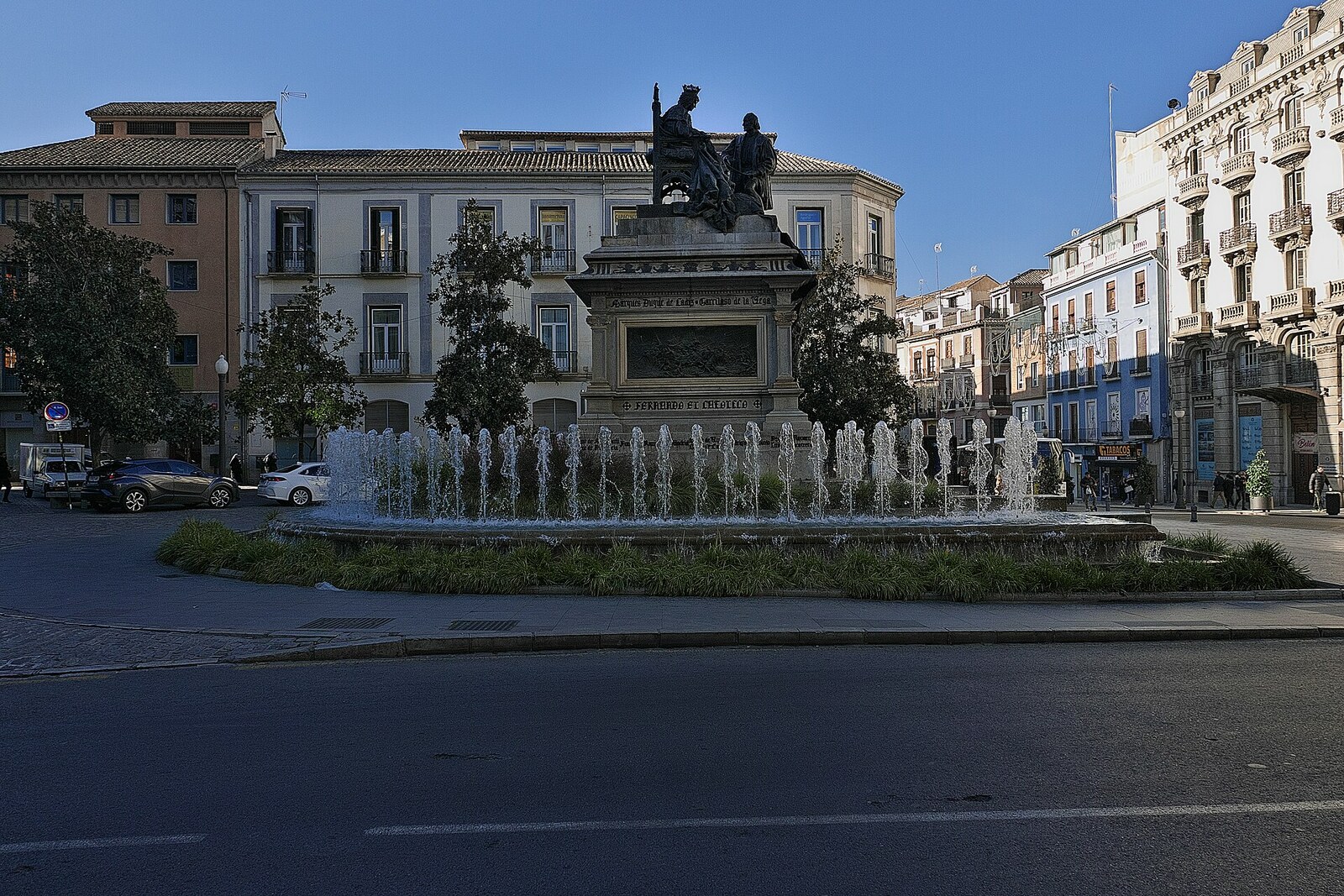
Look around first
What to notice
- Bronze figure of Isabella I of Castile on a throne
- Figure of Christopher Columbus with an unfolded sheet
- Inscription on the back of the pedestal
- Stairs and fountain around the monument
The story of the place
In September eighteen ninety-two, Queen Isabella I of Castile and the navigator Christopher Columbus arrived in Granada in huge wooden crates. The bronze figures had been cast in Rome, and their creator, the young sculptor Mariano Benlliure, came to assemble the monument on Paseo del Salón—a broad promenade where the monument would stand for the next seventy years.
The government conceived it for the four-hundredth anniversary of two events at once: the capture of Granada and Columbus's first expedition across the Atlantic Ocean. The first competition produced no winner, and not a single design was submitted for the second. Then the head of government, Antonio Cánovas del Castillo, who needed a completed monument by the anniversary, gave the commission directly to Benlliure. At the same time, the original two hundred fifty thousand pesetas were reduced to two hundred thousand, including casting, delivery, and installation.
The sculptor responded by reducing the monument itself. In the first version, Boabdil, Granada's last ruler, stood beside Isabella I of Castile and Christopher Columbus, while four more figures held a canopy above the queen. Benlliure removed them, abandoned the prescribed marble in favor of the bronze more familiar to him, and left two participants in one agreement at the top of the pedestal. This produced a queen on a Gothic throne and Columbus one step below, holding an unfolded sheet in his hands.
The completed group was kept under cloth for a long time. It was to be unveiled by Maria Christina of Austria, the queen regent for the underage Alfonso XIII. Residents decorated the balconies and built temporary arches along the planned route of the procession, but the exact date of the visit kept being postponed. On November first, Cánovas announced that the regent and the young king would not come to Granada; officially, rain and the child's illness were cited.
The next day, a local newspaper called for ministers who were planning to replace the royal family not to be received either. A crowd burned the arches prepared for the reception, threw stones at the governor's house, and set fire to the city toll-collection points. Mayor Manuel Tejeiro resigned. The cloth was removed from Isabella I of Castile and Christopher Columbus without the queen, a ceremonial procession, or the planned ceremony. Granada residents first saw the monument, intended for a state celebration, during the unrest.
The sheet in Christopher Columbus's hands explains what both figures are named for. The inscription on the back of the pedestal states: Isabella I of Castile receives Columbus's proposals in the royal camp of Santa Fe. This camp was about ten kilometers west of Granada; no such meeting took place on the site of the present-day square.
Columbus sought support for a westward voyage to Asian lands and for the spice trade. The negotiations dragged on for years. While he awaited a decision, the treasury gave him one-time “assistance with expenses,” and cities, by royal order, provided free lodging. In Santa Fe, he was deciding whether he would remain a petitioner at court or receive funds, offices, and a share of future revenues.
On April seventeenth, fourteen ninety-two, the terms were not approved by Isabella I of Castile alone. Both she and Ferdinand II of Aragon, the second monarch of the married couple, authorized the document with their signatures; the royal secretary Juan de Coloma recorded the agreement. Ferdinand II of Aragon is absent from the monument's upper group. Bronze turned negotiations with two rulers into a personal audience with a queen.
The terms were generous, but depended on the expedition's success. If Columbus found lands, he would become their hereditary admiral, viceroy, and governor, and receive one tenth of the gold, silver, pearls, and spices obtained there. That same year, his ships reached inhabited islands in the Caribbean Sea. The rights promised in Santa Fe proved so extensive that, after Columbus's death, his family spent almost three decades litigating over them with the Crown. The heirs retained the title of admiral, but were not left the offices of viceroy and governor.
The present-day square appeared only in the early nineteen sixties, when, by decision of the city council, an old post-office building occupying part of this site was demolished. In nineteen sixty-two, the monument was moved here from Paseo del Salón, its former fence was removed, and the pedestal was surrounded by stairs, flowerbeds, and a fountain. Isabella I of Castile and Christopher Columbus now stand at the intersection of Calle Reyes Católicos—the Catholic Monarchs Street—and Gran Vía de Colón, Columbus Avenue.
Useful on site
Open city square; to read the monument, it is best to stand on the side of the safe pedestrian crossing, not in the roadway.
Checked: June 28, 2026. Check the official source before visiting.View the monument from the square; walk around the pedestal without lingering in the roadway.