 Guide On Map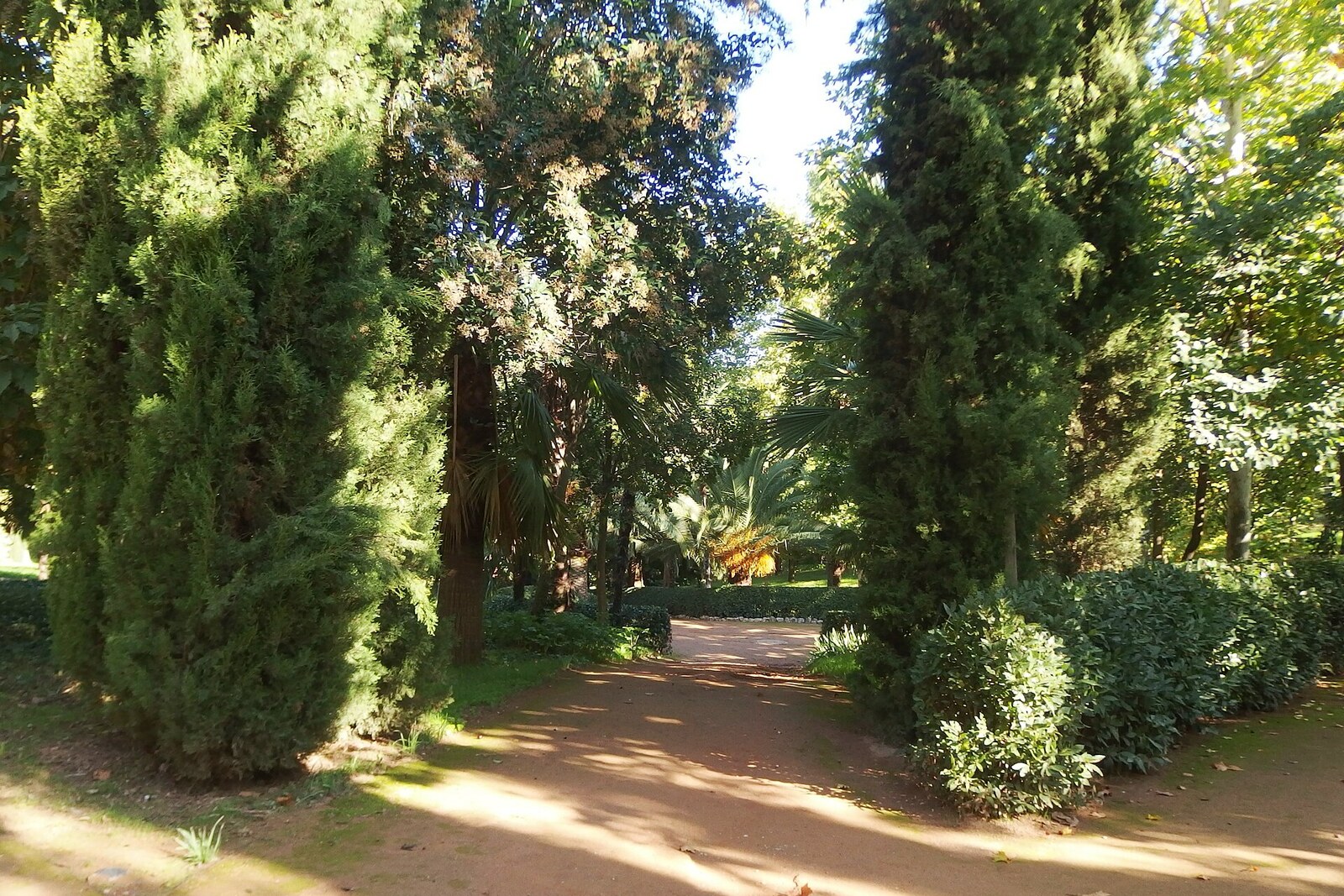
Look around first
What to notice
- The white palace
- The lake
- Garden paths
- Fountains
The story of the place
Behind the shared wall, a house, a garden, and a vegetable plot are gathered together; in Granada, such a property is called a carmen. The white palace stands among a French parterre, a landscaped garden, palm-lined avenues, a lake, and paths between the trees. Its owner, the nun Cristina de la Cruz Arteaga, sold the estate to the city, expecting it to be opened to residents as a park. The name Carmen de los Mártires is linked to a tradition about Christian captives: archaeologists found deep Nasrid grain pits on the slope, and medieval and later authors wrote that prisoners were held in such pits.
In nineteen seventy-four, the gates of Carmen de los Mártires were closed. Behind the fence, a site was being prepared for a five-star hotel: workers began dismantling the palace, cut down most of the centuries-old forest maze, and dug an enormous excavation pit. Under the plans, the hotel was to take the place of the palace, part of the lake, and almost the whole forest.
Before this, Carmen de los Mártires was a large nineteenth-century private estate. In Granada, a carmen is a house combined with a garden and a vegetable plot within a single enclosure. Here, around the palace, they laid out a French parterre, a landscaped garden, a lake, palm-lined avenues, and a forest with paths where visitors really did get lost.
The last private owner was Cristina de la Cruz Arteaga, daughter of the Duke of the Infantado and a nun of the Order of Saint Jerome. In nineteen fifty-seven, she sold the estate to the municipality for eleven million pesetas. Cristina invested the money in restoring her San Jerónimo Monastery, and expected something else from the city: the former family residence was to pass into public use and become a park for the residents of Granada. The gardens opened, and a restaurant began operating in the palace.
Fifteen years later, Mayor José Luis Pérez-Serrabona, who was seeking to build a top-category hotel in Granada, held a competition for a hotel here. The municipal council approved the project and, in the spring of nineteen seventy-four, signed a contract with IFA Carmen de los Mártires. The park bought for the city was handed over to the developer.
The Granada lawyer Fernando Fernández de Bobadilla tried to stop the work through legal means. He sent the head of government a petition detailing the violations, but received no reply. Writers, artists, and other residents spoke out against the hotel, but the protests did not bring back the trees that had already been cut down or the dismantled parts of the palace.
The development was stopped by bankruptcy. In nineteen seventy-six, the company ran out of money. It left the municipality with an excavation pit, a damaged lake, a ruined palace, and the remnants of the forest. The city took the developer's deposit of two million seven hundred twenty thousand pesetas, but even municipal specialists acknowledged that this sum would not be enough for restoration. The hotel was never built, and the closed garden continued to deteriorate for several more years.
The new city council began preparing the restoration in nineteen seventy-nine. Architect Ignacio Gárate Rojas was tasked with restoring the palace's former appearance and adapting it for public events. Landscape architect Consuelo Martínez-Correcher searched for plans and descriptions of the vanished gardens so that they would not be replaced with an arbitrary composition. Work began in nineteen eighty-four: the remaining structures were reinforced, the floors, roof, and finishes were restored, and then work began on the paths, fountains, and irrigation system. Two years later, the palace opened again.
The white building at the beginning of the garden is the result of this reconstruction. The lake and individual garden sections were restored, but the former centuries-old forest maze, in its old composition, disappeared during the hotel development.
The name Carmen de los Mártires refers to another loss. On this slope, archaeologists found deep Nasrid grain pits. Medieval and later authors reported that such pits were also used as prisons: Christian captives were taken out to work during the day and lowered inside at night. Tradition links the field to prisoners who died here or were killed for their faith; their names have not survived. After the capitulation of Granada, Isabella I of Castile ordered the Chapel of the Holy Martyrs built in their memory. Later, a Carmelite monastery rose on its site, and it too was dismantled in the nineteenth century. Of the chapel, the monastery, and the martyrs named in the title, all that remains in the present-day garden is the name.
Useful on site
Gardens: April 1–October 14 Mon–Fri 10:00–14:00 and 18:00–20:00, Sat/Sun/holidays 10:00–20:00; October 15–March 31 Mon–Fri 10:00–14:00 and 16:00–18:00, Sat/Sun/holidays 10:00–18:00. Closures for municipal events are possible.
Checked: June 28, 2026. Check the official source before visiting.Set aside extra time for the gardens. Check access before going uphill; stay on the permitted paths, and do not count on entering every room in the palace.