 Guide On Map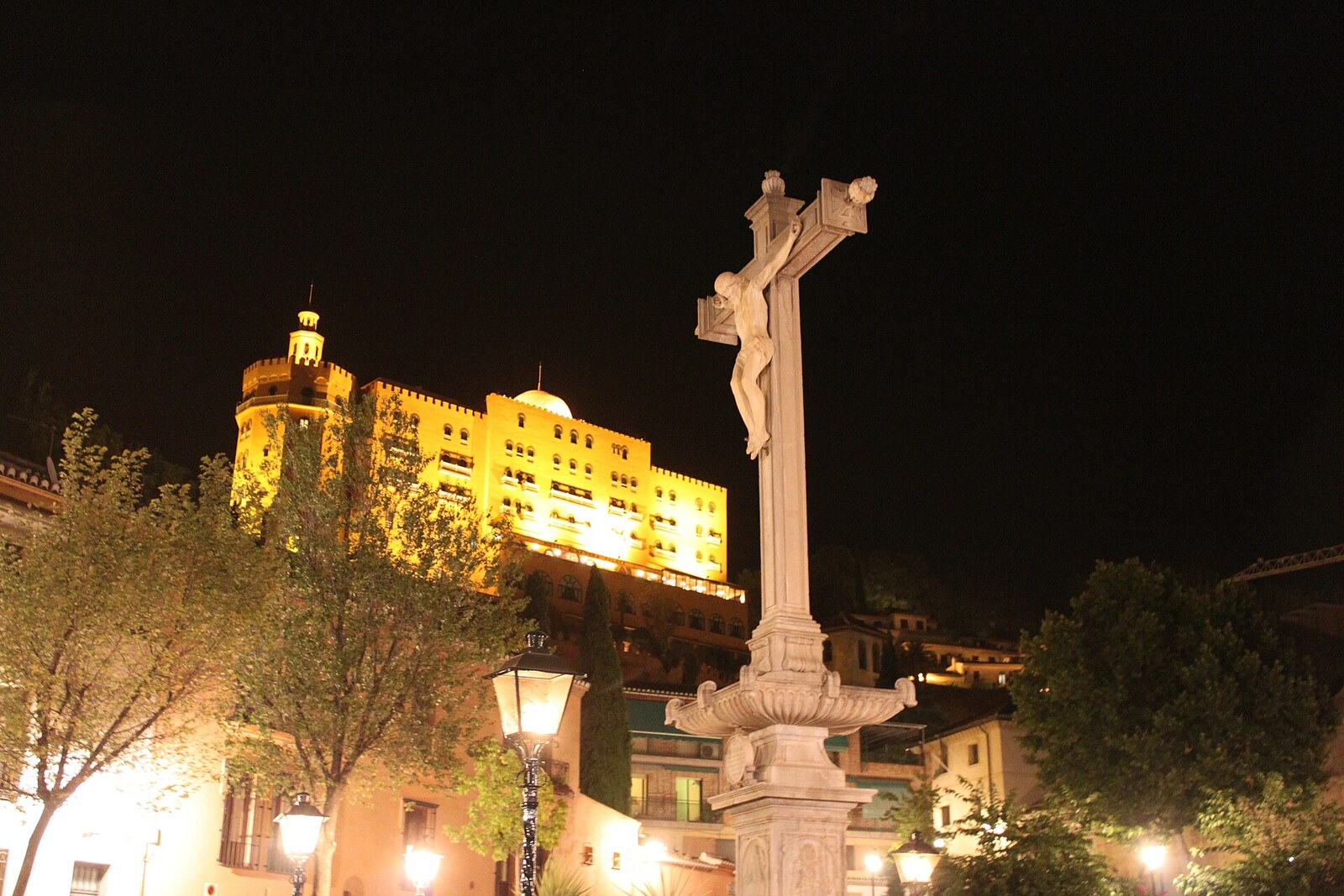
Look around first
What to notice
- The square’s broad open space
- The stone figure of Christ
- The central walking area
- Streets along the edges of the square
The story of the place
Campo del Príncipe long served as Realejo’s large open square, capable of gathering many people at once; streets run along its edges, while a walking area occupies the middle. Horse contests, bullfights, games with reed lances, and processions were held here. The stone figure of Christ appeared in the square much later, when it was moved here in sixteen eighty-two.
The prince who gave Campo del Príncipe—“the Prince’s Field”—its name did not die here. In fourteen ninety-seven, members of the city council ordered the former Field of the Hill leveled and a spacious square prepared for public celebrations marking the marriage of Juan, Prince of Asturias, the only son and heir of Isabella I of Castile and Ferdinand II of Aragon, to Margaret of Austria.
For the couple, this marriage was meant to continue the dynasty and cement an alliance with the House of Habsburg. Six months later, Juan died in Salamanca without leaving an heir. Margaret, who was pregnant, was widowed, and the girl born to her did not survive. Juan’s elder sister was declared heir. In Granada, the preparations left behind a leveled field and a name honoring a prince whose family life ended before the hopes for which it had been celebrated could be fulfilled.
In fifteen thirteen, the city council continued developing the field. Horse contests, bullfights, games involving the throwing of reed lances, and processions were held here. Realejo gained a large square capable of holding many people. A century and a half later, its size allowed silk craftsmen to try to replace the city’s leader.
Most of Granada’s silk workshops stood around Campo del Príncipe. Masters and apprentices lived by selling textiles, and by sixteen forty-eight trade was in a severe slump. Crop failures and grain shortages drove up the price of bread. Municipal officials sold bakers expensive wheat from city stores and prevented them from buying cheaper grain elsewhere. They then ordered the weight of a loaf reduced while keeping its price unchanged. Some bakers stopped working; bread was sold in the city with millet and ash illegally mixed into it.
On May eighteenth, thousands of people gathered in Granada’s poor neighborhoods. The largest group came together here, among the silk workshops. Some men armed themselves. They demanded bread and the resignation of Francisco de Arévalo de Zuazo—the corregidor, the king-appointed head of the city government and judge. Arévalo was blamed for the failure of the food supply. When the crowd went to look for him, he hid in a monastery.
Different neighborhoods had their own candidates to replace him. The silk craftsmen of Campo del Príncipe chose Luis de Paz y Medrano, a local nobleman who had already distributed bread to the poor during the famine. Luis himself did not seek the office, but the number of his supporters settled the dispute. The royal chancery agreed to appoint him corregidor, and the participants in the uprising seated their candidate on a horse and led him through the streets with a crucifix in his hands.
The next day, the city’s nobility tried to bring Arévalo back. Residents began building barricades, and the nobles retreated. Arévalo lost his office, the price of bread was lowered, and Luis obtained from King Philip IV a general pardon for the participants in the uprising. Soon afterward, Luis himself resigned the post, and the king sent another corregidor.
There is no monument to this uprising in the square. The stone Christ standing here now was not moved here until sixteen eighty-two. What remains from the events of sixteen forty-eight is the broad field itself: the very space where the silk craftsmen were able to gather enough people to bring their candidate into the city government.
Useful on site
Open square; it may be crowded during religious dates and in the evening, especially around Cristo de los Favores.
Checked: June 28, 2026. Check the official source before visiting.The square is easy to explore around its perimeter. During religious gatherings, keep passageways clear and treat what is happening as a living rite, not a performance.