 Guide On Map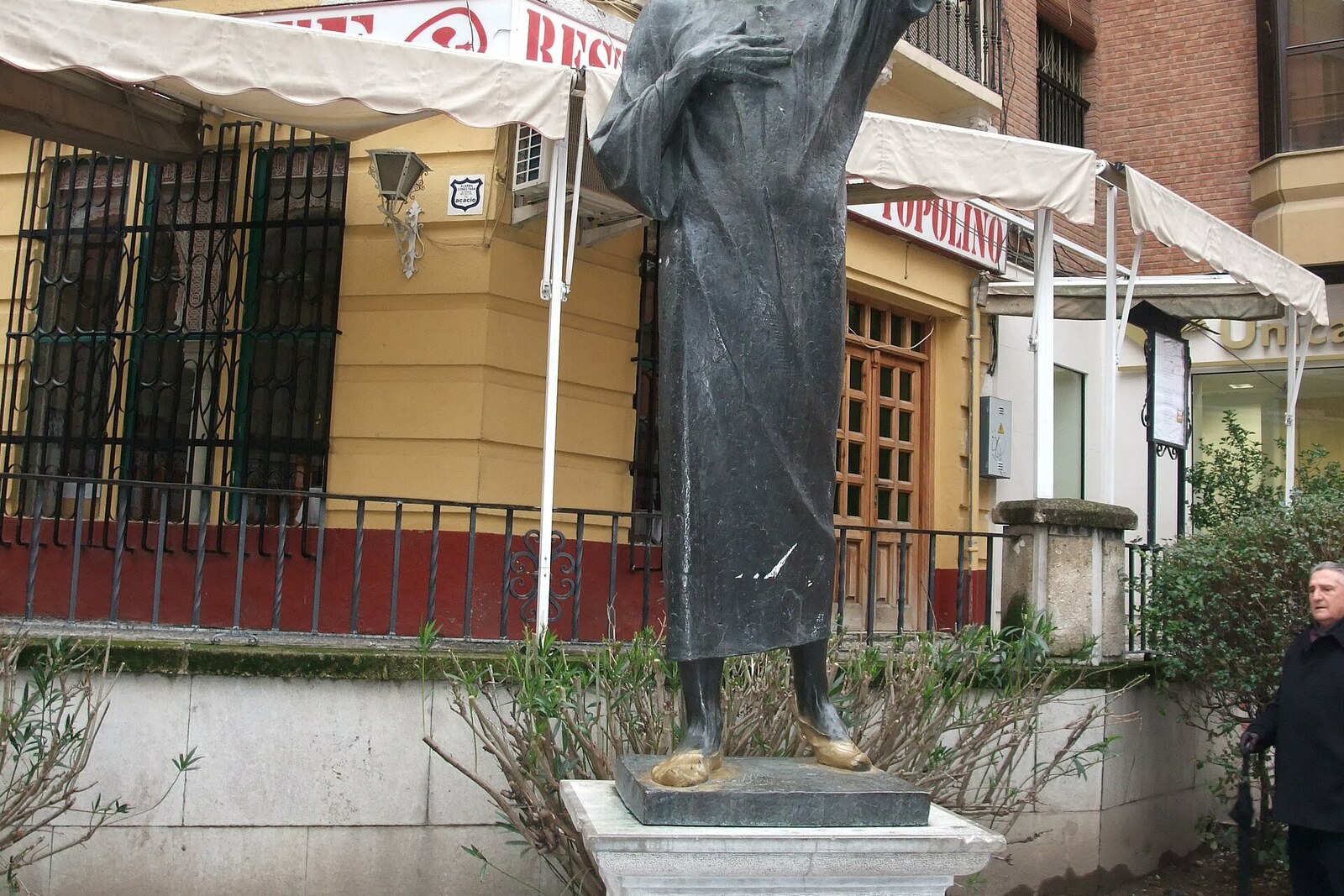
Look around first
What to notice
- Bronze figure of the translator
- Scroll raised above his head
- Right hand at his chest
- Inscription on the pedestal
The story of the place
In nineteen eighty-eight, the Italian-Mexican historian Gutierre Tibón came to Granada with a completed commission for the city. He considered himself a descendant of the medieval translator Yehuda ibn Tibbon and, at his own expense, commissioned the Granada sculptor Miguel Moreno Romera to cast his ancestor in bronze. The fork where Calle Colcha, Calle San Matías, and Calle Pavaneras meet was chosen for the monument—a symbolic entrance to Realejo.
Realejo is the present-day name of the district that, in Muslim Granada, was called Garnata al-Yahud, “Granada of the Jews.” Yehuda's exact house is unknown, and this fork is not presented as his address. The statue marks the boundary of the vanished Jewish quarter.
Yehuda himself was born in Granada around eleven twenty. He grew up among Jewish scholars who wrote books in Arabic, and he knew Arabic and Hebrew. Around eleven fifty, when the Almohad conquests were accompanied by persecution of those of other faiths, Yehuda left his native city. He settled in Lunel, in the south of present-day France, and earned a living practicing medicine.
There it became clear that the exile had brought with him a rare skill. The scholars of Lunel wanted to read the works of Jewish thinkers from Andalusia, but they did not know Arabic. They asked Yehuda to translate these books into Hebrew. In eleven sixty-one, he began translating Bahya ibn Paquda's work on the moral duties of humankind. Yehuda doubted that he had enough Hebrew words for Arabic philosophy, and warned that he would be criticized for new expressions. First he made a literal translation, then rewrote it as an independent text and created the missing terms.
His versions displaced some earlier translations. The works of Yehuda Halevi, Ibn Gabirol, Ibn Janah, and Saadia Gaon followed the first book. Yehuda's son, Samuel ibn Tibbon, continued this craft and translated Maimonides' The Guide for the Perplexed; later generations of the family took up philosophy, medicine, mathematics, and astronomy. Samuel called his father “the father of translators.” Hence the inscription on the Granada pedestal: “patriarch of translators.”
On June twenty-fourth, nineteen eighty-eight, Gutierre Tibón presented the monument to the city. Yehuda is depicted walking forward, with his right hand at his chest and a scroll raised above his head. This is not a surviving manuscript or an object taken out of Granada: the scroll represents the books that the exile began translating only in Lunel. The exact threshold of his house is not here; there is a bronze man at the threshold of the quarter he left.
Useful on site
An open sidewalk monument; view it as an entrance marker for Realejo, without lingering on the narrow roadway.
Checked: June 28, 2026. Check the official source before visiting.This is an outdoor stop; to follow the story, it is enough to view the figure and inscription from the sidewalk.