 Guide On Map
Alhambra and Generalife: Power, Water, and People
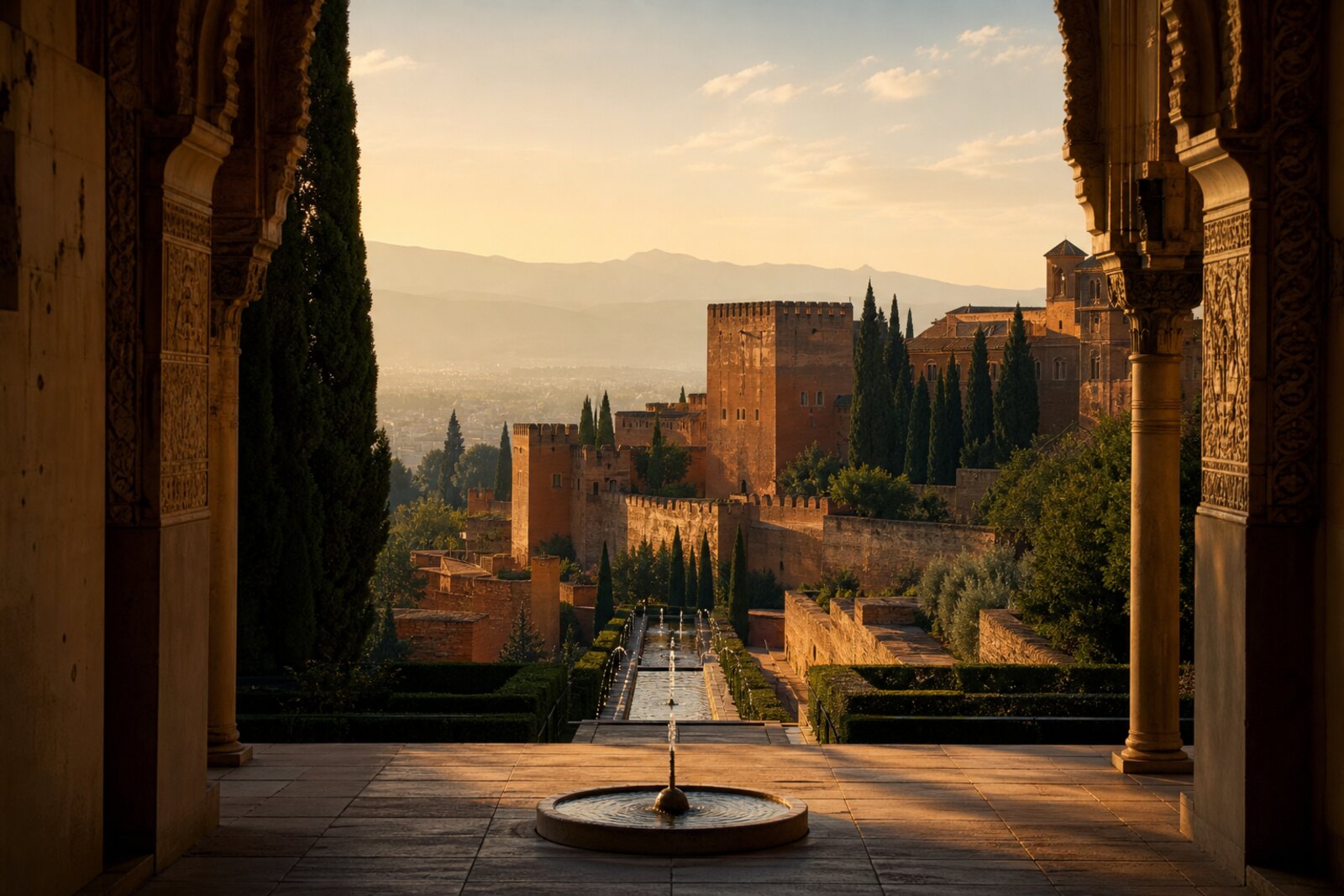
From the Gate of Justice through Alhambra to the gardens of Generalife
Guide On Map on your phone
Open the walk like a regular app
It takes about 10 seconds to install. No app store needed.
The whole path
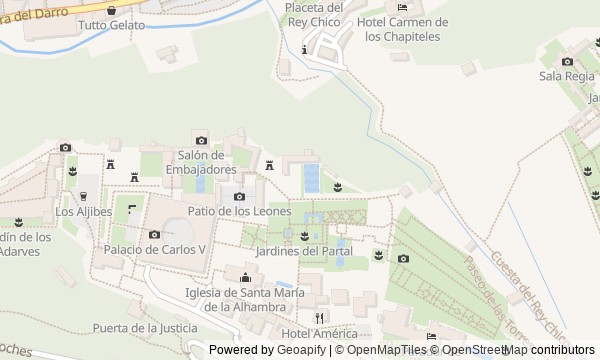
Route map
About the walk
You will enter Alhambra through the Gate of Justice and climb from the fortress wall to the square above a hidden water reservoir. The route then passes through the Alcazaba, the imperial palace, and the rooms of Comares Palace, emerging at Partal Palace before continuing into the gardens of Generalife, toward the canal and the Water Stairway.
This is not a walk through famous interiors alone. You will see how the palace city depended on those who stored water, rang the bell, repaired the pipes, and paid for someone else's construction. The stories bring in a knight who waited in vain for his rival, an apartment inside a tower, a dismantled gallery, and a dome that ended up far from the room it once belonged to. The route follows human decisions and objects with long afterlives.
By the end, you will understand why Alhambra's power rested on more than beauty alone: it constantly needed water, money, and people able to preserve both.
Why this order
The gate leads into the palace city and out onto a square created above a reservoir: after the ceremonial entrance, the fortress's dependence on water becomes clear at once. The square lies between the palaces and the Alcazaba, so the story of the hidden supply continues at the tower from which farmers were signaled about their turn for water. Returning across the square to the Palace of Charles V shows how, after the conquest, new rulers moved from reinforcing the citadel to imperial construction. Nearby Comares Palace places an unfinished residence beside the Nasrid throne room, while the way out of the palaces leads to Partal Palace, where the fates of a building and an exported dome diverged. From Partal Palace, the route follows water beyond the walls: first to Generalife's main canal and the land around it, then uphill to the stairway, where the labor required by the whole system comes into view.
Those who want to connect Alhambra's main spaces into one story Those interested in the human decisions behind ceremonial facades Those who enjoy the fates of objects, engineering details, and historical collisions
Those who want to focus only on the decoration of the Nasrid Palaces Those looking for a quick overview without detailed stories Those who prefer walks without climbs or long stretches on foot
Before you go
Before your visit, check the complex's official website for access conditions for the Nasrid Palaces and any temporary closures: this is the part that requires especially careful planning. Keep your ticket and identification handy if they are required for your type of entry. Wear shoes suited to long walks on uneven stone and stairs, and bring water and sun protection: open areas alternate with cool interiors, but shade is not everywhere. Do not expect to move through the whole route at an even pace—security checks, crowded rooms, and narrow passages can noticeably change it.
When to go
The walking line covers about 2.4 km, but allow roughly three hours for the route. This includes transitions, waits at controlled entrances, climbs, and stops to look around. If you have a timed entry for the Nasrid Palaces, plan the entire order of the walk around it first and do not linger at the early stops.
Backup plan
If individual rooms or gardens are closed, keep the sequence of ideas rather than trying at all costs to reach every stop. The gate, the square, the exterior mass of the Palace of Charles V, and the buildings' relationship with the hill still tell a great deal even without going inside. If time is short, prioritize the section with access scheduled for a specific time, and shorten the Alcazaba or the farther part of Generalife. If the climbs and stairs prove too demanding, end the walk at Partal Palace: by then, the themes of water, loss, and the passage from palace to garden have already come together.
Route conditions
Surface. Paved — 1.3 km; unpaved — 343 m (data covers 69% of the route)
Stairs. Flights: 9, 61 m in total
Access. Wheelchair — no; stroller — limited (stairs)
Facilities. Toilets — 5; drinking water — 20
Elevation. Ascent — 60 m; descent — 28 m
OpenStreetMap extract of June 18, 2026: database data, not a check on the ground. Data © OpenStreetMap contributors, ODbL licence
Walk plan
Open in maps ↗- 1
Gate of Justice
This stop explains why the ceremonial entrance became a fitting stage for a dispute over knightly honor. - 2
Plaza de los Aljibes
Beneath the level square, the fortress’s main vulnerability after the conquest becomes clear: its water supply. - 3
The Alcazaba and Torre de la Vela
The bell will link a military tower, the life of a service family, and the distribution of water across the plain. - 4
Palace of Charles V
The unfinished residence will show who paid for the imperial plan and why its owner never moved in. - 5
Comares Palace and the Hall of the Ambassadors
The rescued ceiling will show how one night’s work separated the original from a later reconstruction. - 6
Partal Palace
The story of the removed dome will show the cost of returning a private palace to the state. - 7
Patio de la Acequia
The canal will connect the ownership dispute with the income that irrigated gardens brought their owners. - 8
Water Stairway
The finale will explain why, after the workers were expelled, it was specifically water specialists who had to be brought back.
Route features
Everything you need stays in the browser
Progress, saves and your trip plan are stored on this device.
Add Guide On Map to your home screen so the walk opens outside the browser.
How we handle sources, maps and corrections: our editorial standards