 Guide On Map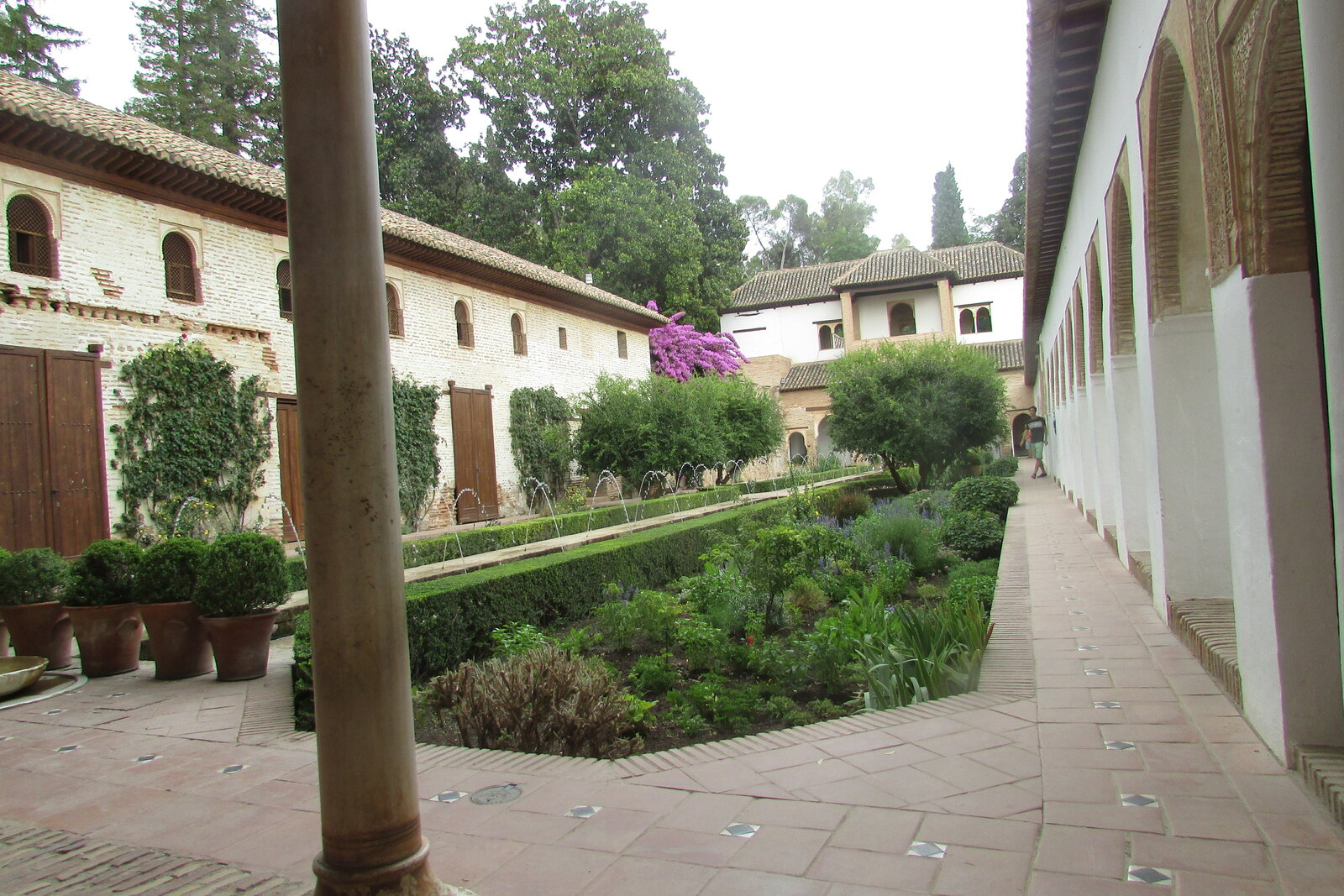
Look around first
What to notice
- The long channel
- The crossing jets
- Four sunken flower beds
- The plaque in the southern portico
The story of the place
Patio de la Acequia is named after the Royal Canal: its open channel runs through the middle of the palace courtyard. In the thirteenth century, by order of Muhammad I, water from the Darro River was brought more than six kilometers so that it would first supply the gardens of Generalife and then continue to the Alhambra. Under Muhammad II, this water made it possible to establish a country residence here beside a productive garden estate. The canal's side openings served gardeners who flooded four sunken flower beds; the crossing jets above the channel appeared only in the nineteenth century.
On October second, nineteen twenty-one, in this courtyard, Giovanni Pannicciotti, the representative of Matilde Giustiniani, holder of the Marquessate of Campotéjar, handed the state three keys. Each had a bow in the colors of the Spanish flag tied to it. The keys were received by José Bertrán y Musitu, deputy minister of finance. Pannicciotti had come to settle the dispute over who owned Generalife. The dispute had lasted almost one hundred years, though its cause was three centuries older.
In fifteen forty-five, the future King Philip II granted Pedro de Granada Venegas the hereditary office of alcaide of Generalife. Here, an alcaide was a steward who administered the palace and a revenue-producing rural estate, looked after their upkeep, and was required to spend one hundred ducats on repairs each year. The family received the right to administer the estate indefinitely. At first, there was no question of transferring it into ownership.
The ambiguity arose in sixteen seventy-two. The regent Mariana of Austria confirmed the rights of the next holder of the Marquessate of Campotéjar and used the word “property” in the document. After that, his descendants treated Generalife as hereditary property. At stake were the palace, the land, and the harvest from the irrigated gardens. For the family, it was an asset that generated income and passed from generation to generation; for the Crown, it was a former royal estate once entrusted only to administration.
In eighteen twenty-six, the royal prosecutor demanded the return of Generalife. Court rulings were followed by appeals. In nineteen twelve, the Granada court recognized the Crown as the owner, but the representatives of the marquesses continued the dispute. Only nine years later did Matilde Giustiniani agree to a deal: the Marquessate of Campotéjar ceded Generalife and the adjoining lands to the state. In exchange, Matilde received the lifetime title of Marchioness of Generalife. It could not be inherited; after her death in nineteen seventy, the title ceased to exist.
The ceremony was held in the palace's central courtyard. Its name, Patio de la Acequia, literally means the courtyard of the irrigation canal. The long channel down the middle is part of the Royal Canal, which was brought from the Darro River in the thirteenth century by order of the first Nasrid sultan, Muhammad I. The water traveled more than six kilometers, first reaching Generalife and supplying its gardens and working plots, before continuing to the Alhambra. Thanks to this canal, Muhammad II was able to establish a country residence here together with a productive estate.
The crossing jets above the channel were added in the nineteenth century. The medieval side openings served another purpose: through them, gardeners flooded four sunken flower beds with water. The canal produced harvests on the very lands over which the heirs of the alcaide and the state disputed for centuries.
After the transfer, a separate Board of Trustees of Generalife was created, and in nineteen twenty-five the estate was united with the Alhambra under joint administration. A plaque marking the end of the litigation remains in the southern portico. In front of it, the acequia still runs from one end of the courtyard to the other, beside the spot where Pannicciotti placed three keys on the table.
Useful on site
Generalife as part of the daytime tour: 8:30-20:00 summer, 8:30-18:00 winter.
Checked: June 28, 2026. Check the official source before visiting.The modern high jets do not show the courtyard's original appearance. Also look at the low line of the canal and at how the arches admit the distant landscape into the garden.