 Guide On Map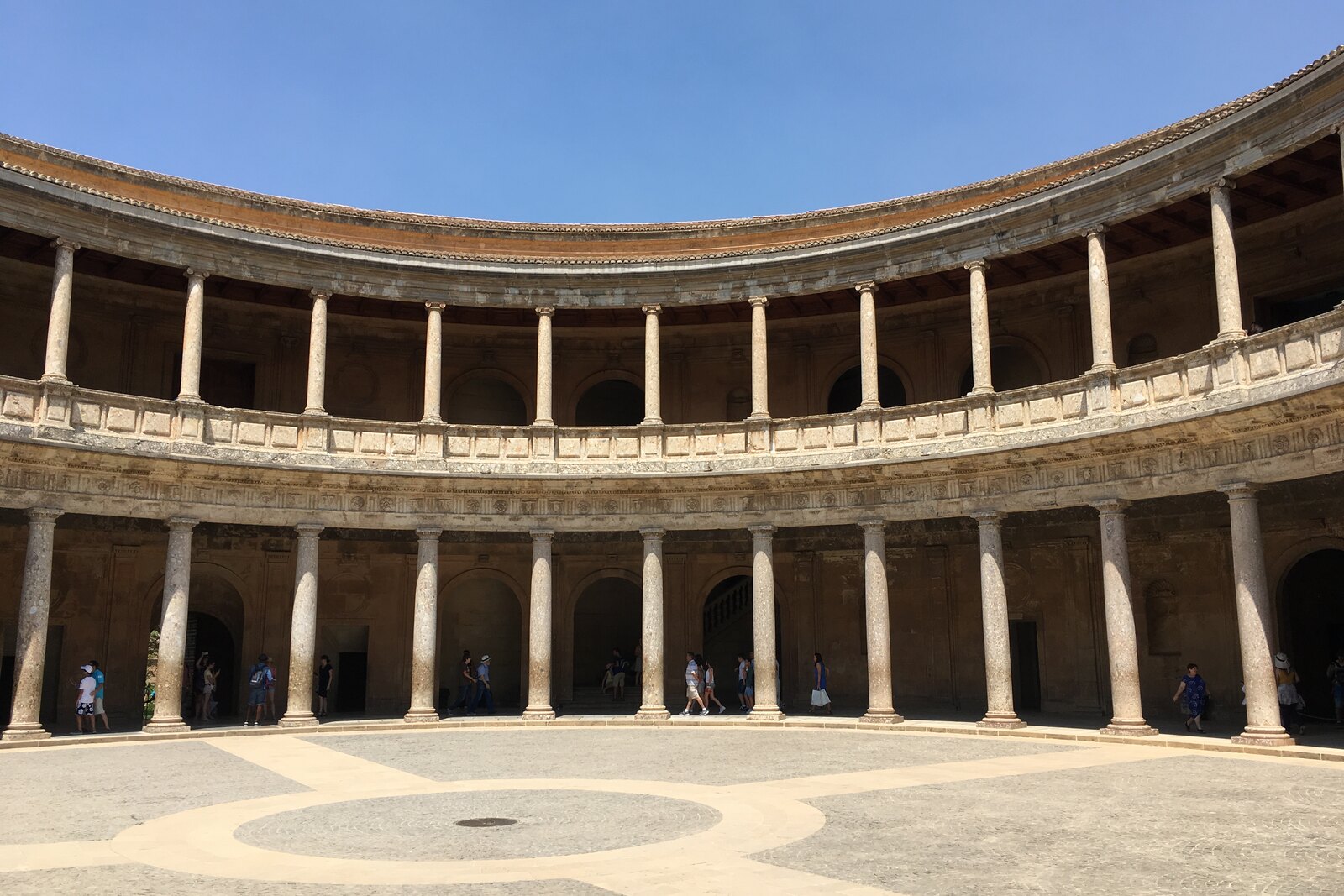
Look around first
What to notice
- Square stone structure
- Circular inner courtyard
- Open colonnade
The story of the place
Among the Nasrid chambers of the Alhambra rises a heavy square palace, where an open colonnade surrounds a circular courtyard. Its facades are designed in the Roman style, and this circle set within a square sets the building apart from the neighboring palaces. It stood without a roof for almost three centuries, and the interior rooms were completed only in the twentieth century. The Alhambra Museum now operates downstairs, the Museum of Fine Arts is housed upstairs, and concerts resound in the courtyard.
The stone square with a circular courtyard bears the name of Charles V. In Spain, he ruled as King Charles I, while in the Holy Roman Empire he was the elected emperor Charles V. This palace is the only residence he commissioned for himself.
In the summer of fifteen twenty-six, Charles came to Granada with his young wife, Isabella of Portugal, the Portuguese infanta. Their marriage was arranged for an alliance between two crowns and for the rich dowry Charles needed for wars and his imperial coronation. The couple lived in the Alhambra for more than half a year. Rooms in the Nasrid Palaces were adapted for them, while the courtiers were housed throughout the fortress and the city. Charles decided to leave a permanent residence here, where the court could be accommodated and imperial ceremonies held.
Luis Hurtado de Mendoza, the governor of the Alhambra, was tasked with organizing the construction. He brought in Pedro Machuca, an artist and architect who had worked in Italy. Machuca set a circular courtyard within a square building and designed the facades in the Roman style. Charles saw himself as the heir to the ancient emperors, so the palace among the chambers of the overthrown Nasrid dynasty was meant to speak in a language understood by European courts.
The people who came to Charles seeking protection had to pay for this plan. The Moriscos—baptized Muslims of Granada and their descendants—submitted a complaint to the emperor about exactions and abuses by officials and clergy. An investigation ordered by Charles confirmed many of the complaints. Yet a church assembly then accused the petitioners themselves of secretly remaining Muslims. Arabic, traditional clothing, public baths, and wedding rites were being prepared for prohibition.
Through Luis Hurtado de Mendoza, representatives of the Moriscos secured a postponement of these bans for several decades. In return, they undertook to pay a large sum and a special annual levy. From fifteen thirty-three onward, ten thousand ducats from this levy went toward Charles's palace. Stonemasons and carvers were paid with money from people buying themselves the right to keep speaking, dressing, and marrying according to their customary practices for a while longer.
When the postponement ended, the earlier bans were reinstated. In fifteen sixty-eight, the Morisco revolt began, the flow of money stopped, and work on the palace was halted for fifteen years. After the revolt was crushed, the Moriscos were forcibly resettled outside the Kingdom of Granada. Construction resumed later, but was abandoned for good in sixteen thirty-seven: the building remained without a roof for almost three centuries, and no one ever lived in it.
The roof and interior rooms were completed only in the twentieth century. The Alhambra Museum now occupies the lower floor, the Museum of Fine Arts the upper floor, and concerts take place in the circular courtyard. Charles and Isabella lived in the neighboring Nasrid chambers; they never entered this palace.
Useful on site
Part of the complex; check exhibitions and museums separately.
Checked: June 28, 2026. Check the official source before visiting.First take in the outer volume, then enter the courtyard and stand closer to the center: the contrast between mass, circle, and open sky reveals itself gradually.