 Guide On Map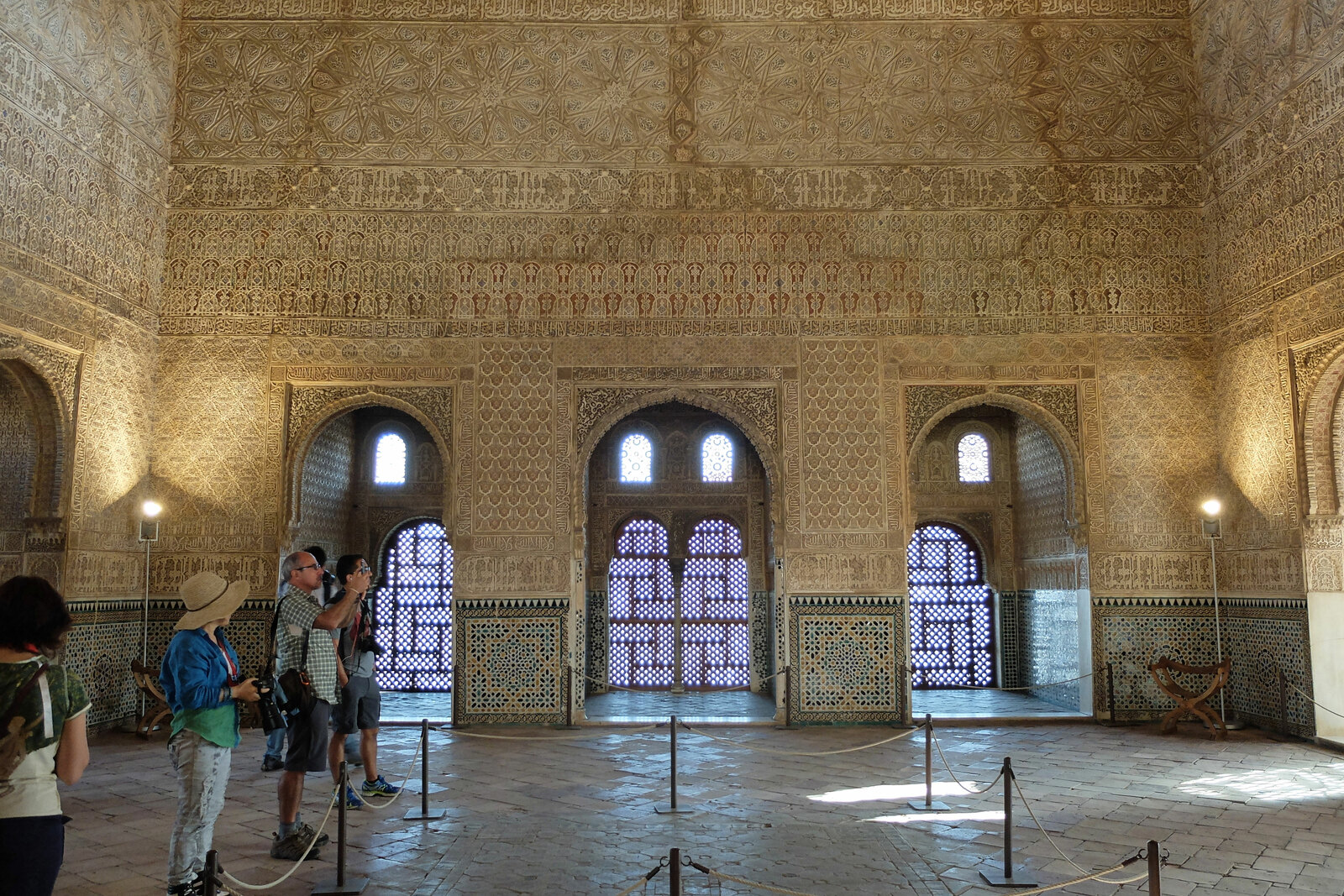
Look around first
What to notice
- Wooden ceiling with star-shaped bands
- Main niche opposite the entrance
- Side niches
- Pool of the Myrtles
The story of the place
Envoys from neighboring rulers were received in the Hall of the Ambassadors when they came to discuss a truce, tribute, trade, or an alliance. The sultan sat in the deep niche opposite the entrance, while the eight side niches were set aside for courtiers and participants in the reception. Above them, the wooden ceiling forms star-shaped bands; researchers see in this pattern the seven heavens of Islamic tradition and paradise at the center of the dome.
On the evening of September fifteenth, eighteen ninety, a watchman on San Nicolás Hill noticed a glow above the Alhambra. He ran down to Plaza Nueva to raise the alarm. About thirty minutes passed while people called by telephone and rang church bells.
The Hall of the Barque was burning—the antechamber through which visitors enter this hall. The fire had already spread to the gallery of the Court of the Myrtles and part of the Tower of Comares. The first people to arrive found a small pump and began pumping water directly from the long pool in the courtyard. It was not enough.
One of the first to enter was Mariano Contreras, the Alhambra’s architect-conservator. He had been appointed only a few months earlier: preserving the palaces was his profession and direct responsibility. When firefighters arrived around midnight, Contreras and their chief ordered the wooden structures at the edges of the burning gallery to be cut through. One of the gaps was made near the wall of the Hall of the Ambassadors, so that the flames would have no path to its ceiling.
Soldiers, workers, journalists, and townspeople joined the firefighting; newspapers even noted several ladies among the volunteers. Three firefighters suffered serious injuries and were taken to hospital. By half past two, the burning sections had been cut off, and by four o’clock the fire was extinguished. The wooden vault of the Hall of the Barque was lost. It was reconstructed from fragments, old images, and a model made in advance, but the work was not completed until nineteen sixty-four. The ceiling of the Hall of the Ambassadors was saved.
It was for that ceiling that people cut the timber at the entrance. Eight thousand seventeen elements are assembled into successive star-shaped bands. Researchers read in them the seven heavens of Islamic tradition and paradise in the central dome. Beneath this heaven, in the richest niche opposite the entrance, sat the Nasrid sultan. The other eight niches were intended for courtiers and participants in the reception.
Envoys came here as trusted representatives of neighboring rulers, sent to negotiate truces, tribute, trade, or an alliance. These receptions gave the Hall of the Ambassadors its present name. Sultan Yusuf I ordered the throne room arranged so that an arriving delegation would find itself before his niche and beneath an entire celestial order laid out in wood.
The vault before the entrance belongs to the twentieth-century reconstruction. Above the throne room itself remains the medieval ceiling, which the firefighters of eighteen ninety did not let the fire reach.
Useful on site
Entry strictly at the Nasrid Palaces time stated on the ticket.
Checked: June 28, 2026. Check the official source before visiting.This area can be crowded and may have special access arrangements. Do not try to hold up the flow: choose one niche or section of ornament and examine it closely.