 Guide On Map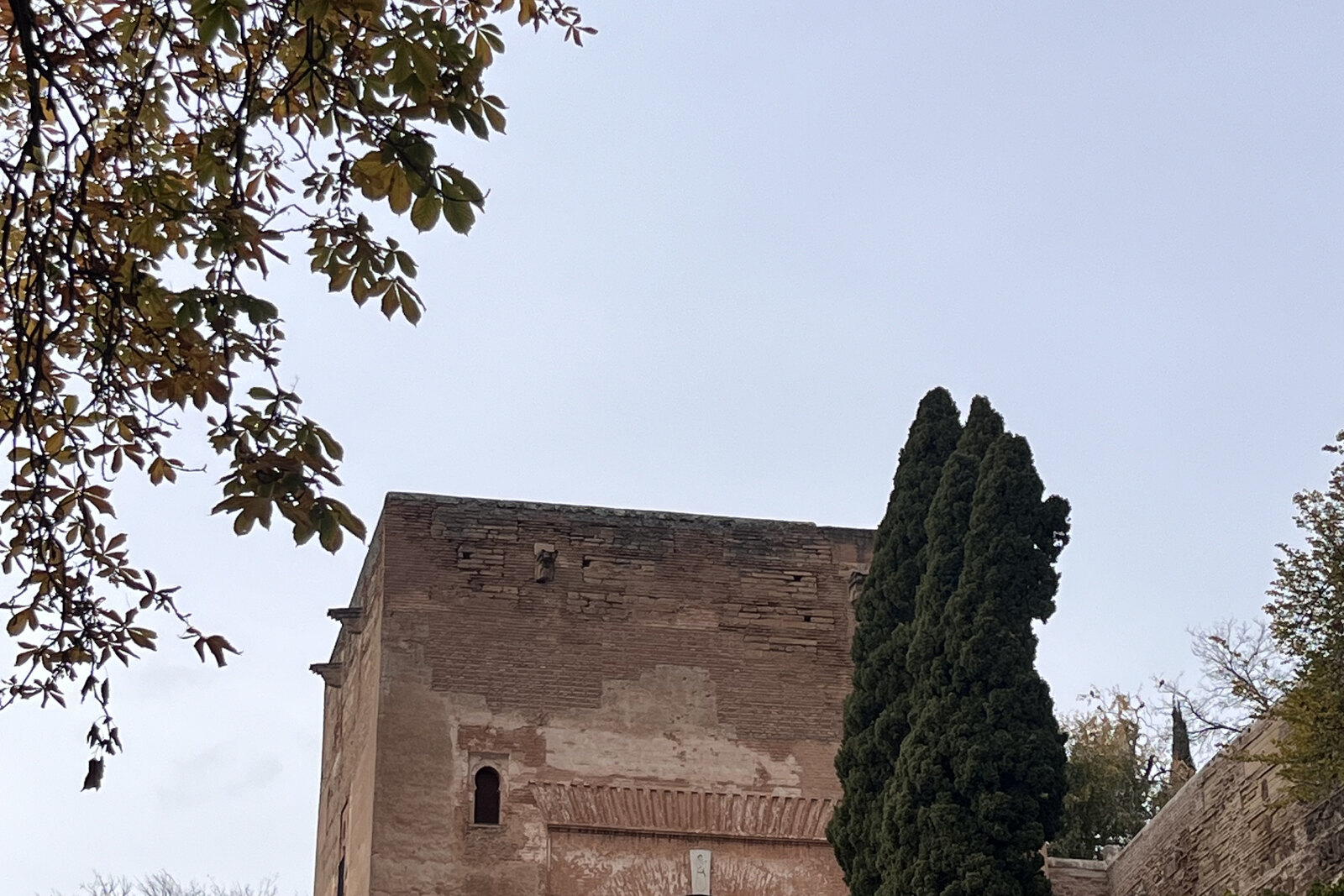
Look around first
What to notice
- Tower above the passage
- Upper window of the tower
- Winding passage
The story of the place
The tower above the roadway stands at the Alhambra's outer wall, and the route inside immediately turns, so it is impossible to enter the palace city here in a straight line. Under Yusuf I, this ceremonial, guarded entrance was completed in thirteen forty-eight; ambassadors, military commanders, and noble guests were received here, while townspeople more often used the Gate of Arms. A broad open strip was left before the wall, where armed arrivals remained in view, and the tower's upper window made it possible to watch them from above.
In front of this gate, a field was once prepared for a judicial duel. One opponent arrived with a lance and shield, the other stayed home, and the judge gave a signal from the window of the tower above the passage.
It began in Cordoba in the autumn of fourteen sixty-nine. Two branches of the Fernández de Córdoba family shared the post of commander of Alcalá la Real, a frontier fortress on the road between Castile and Granada. For these men, a fortress post meant military command, income, and a place at court.
The son of the Count of Cabra, the royal marshal Diego Fernández de Córdoba, came to Cordoba to support his candidate for a city office. His relative and rival Alonso de Aguilar invited the marshal to dinner. The food had not yet been served when Alonso's men seized their guest and sent him to the fortress of Cañete. Diego was kept in irons for several days, then forced to swear that his family would give up Alcalá la Real. Only after that was the prisoner released.
The Castilian Crown declared the oath extracted by force invalid. For Diego, that was not enough. He had been lured to dinner, put in irons, and forced to surrender the family fortress; among the nobility, such a way of being defeated deprived a man of honor along with his office. The marshal challenged Alonso to a duel.
The king of Castile forbade the relatives to fight. Diego then chose Granada, the capital of the neighboring Nasrid Kingdom, as the meeting place and asked Muley Hacén, the sultan of Granada, to judge them. The sultan was to guarantee the safety of both opponents. He agreed and issued safe-conducts.
Alonso declared that he did not trust the promise of a ruler with whom Castile alternated between war and truce. He demanded that Diego's elderly father and his brother be handed over as hostages. Diego refused to risk his father, offering instead his own eldest son and two brothers. Alonso did not accept the substitution.
Despite this, on August tenth, fourteen seventy, Diego arrived at the Alhambra. At that time, a broad cleared strip lay before the southern wall, used for military reviews, tournaments, and ceremonial receptions. The sultan's attendants led the marshal to an enclosed place for the fight. Muley Hacén appeared at the upper window of the Tower of Justice—the very tower into which this gate is cut—and gave the agreed signal. Diego took up a lance and shield. A herald went to the four corners of the field and, at each one, called for Alonso de Aguilar three times. There was no response.
Six days later, Muley Hacén announced his decision: Diego had appeared according to the rules and was therefore considered the victor; his knightly honor was restored. Alonso kept his life but received an official defeat for failing to appear. The dispute over fortresses and offices continued without a duel; in the next generation, the two branches of the family ended their feud through the marriage of their heirs.
The site was chosen because of how this place was arranged. Yusuf I ordered the gate completed in thirteen forty-eight as a ceremonial, guarded entrance to the palace city. Ordinary residents more often came up through the Gate of Arms, while ambassadors, military commanders, and noble guests were received here. The open field kept armed arrivals before the wall, the sultan watched them from above, and the winding passage inside delayed anyone who was nevertheless allowed to enter.
The Arabic name of the gate is Gate of Justice. It has long been translated as the “Gate of Law” or the “Gate of Justice,” although some researchers connect the name with the outer square. That is why stories of a permanent court beneath the arch remain disputed. The duel between Diego and Alonso is confirmed by their correspondence and old chronicles.
The enclosed field is gone: trees and roads now occupy the former open strip. The tower remains, from whose window Muley Hacén gave the signal for the fight. Beneath it, Diego waited for the man who never passed through the Gate of Justice.
Useful on site
Complex 8:30-20:00 in the summer season; 8:30-18:00 in the winter season.
Checked: June 28, 2026. Check the official source before visiting.Look at both arches before passing beneath the vaults: when you are moving, the symbols are easy to miss overhead. Do not linger in the middle of the busy entrance.