 Guide On Map
Dante Alighieri and the City's Memory: from Bargello to Santa Croce
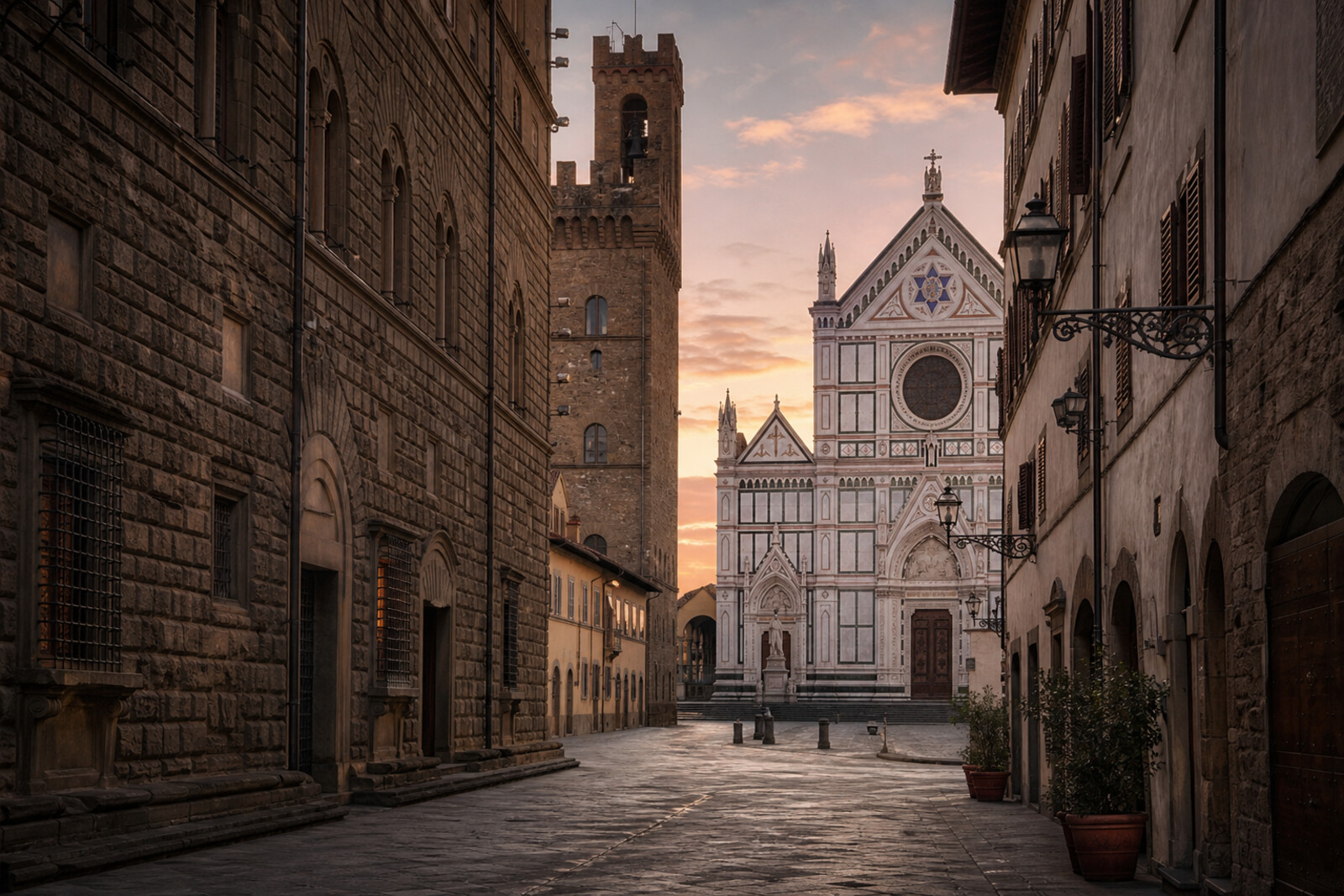
Through the Dante Quarter to Piazza Santa Croce and the Basilica of Santa Croce
Guide On Map on your phone
Open the walk like a regular app
It takes about 10 seconds to install. No app store needed.
The whole path
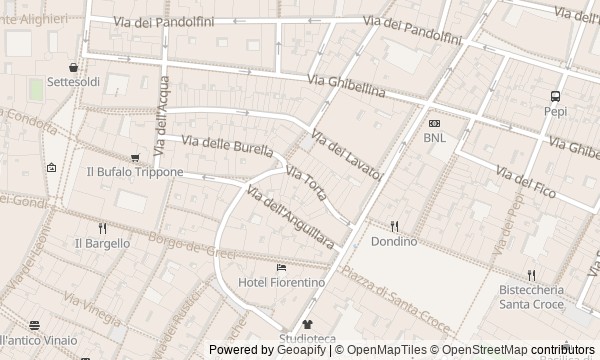
Route map
About the walk
From the austere Bargello, you will make your way through the narrow Dante Quarter to the broad Piazza Santa Croce, ending behind the basilica in a monastic workshop. Along the way come a courthouse, a small charitable oratory, a reconstructed “poet's house,” an abbey, an old notaries' residence, a square for public games, and the church of Florence's great figures.
The story reveals how Florence judged, concealed, reclaimed, and rearranged its own past. You will find a portrait beneath whitewash, black and white beans, a well with a doubtful pedigree, a cannonball that did not stop a match, and a monument without the person it honors. The answers come from verdicts, account books, and city decisions; legend is kept separate from document.
By the end, you will be able to explain why the exiled Dante Alighieri was given a museum house and an honorary tomb in Florence, yet never returned there himself.
Why this order
Bargello sets up the central collision: city power condemned Dante Alighieri, then later restored his image in that same palace. In the neighboring San Martino quarter, the scale narrows from a state sentence to hidden help for one family, while the next passage to Dante's House Museum shows how a private address became a municipal monument. Badia Fiorentina continues the thread not through a building, but through a public reading of the poet paid for by the city. Nearby, Palazzo del Proconsolo links the literary canon to the profession of notaries, for whom the written word carried direct consequences. Along Via dei Pandolfini, the route leaves tight service spaces for Santa Croce, where the city presents itself through public play. The Basilica of Santa Croce gathers the attempts to reclaim famous exiles, while the school behind its apse ends the walk not with a monument, but with a craft one family has continued to pass on.
Those who have already seen the major Renaissance squares and want to understand how the city works Readers of Dante Alighieri who care about his Florentine fate rather than a retelling of his biography Anyone drawn to archival details, small interiors, and historical collisions
Those looking for an overview of the Uffizi Gallery's major works Those who want a walk only through open squares, without museums or church interiors Those who prefer legends without verification or caveats
Before you go
Check visiting conditions for Bargello, Dante's House Museum, the Basilica of Santa Croce, and Scuola del Cuoio for your chosen day: they are independent venues, and the route itself does not guarantee access. Badia Fiorentina and the Oratory of Buonomini di San Martino remain active religious spaces, so entry may be limited by a service or internal gathering. For churches, choose clothing that covers your shoulders and knees, speak quietly inside, and check the photography rules. Wear sturdy shoes: the lanes are stone-paved, and some stops call for a long look while standing. During city events, Piazza Santa Croce may be occupied by structures, sand, or crowds.
When to go
Start in the first half of the day, and do not give every stop the same pace. Bargello and the basilica deserve more attention, while Via del Proconsolo is best taken slowly but without a long pause in one spot. Before setting out, compare the schedules of the independent venues and build the shortest access window into your day.
Backup plan
If Bargello or Dante's House Museum is unavailable, study their stone facades and continue the route, without trying to replace the museum with invented “authenticity” outside. Closed Badia Fiorentina and the oratory still make meaningful pauses: at the first, keep the theme of Dante Alighieri's public reading; at the second, find the modest entrance and remember help given without spectators. If the basilica is closed, linger in the square and look at the facade, the Dante Alighieri monument, and the shape of the city space. If you cannot enter the leather school, end the walk at the monastic complex and notice the names of nearby streets, which preserve the memory of tanners and dyers.
Route conditions
Surface. Paved — 808 m (data covers 92% of the route)
Facilities. Toilets — 4; drinking water — 3
Elevation. Ascent — 15 m; descent — 18 m
OpenStreetMap extract of June 18, 2026: database data, not a check on the ground. Data © OpenStreetMap contributors, ODbL licence
Walk plan
Open in maps ↗- 1
Bargello
Here the route's central conflict emerges: the city will condemn the poet, then later return his image to the same palace. - 2
Oratory of Buonomini di San Martino
This stop shifts the scale: from a civic sentence to helping a single family without public humiliation. - 3
Dante's House Museum
Here you will see how the municipal government created a physical address for memory when the evidence was insufficient. - 4
Badia Fiorentina
This stop will show how the reading of Dante changed from a private matter into a public practice funded by the city. - 5
Via del Proconsolo
The notaries’ house will link the power of the written word to a posthumous gallery of poets. - 6
Piazza Santa Croce
The square will add the action of a living city to the theme of memory: a public game during the siege. - 7
Basilica of Santa Croce
Here, two attempts to return Florence’s great exiles will converge—one through a body, the other through a monument. - 8
Scuola del Cuoio
The finale shifts the theme of inheritance from memorials to a workshop where a craft is passed on within a working production facility.
Route features
Everything you need stays in the browser
Progress, saves and your trip plan are stored on this device.
Add Guide On Map to your home screen so the walk opens outside the browser.
How we handle sources, maps and corrections: our editorial standards