 Guide On Map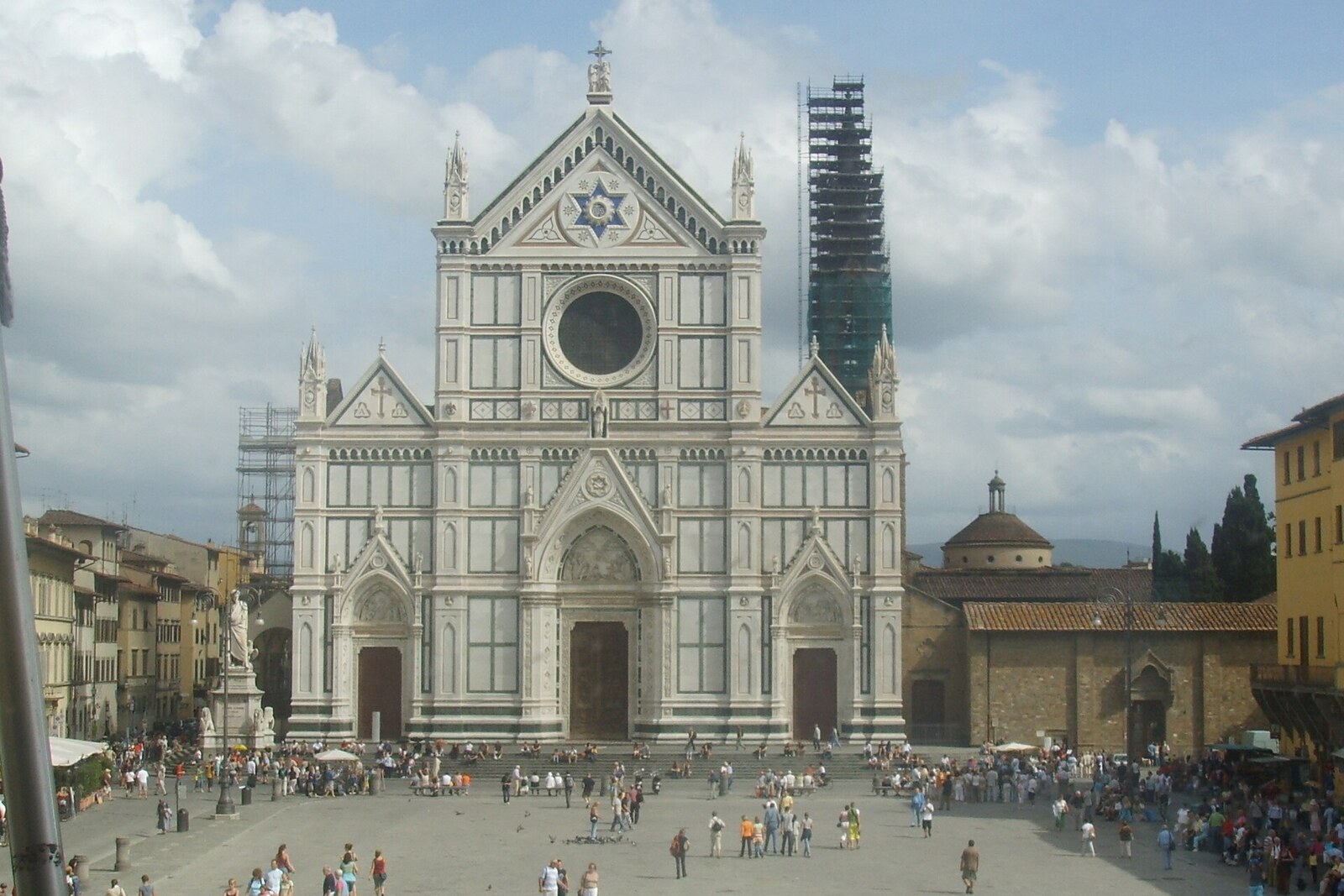
Look around first
What to notice
- The circular stone marker at the middle of the field
- The painted façade of Palazzo dell'Antella
- The façade of the Basilica of Santa Croce
The story of the place
On February seventeenth, fifteen thirty, two teams of young Florentines—the Whites and the Greens—took the field on Piazza Santa Croce. They were going to play Calcio Storico Fiorentino: the ball could be kicked with the feet and carried in the hands toward the edge of the field, while physical struggle was part of the game. The winners were due a calf. In a city that had already been supplied through the siege ring for several months, such a prize meant a food reserve.
Three years earlier, the Florentines had expelled the Medici family and restored the republic. Pope Clement VII, born Giulio de' Medici, was seeking his family's return. He made an agreement with Emperor Charles V, and in the autumn of fifteen twenty-nine imperial troops surrounded Florence.
The February match was part of the carnival custom, but the players chose Santa Croce with the besiegers in mind. This square arose beside the Basilica of the Holy Cross—hence its name. The Franciscans needed an open space for the many townspeople who came to hear sermons; later, the broad rectangle hosted equestrian contests and games. From positions on the surrounding heights, the field was clearly visible.
So that the enemy would hear the match as well, the city musicians climbed onto the basilica roof with trumpets and drums. In doing so, the Florentines showed that they themselves controlled their carnival, although an army capable of cutting off food supplies and shelling the city stood all around them.
The imperial artillerymen responded from a position at Giramonte. A cannonball passed above the roof and hit no one. The shot did not disrupt the game: an anonymous diary of the time names the Greens as the winners, and they received the calf.
The match raised the townspeople's spirits, but it did not change the outcome of the siege. In August, the republic capitulated, the Medici family returned, and two years later its elected institutions were abolished and Alessandro de' Medici became Duke of Florence.
The modern tournament was restored in nineteen thirty. Now, every June, municipal services lay out a rectangular field of sand here and build stands; the teams of the four old quarters play Calcio Storico Fiorentino again, and Santa Croce is represented by the Blues. On the painted façade of Palazzo dell'Antella, to the right of the basilica, a circular stone marker marking the middle of the playing field has survived.
Useful on site
The square is open around the clock; in June the area may be closed off because of a Calcio Storico match.
Checked: June 17, 2026. Check the official source before visiting.The square is open to the city and changes during events. Do not go beyond the barriers, and bear in mind that temporary structures may block familiar views.