 Guide On Map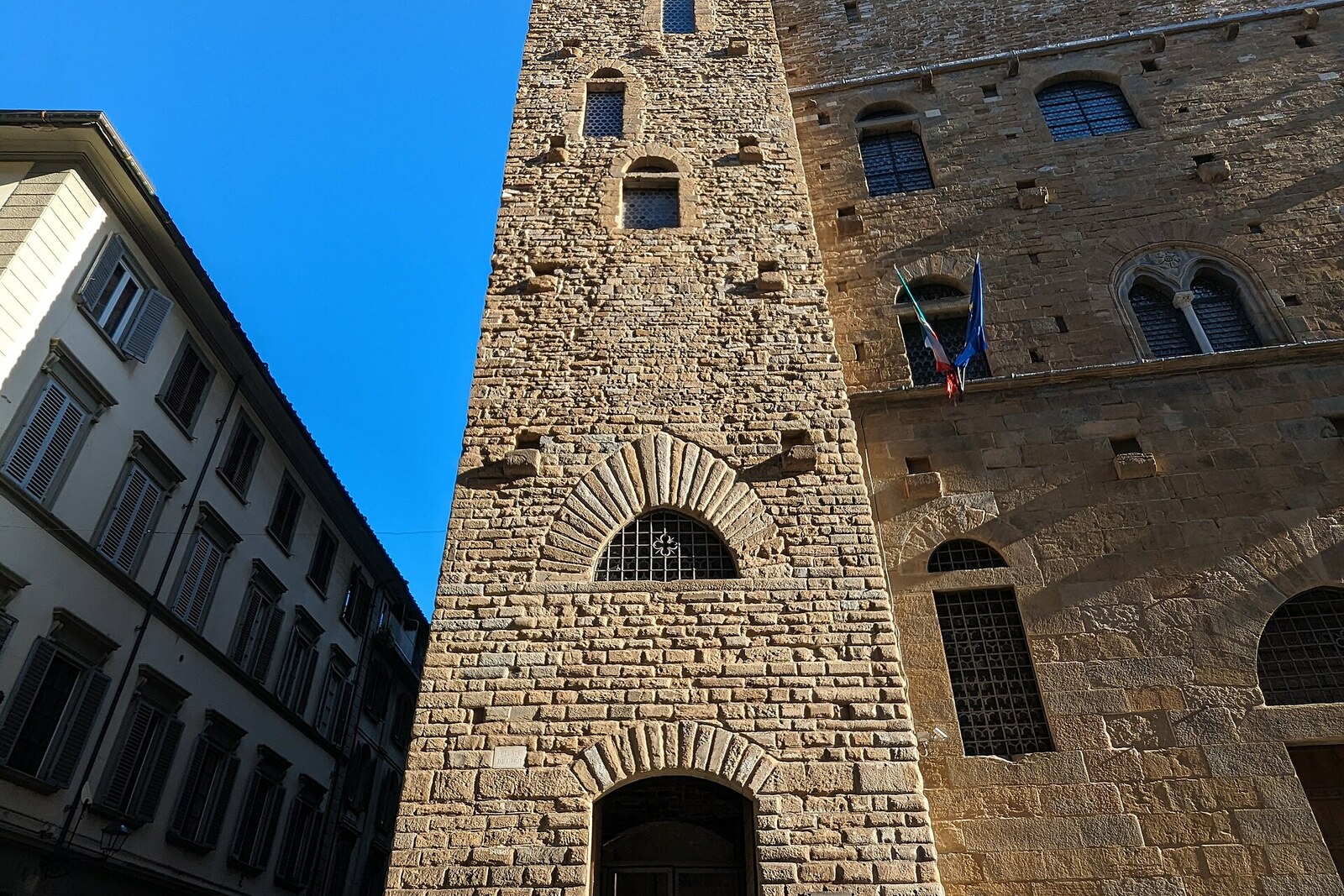
Look around first
What to notice
- Stone inner courtyard
- Donatello Hall
- Fresco with Dante's portrait
The story of the place
The palace received its present name from the bargello, the chief of the city guard: when the building became a prison, arrests, interrogations, and executions were under his authority. The stone inner courtyard is now surrounded by museum halls, although prison rooms once operated here. After the prison was removed, the palace was restored and the first national museum of the Kingdom of Italy opened inside it. Sculptures stand in Donatello Hall, while the former Magdalen Chapel preserves wall paintings.
Before us stands the palace of the city court. In the Middle Ages, the podestà sat here: a judge invited from another city, whom the Florentines entrusted for a short term with civil and criminal cases. That is why Dante Alighieri was summoned here in January thirteen oh two.
Dante was a poet, but he was tried as a former prior, one of the leaders of the Florentine Republic. The city was then divided between two parties: the White Guelphs, to whom Dante belonged, resisted the pope's interference in city affairs; the Black Guelphs counted on papal support. In November thirteen oh one, the French prince Charles of Valois, sent by the pope, entered Florence. The Blacks returned from exile, took city offices, and began hearing cases against their opponents.
The new podestà was Cante de' Gabrielli, a committed supporter of the Blacks. He sought the conviction of the former priors for decisions made before the coup. Dante was then with an embassy at the papal court and did not come when summoned: appearing threatened him with prison and torture. On January twenty-seventh, the court treated his absence as an admission of guilt. Dante was accused of appropriating city money and acting against the pope and Charles of Valois. He was fined five thousand florins, required to pay it within three days, barred from holding office, and threatened with the confiscation and destruction of his property.
A second sentence followed on March tenth. If Dante were captured within Florence, he was to be burned. What is now Donatello Hall then contained the large courtroom; here they announced the decision after which Dante never returned home. He lived at the courts of other rulers, depended on their hospitality, and later wrote himself about the poverty of an exile. His family and property remained in Florence, while he died in Ravenna in thirteen twenty-one.
Three decades later, masters from Giotto's circle painted the palace chapel. Those condemned to death waited here for execution, so Inferno, Paradise, and scenes of repentance appeared on its walls. Dante was placed among the saved in Paradise. There was no allegory in this juxtaposition: in the courtroom he was sentenced to the stake, while in the chapel of that same court he was painted among the righteous.
In fifteen seventy-four, the palace was turned into a prison. The bargello, the chief of the city guard responsible for arrests, interrogations, and executions, took up residence here. His office gave the building its present name. The chapel was adapted for prison needs, the frescoes were whitewashed, and Dante's face disappeared for several centuries.
In eighteen forty, the artist Antonio Marini removed the whitewash and discovered the portrait. The find became one reason to restore the palace after the prison was removed and to open here, in eighteen sixty-five, the first national museum of the Kingdom of Italy. Sculptures by Donatello now stand in the former sentencing hall, while in Magdalen Chapel Dante still remains on the side of Paradise.
Useful on site
Tue–Sun 08:15–18:50; last entry 50 min before; Mon – closed.
Checked: June 17, 2026. Check the official source before visiting.The facade is visible from the street, but the courtyard, chapel, and sculptures are part of the museum visit. Inside, follow the established photography rules and do not touch the exhibits.