 Guide On Map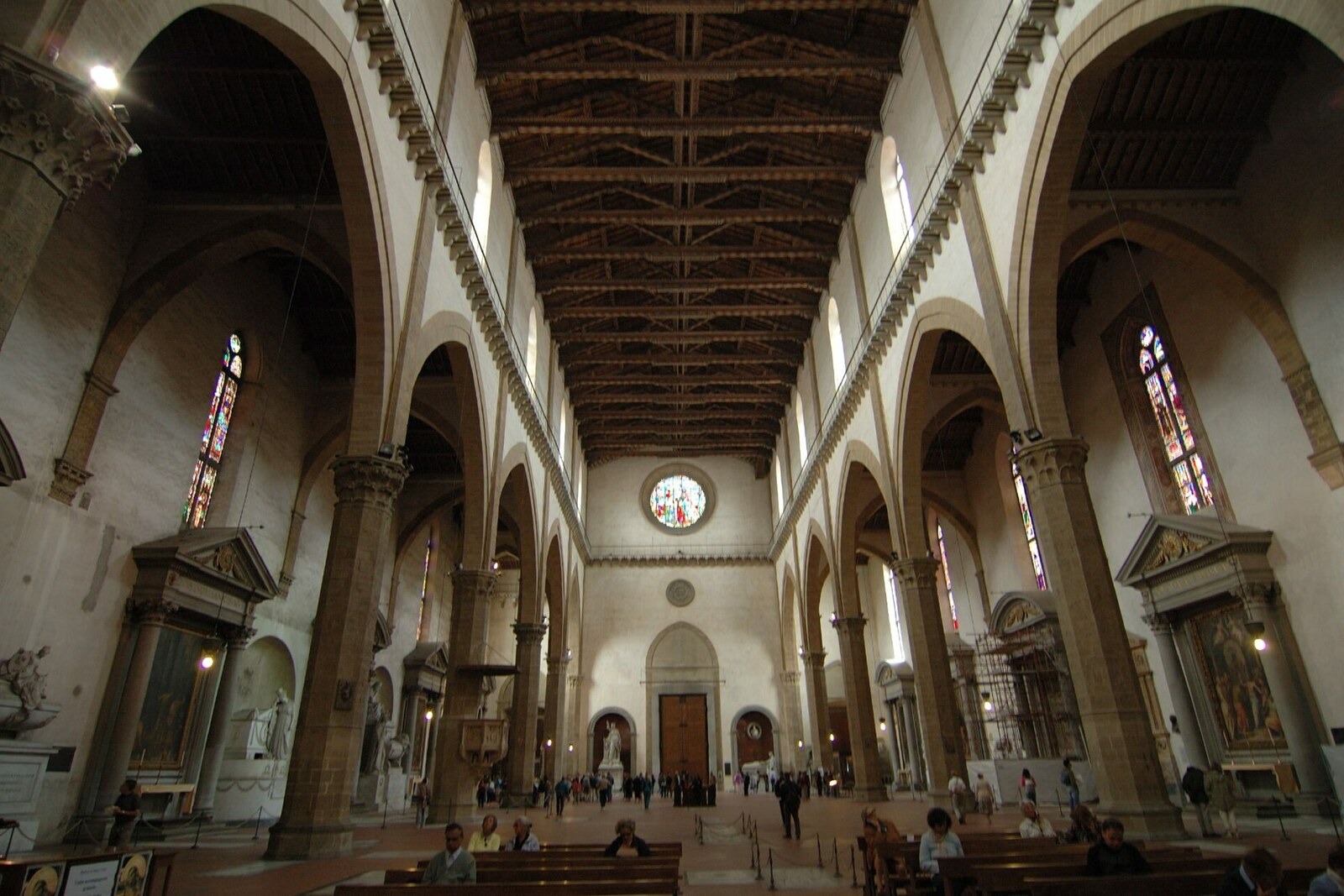
Look around first
What to notice
- Michelangelo’s tomb
- Three marble female figures
- Three interlocking crowns
- Dante’s empty tomb
The story of the place
In March fifteen sixty-four, they tried to bring Michelangelo’s coffin into the Basilica of Santa Croce without attracting attention. The news spread anyway. People packed the church so tightly that the attendants could barely carry the body into the sacristy and lay it out for viewing.
Michelangelo was a Florentine sculptor, but for the last thirty years he had lived in Rome, worked on papal commissions, and directed the construction of St Peter’s Basilica. He wanted to be buried in Florence, at the Basilica of Santa Croce, where the Buonarroti family tomb was located. After the artist’s death, his body had already been placed in a Roman church. His nephew Leonardo Buonarroti sought to carry out his uncle’s last wish and secretly removed the remains: they were packed into a bale declared to be commercial cargo. An open transfer might have ended in Rome itself; Leonardo took one of Italy’s most famous men home disguised as merchandise.
A solemn ceremony was held later at the Basilica of San Lorenzo, but Michelangelo was buried here. Duke Cosimo I ordered that he be given a place of honor, and the artist’s architect and biographer Giorgio Vasari designed the tomb in the right nave. Three marble women—Painting, Sculpture, and Architecture—bow beneath Michelangelo’s bust. The monument bore the emblem of the recently founded Academy and Company of the Arts of Drawing: three interlocking crowns. Its masters claimed the deceased as their teacher, while the Florentines received the body of a man who had not returned to the city for decades during his lifetime.
Forty-five years before his own death, Michelangelo tried to arrange another tomb here. In fifteen nineteen, he signed a petition to Pope Leo the Tenth asking for Dante’s remains to be returned from Ravenna, and offered to carve the poet a worthy monument in Florence himself. Dante died in exile, and his body was kept by the Franciscan monks of Ravenna. Learning of the planned transfer, the monks broke through to the sarcophagus from their monastery, removed the bones, and hid them. Michelangelo never received the remains for which he intended to work.
By the beginning of the nineteenth century, the Florentines were already using the Basilica of Santa Croce—the Franciscan Church of the Holy Cross—as a place to bury and honor famous fellow citizens. Michelangelo, Galileo, and Machiavelli lay here. For Dante, Grand Duke Ferdinand III, Grand Duke of Tuscany, and Florentine cultural figures had to raise money for an empty tomb.
The sculptor and Academy professor Stefano Ricci received the largest commission of his career. He changed the designs, enlarged the figures so they would not be lost in the high nave, and worked for more than ten years. Ferdinand III, Grand Duke of Tuscany, died without seeing the result. In eighteen thirty, the Florentines unveiled the first official city monument to the poet whom their predecessors had exiled. Above the sarcophagus, Ricci seated Dante with The Divine Comedy, placed Italy beside him wearing a crown of city walls, and bent weeping Poetry over them.
Under the three grieving arts lies Michelangelo’s body, which his nephew brought here as commercial cargo. Under weeping Poetry there is no body. Dante’s bones were found in Ravenna only in eighteen sixty-five, beneath the threshold of a bricked-up door, and were left there.
Useful on site
Mon–Sat 09:30–17:30; Sun and religious holidays 14:00–17:30; last entry 17:00; closed 25 December.
Checked: June 17, 2026. Check the official source before visiting.This is an active church and a large museum complex: observe the dress code, allow time to move between the interior spaces, and be prepared for possible closures of individual areas.