 Guide On Map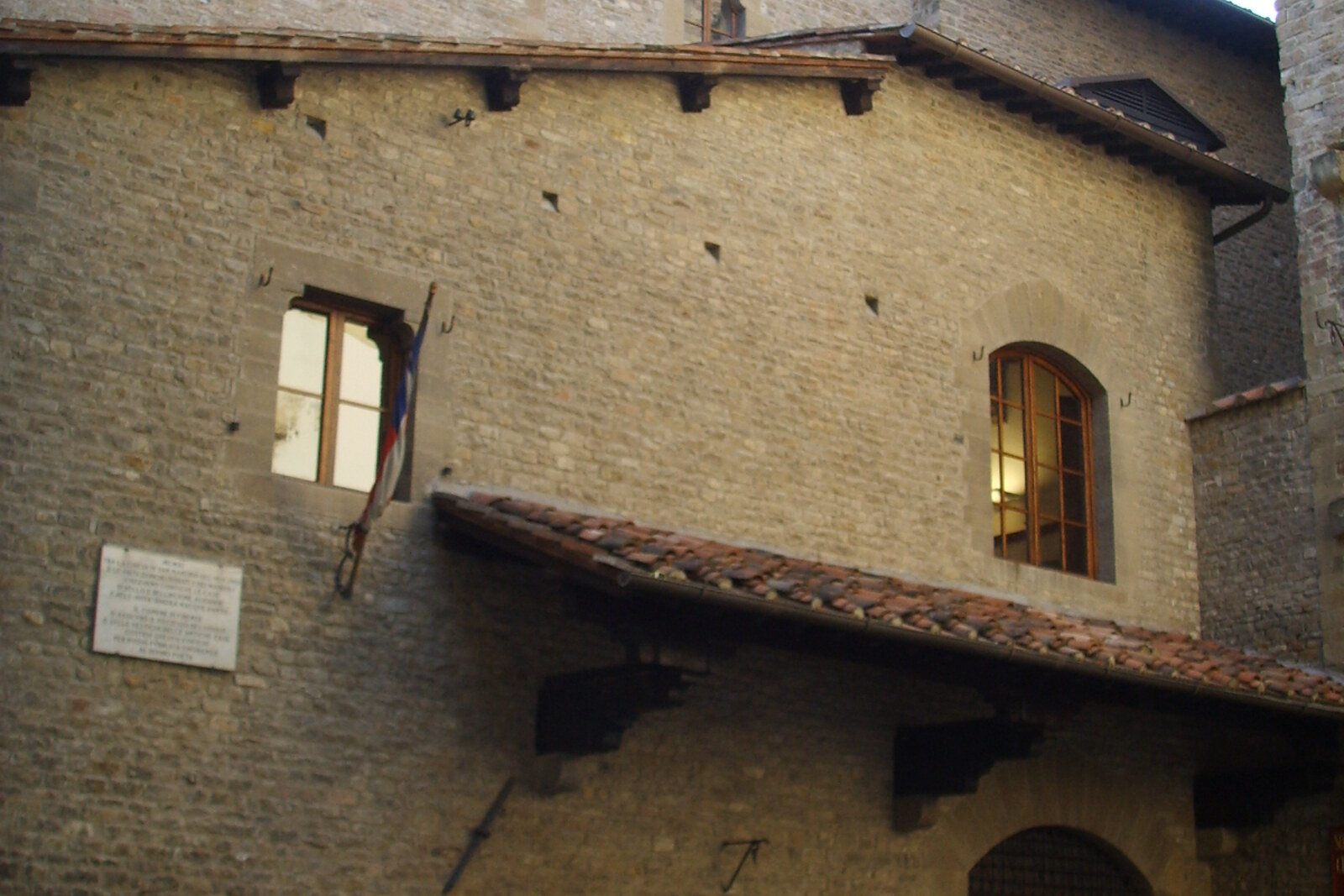
Look around first
What to notice
- The inscription “Dante's House”
- Stone masonry
- The well in the square
The story of the place
Above the entrance, it says: Dante's House. The documents call for a more cautious statement. Dante Alighieri, a Florentine poet, was born in this quarter, but ownership of this particular building by his family has never been proven.
The search for the house began among people living five and a half centuries after Dante Alighieri. In eighteen sixty-five, Florence became the capital of united Italy and at the same time marked the poet's six-hundredth anniversary. The city council decided to acquire his residence. Florentines needed an exact address for the man whom the city had once exiled and now honored as one of the creators of the Italian language.
For two years, a municipal commission went through old land registers, opened up masonry, and drew plans of the quarter. Among the clues was a document from eleven eighty-nine. Two ancestors of Dante Alighieri, who owned a garden here, undertook to cut down a fig tree: its branches or roots extended beyond the wall of the Church of San Martino. An everyday quarrel helped establish where the Alighieri property stood, but it did not preserve the plan of the house itself. The commission nevertheless marked its presumed boundaries, the small square, and the well on a drawing.
The doubts did not disappear. In nineteen oh five, the researcher Giorgio Piranesi published documents that challenged the commission's certainty. Even after the purchase of the corner houses in nineteen oh eight, an examination of the walls did not prove that the Alighieris had owned the corner houses. The city council decided to build.
The commission went to Giuseppe Castellucci, an architect-restorer serving in the regional office for the protection of Tuscan monuments. He had to give the stones the appearance of Dante Alighieri's house without a reliable depiction of that house. Castellucci presented two different designs to the commissions, then demolished the corner building, removed later additions, and cleared space for a square. The medieval walls incorporated into the new structure had belonged to the Alighieris' neighbors—the Giocchi family. The well was installed again according to the commission's drawing.
In nineteen eleven, the building opened for the fiftieth anniversary of the unification of Italy. The ground floor was fitted out as the home of a fourteenth-century Florentine craftsman, with furnishings selected in an old style; municipal offices occupied the upper floors. The museum came later. In nineteen sixty, the cultural association Florentine Union asked for the office rooms to be transferred to it and, for the seven-hundredth anniversary of Dante Alighieri's birth, opened an exhibition here about the poet. Today, copies of manuscripts and documents, digital materials, and reconstructions are displayed inside.
The authentic medieval masonry of the present house belonged to the Giocchi family. The square, the well, and Dante Alighieri's house in its familiar form were created by Florentine officials, researchers, and Castellucci in the early twentieth century.
Useful on site
Apr-Oct daily 10:00-18:00; Nov-Mar: Tue-Fri 10:00-17:00, Sat-Sun 10:00-18:00; Mon – closed; last entry 30 minutes before closing.
Checked: June 17, 2026. Check the official source before visiting.The museum and the neighboring church are visited separately. Do not mistake the reconstructed house for Dante Alighieri's exact residence, and check access directly with each site.