 Guide On Map
Above Edinburgh: Calton Hill, Holyrood and Salisbury Crags
From Waterloo Place through Calton Hill and Regent Terrace to Salisbury Crags

Guide On Map on your phone
Open the walk like a regular app
It takes about 10 seconds to install. No app store needed.
The whole path
Route map
About the walk
You will begin on Waterloo Place, above a stone arch that is almost invisible from street level. Then you will climb Calton Hill. At the top, unfinished columns, a tower with a time ball, and an observatory with a slit in its roof await you. Simple questions will arise. Why did the great memorial stop at its portico? What kept sailors from seeing the exact time? How could caution cost a scientist priority?
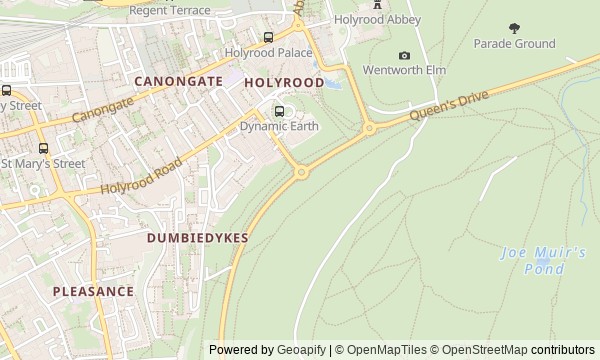
From the hill, you will descend to the formal facades of Regent Terrace and one address that became a fragment of another country during the war. Then the city's stone gives way to the grass of Holyrood Park. The route passes an artificial loch, beneath the ruins of a pilgrims' chapel, and ends at dark rock between uplifted layers.
The story will be calm and specific. It will separate document from legend. After the walk, you will be able to read Edinburgh's silhouette along its seams: a bridge over a former hollow, unfinished columns, a meridian slit, and the rocks of Salisbury Crags.
Why this order
Regent Bridge comes first because it carried the eastern road across the former hollow and brought the city to Calton Hill. The climb leads to the National Monument of Scotland, whose columns are the first to explain the summit's classical silhouette. The nearby Nelson Monument continues the theme of height, but shifts from ceremonial ambition to a practical connection with the port. Next comes the City Observatory, because its clock controlled the signal on the tower; from here, the story moves naturally from maritime time to observing the stars. The descent to Regent Terrace takes Regency architecture from public monuments to a residential facade behind which a very different life appeared during the war. Beyond it, the built city yields to Holyrood Park: the artificial loch beneath the medieval chapel shows how people changed the purpose of a single slope twice. The final stretch along the foot of Salisbury Crags goes deeper than all the structures before it—to the rock over which the debate was no longer about the appearance of Edinburgh, but about the origin of the rocks themselves.
Those who want to connect city architecture with the open terrain of Holyrood Park Those interested in engineering and scientific stories with human stakes Those who enjoy finding specific traces of the past in a panorama
Those expecting a walk without climbs or uneven park paths Those who care more about palace interiors than city engineering and open terrain Those who prefer a short loop limited to central streets
Before you go
Wear shoes with reliable grip: city pavements give way to paths and stony sections around Holyrood Park. There is little shelter from the wind on Calton Hill and near the crags, so the weather feels harsher than it does among the buildings.
The observatory buildings, Collective, and the Nelson Monument may each have their own access arrangements; the route still works from the outside, but check interior visits separately. At Salisbury Crags, follow current barriers and signs: access to Hutton's Section may be restricted after rockfalls, and a visible path is not necessarily open for use.
When to go
Go in daylight, so you can make out architectural details, old paths, and the boundaries between rock layers. Do not rush the climb to Calton Hill, and allow extra time for the section from the loch to the crags: the permitted approach may be longer than expected.
Backup plan
If the top of the hill is lost in cloud or strong wind makes stops uncomfortable, focus on Regent Bridge, the monuments from the outside, and Regent Terrace, sheltered by the buildings. The stories of the first five stops do not require going inside.
If access to Hutton's Section is closed, do not go around barriers or try to reach it by scree. End the route at a permitted point with a view of the crags' dark wall, and use the overall shape of the slopes as the final image instead of examining the rock contact up close.
Route conditions
Surface. Paved — 2.9 km; unpaved — 1.4 km (data covers 90% of the route)
Stairs. Flights: 10, 94 m in total
Access. Wheelchair — no; stroller — limited (stairs)
Facilities. Toilets — 5; drinking water — 3
Elevation. Ascent — 127 m; descent — 72 m
OpenStreetMap extract of June 18, 2026: database data, not a check on the ground. Data © OpenStreetMap contributors, ODbL licence
Walk plan
Open in maps ↗- 1
Waterloo Place and Regent Bridge
Here you will see the price private initiative paid for a direct eastern entrance to the center. - 2
National Monument
The portico will show how a national ambition stopped at the limit of the money raised. - 3
Nelson Monument
The tower will link the city skyline to a practical task for captains in Leith. - 4
The Observatory and the Collective Art Center
This stop will show why a correct observation does not yet guarantee scientific priority. - 5
Twenty-eight Regent Terrace
One residential address preserves the story of French servicemen who had nowhere to return to on leave. - 6
St Anthony's Chapel and St Margaret's Loch
Here, two states of the hillside sit side by side: a medieval place of pilgrimage and an urban park. - 7
Salisbury Crags and Hutton's Section
The exposure makes it possible to see the arguments in an old scientific dispute in the rock itself.
Route features
Everything you need stays in the browser
Progress, saves and your trip plan are stored on this device.
Add Guide On Map to your home screen so the walk opens outside the browser.
How we handle sources, maps and corrections: our editorial standards