 Guide On Map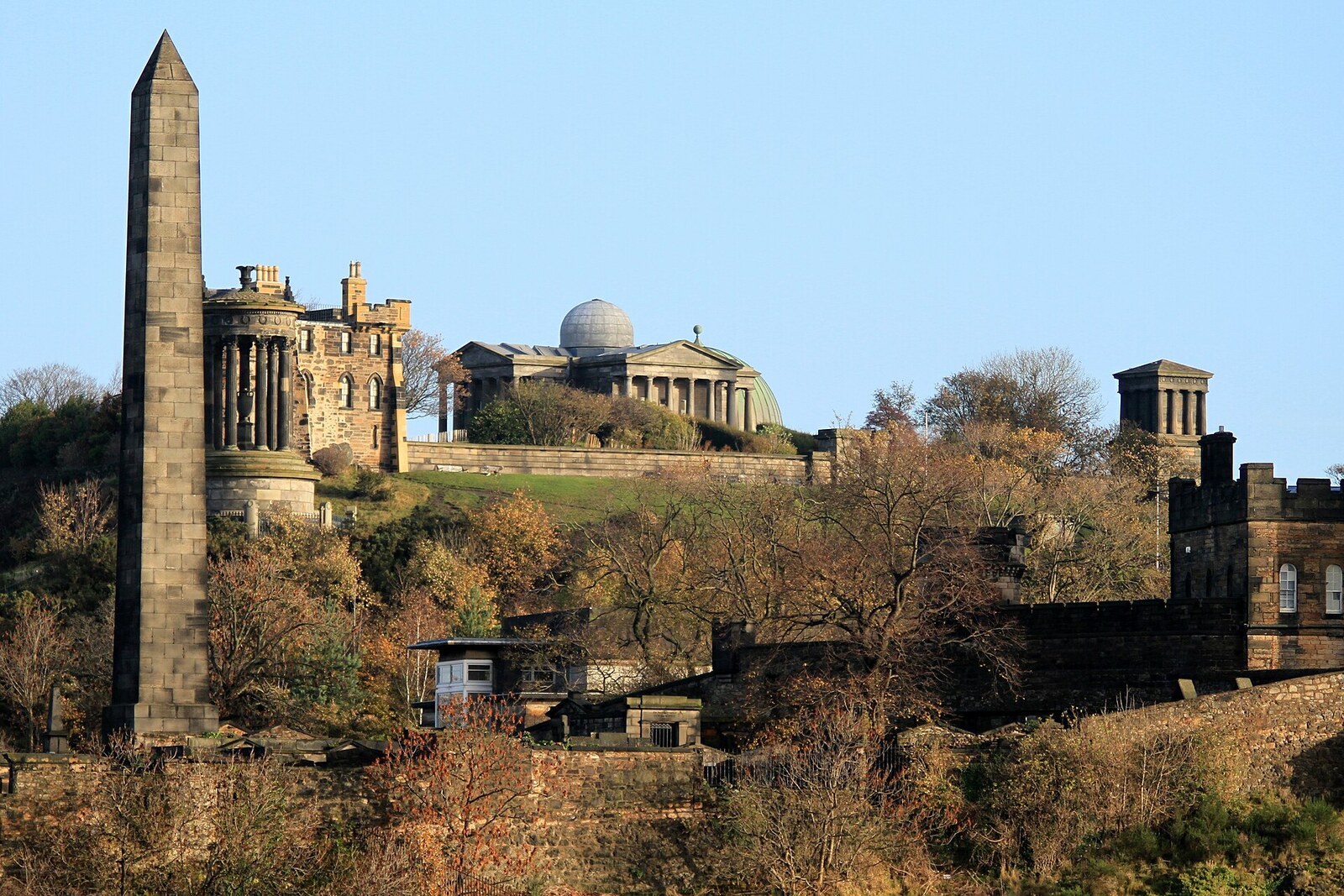
Look around first
What to notice
- Cruciform pavilion
- Meridian slit in the roof
- Transit telescope
- Sunken gallery on the northern slope
The story of the place
On the northern slope of Calton Hill, the exhibition gallery is almost hidden underground, while above it stands the cruciform stone pavilion of the former City Observatory. City light and smoke eventually made observations on the hill too difficult, and astronomers moved elsewhere. Later partitions were removed, the roof was restored, and a new art space was built into the slope below the old halls. Exhibitions now take place here and studios are in use, while the old transit telescope remains in the east wing.
The roof of the cruciform pavilion is cut by a straight line running north to south. This is the meridian slit. Wooden shutters were opened so that the transit telescope could catch the moment when a star crossed the Edinburgh meridian. The telescope moved in only one vertical plane, and astronomers derived the exact time from the observations. The high, open hill suited this work; the proximity of the port of Leith also made it practically necessary for sailors. A large telescope installed here in eighteen thirty-one survives in the east wing.
Three years later, it was placed under the direction of Thomas Henderson—the first Astronomer Royal for Scotland, meaning the state head of the observatory and a professor at the University of Edinburgh. Before this, Henderson had earned his living in legal service for eighteen years. He did astronomical calculations in his spare time and accepted no payment for them. The post on Calton Hill, with a salary of three hundred pounds a year, allowed him for the first time to live by his true profession.
Henderson returned to Scotland from the observatory at the Cape of Good Hope: his health could not withstand the local climate and the demanding work. He brought back piles of observations of Alpha Centauri. This star cannot be seen from Edinburgh, but it was here that Henderson began to process the measurements made in the south.
He was interested in the barely noticeable shift of a star against the distant background when Earth is on opposite sides of its orbit. Such an angle—parallax—makes it possible to calculate distance. Before Henderson, no one had yet obtained a reliable distance to a star beyond the Solar System.
The calculations showed a shift of about one arcsecond. However, Henderson knew that the instrument at the Cape of Good Hope produced a small error. Earlier claims of stellar parallax had already proved mistaken, and he decided to wait for confirmation. While he was checking the result, the German astronomer Friedrich Wilhelm Bessel published the distance to another star—sixty-one Cygni.
Henderson presented his work in January eighteen thirty-nine, several months after Bessel. He had made the observations of Alpha Centauri earlier, but priority went to the one who was first to venture to publish the result. Henderson's caution had reason: the original distance had to be corrected. He had detected the shift itself correctly, in a star system now considered the closest to the Sun.
Henderson directed the observatory for another ten years and made more than sixty thousand observations here. He died at the age of forty-five. Alpha Centauri does not appear above Edinburgh; the local traces of his work are a commemorative plaque on the wall and the transit telescope, standing in the same place where it was used under the first Astronomer Royal for Scotland.
By the end of the nineteenth century, city light and smoke were interfering with observations. In eighteen ninety-six, the Astronomers Royal for Scotland were moved to Blackford Hill, and the municipality named the old complex the City Observatory. Later, the amateur Astronomical Society of Edinburgh worked here, but in two thousand nine it closed the site.
Artists came here next. Collective was founded in nineteen eighty-four by a group of graduates of the Edinburgh College of Art who lacked places for their own exhibitions. In two thousand ten, they staged a project inside the observatory for the first time, then moved to the hill and, together with the city council, raised money to restore the complex.
The restorers removed later partitions, repaired the shutters of the meridian slits, and enclosed them with glass. The new exhibition gallery was sunk one floor below the old observatory and cut into the northern slope. In November two thousand eighteen, a contemporary art center opened here, with exhibitions, studios, and programs for young artists. The transit telescope was left in the east wing, beneath that very line in the roof through which Henderson measured the Edinburgh meridian.
Useful on site
Wednesday through Sunday 10:00–17:00; closed Monday and Tuesday
Checked: July 11, 2026. Check the official source before visiting.You can explore the architecture and panorama without entering. Visit the exhibition spaces and preserved interiors only within the art center's current access arrangements.