 Guide On Map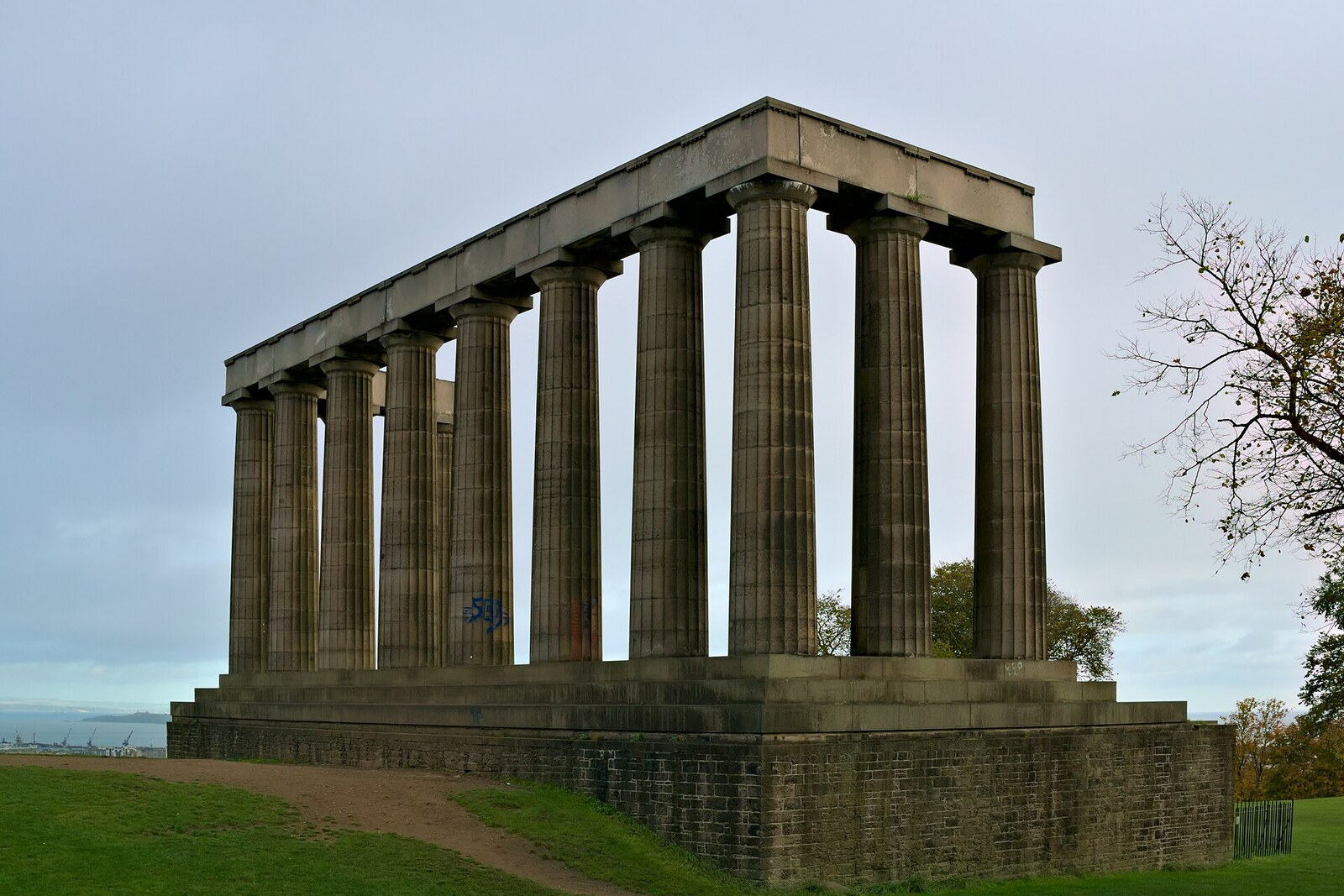
Look around first
What to notice
- Twelve fluted columns
- Stone beams
- Massive foundation
- Empty space behind the portico
The story of the place
There is no visible inscription bearing names on the twelve Doric columns. This is the National Monument of Scotland—a memorial to Scottish soldiers and sailors who died in the Napoleonic Wars. They served in the British army and navy, fought in France, Spain, Portugal, the Netherlands, and at sea. Their remains are not here: the organizers intended to commemorate the dead with a single structure.
The first to pursue this was Michael Linning, an Edinburgh lawyer. In eighteen sixteen, soon after Napoleon’s defeat at the Battle of Waterloo, he proposed creating a separate Scottish memorial. A common British monument was already being discussed in London, but Linning wanted Scots not to have to travel to the capital of England to remember their dead. He became secretary of the association that collected donations and devoted the next two decades to the project.
Thomas Bruce, 7th Earl of Elgin, determined the monument’s form. He had previously served as British ambassador to the Ottoman Empire and removed sculptures from the Parthenon in Athens. Their transportation nearly bankrupted Elgin, and contemporaries accused him of damaging the ancient temple. Now the earl sought to build an exact copy of the Parthenon in Edinburgh: his name would once again be linked to Athens, this time through a newly built temple in its entirety. The subscribers supported this project.
The organizers chose Calton Hill because, from the summit, the copy of the Parthenon was meant to be seen from the city like the Acropolis in Athens. Edinburgh was then called the Athens of the North for its scholars, philosophers, and Greek architecture. At the same time, the military memorial secured Scotland’s own place within the United Kingdom.
In August eighteen twenty-two, the Duke of Hamilton led a procession of Masonic lodges and royal representatives here and laid a six-ton stone. The ceremony was timed to coincide with the visit of King George IV, although the king himself did not climb the hill. The project was estimated at about forty-two thousand pounds. In the first sixteen months, subscribers gave only sixteen thousand, and an attempt to obtain a large sum from the treasury became bogged down in the House of Commons: members of parliament recalled the famine in Ireland and hardship in England, after which the petition was withdrawn.
Despite the missing money, the association’s leaders hired a contractor. Stonework began in eighteen twenty-six. Three years later, the funds ran out, and the directors stopped construction. Linning continued to seek money. In eighteen thirty-five, he asked the Duke of Buccleuch to pass new petitions to the king and Parliament, and separately reminded him of his own contributions. He received no help. Linning died in eighteen thirty-eight, leaving on the hill the part of the plan that he had managed to pay for with the other subscribers.
The foundation, twelve fluted columns, and the stone beams resting on them survive. They form the façade portico of the intended Parthenon. Behind it, neither an inner hall, nor a roof, nor the planned catacombs ever appeared.
Useful on site
Around the clock, unguarded
Checked: June 17, 2026. Check the official source before visiting.Do not climb the masonry for a photograph: the scale and incompleteness of the structure are best seen from a short distance.