 Guide On Map
From Qutb Minar to Mehrauli: power, building projects, and remaking
From Qutb Complex through the archaeological park to old Mehrauli
Guide On Map on your phone
Open the walk like a regular app
It takes about 10 seconds to install. No app store needed.
The whole path
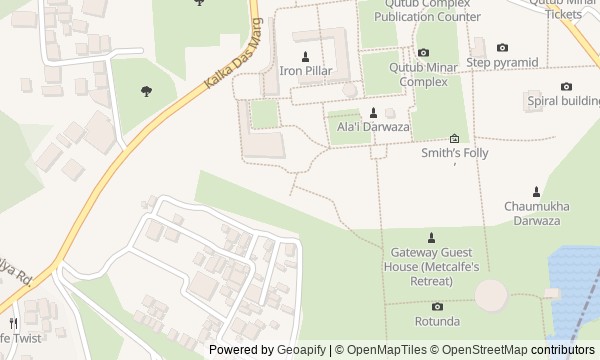
Route map
About the walk
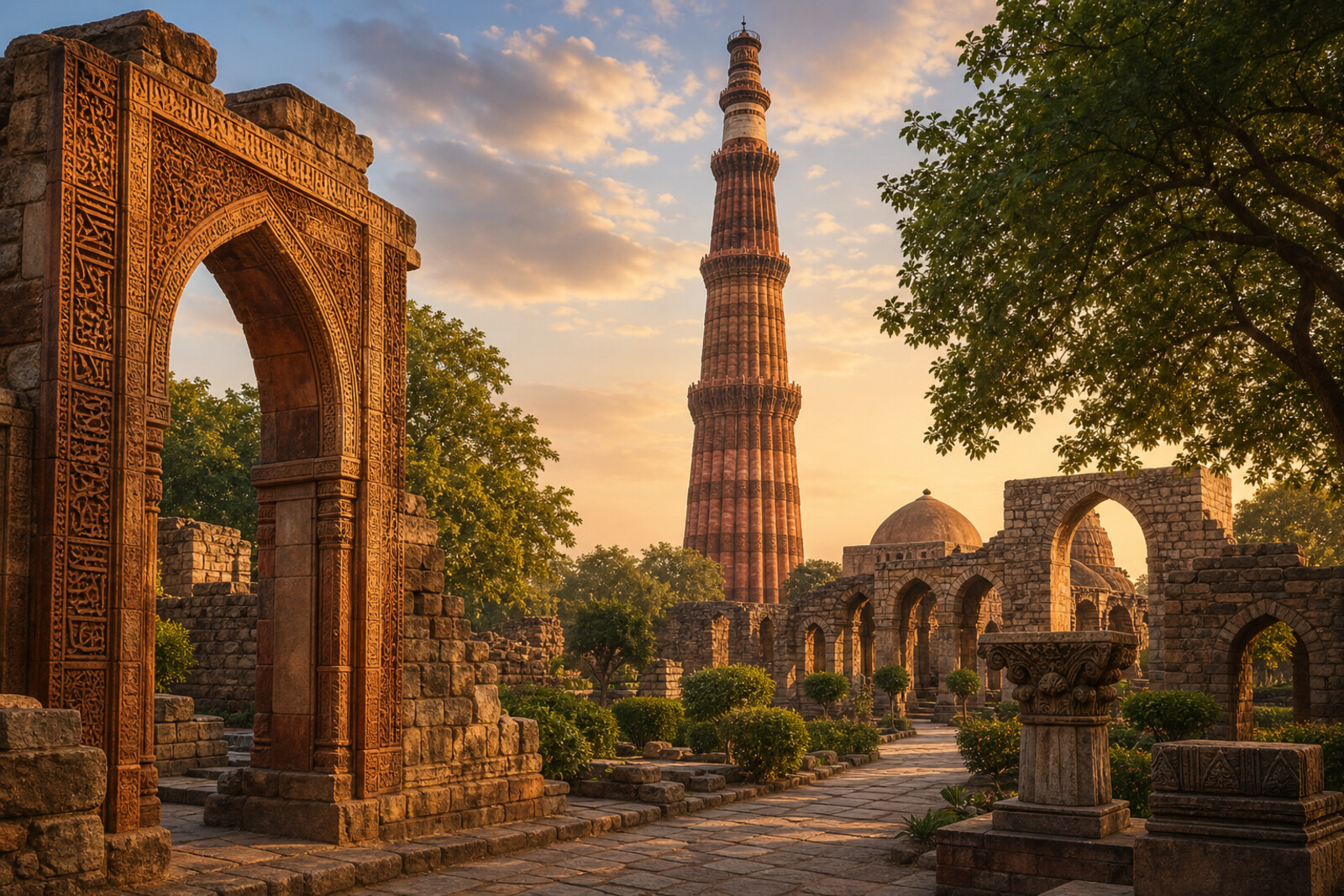
You will begin at Qutb Minar and step into the courtyard of the first congregational mosque of sultanic Delhi. Here, an ancient Iron Pillar, temple stones, a ceremonial gateway, and a tower left without its facing will stand close together. Then the route leads out of the famous complex and into Mehrauli Archaeological Park. Among the trees, you will find a Sufi sanctuary, a tomb turned into a country house, and a stepwell once inhabited by stonecutters. The ending waits by the old settlement, beneath a heavy dome set into the wall of Lal Kot.
The story will examine inscriptions, rebuildings, and disputed theories without museum-like solemnity. You will learn why an ancient royal emblem was placed before an arch, why only a gateway remained of an enormous plan, and where the tombstone from a ceremonial hall disappeared. By the end, you will be able to read Mehrauli as a draft of Delhi's power: through borrowed columns, abandoned building projects, and structures whose purpose changed more than once.
Why this order
Qutb Minar poses the route's central question: how a monument of one conquest changed along with its owners. Just beyond the tower, the mosque and the Iron Pillar reveal the same transition in the courtyard itself: the new power used not only the site of the former citadel, but also its stones and an ancient royal emblem. Alai Darwaza continues that story as the only completed part of a new courtyard; Alai Minar follows, where the same plan stopped before its facing was ever added. After these 2 unfinished structures, the Tomb of Iltutmish brings the route back to the man who managed to finish his tower and hold the sultanate together, but could not secure a peaceful succession.
Entering the archaeological park shifts the story from the first sultans to the ways Mehrauli lived through new dynasties and new inhabitants. Jamali Kamali links the courts of the Lodi dynasty and the Mughals; farther on, Quli Khan's Tomb (Dilkusha) shows how a Mughal mausoleum was adapted to British domestic life. From the house, the route descends to Rajon Ki Baoli, where an abandoned structure was occupied by people without grand titles. The final walk to Adham Khan's Tomb again joins dwelling and mausoleum, but ends with the question of what place a ruler assigned to a man he had punished himself.
Those who want to understand the early Delhi Sultanate through buildings and human decisions Those interested in inscriptions, reused stone, and traces of rebuilding Those ready to continue beyond the famous complex into the archaeological park
Those looking only for a short visit to Qutb Minar Those who prefer separate sights without a connected historical story Those worn out by ruins, unfinished structures, and disputed theories
Before you go
Wear shoes with good grip: stone around the baoli and on exposed ruins can be slippery after rain, and the paths in the park are uneven. Bring water and sun protection—there are few predictable places to rest between Mehrauli's monuments. You cannot climb inside Qutb Minar; access to individual mausoleums and closed interiors can also change, so expect to view some details from the entrance or only from outside. Qutb Complex and the archaeological park are in different areas, and the walk between them requires attention to city traffic. Check the current visiting rules on official resources before you leave.
When to go
Set aside about three hours. The first five stops are easy to see at an unhurried pace within one complex, but leave enough daylight for the second half: among Mehrauli's greenery, finding monuments and navigating uneven ground usually takes longer.
Backup plan
If an individual tomb is closed, do not try to enter: at Jamali Kamali, focus on the mosque facade and the overall layout of the courtyard; at Quli Khan's Tomb (Dilkusha), look at the mausoleum's form and traces of the altered garden. After heavy rain, do not descend the wet steps of Rajon Ki Baoli; its arcades and depth can be appreciated from above. If heat or fatigue makes the full park walk impractical, end the route after the baoli or go straight to Adham Khan's Tomb for the route's final story.
Route conditions
Surface. Unpaved — 537 m; paved — 415 m (data covers 38% of the route)
Access. Wheelchair — limited; stroller — limited
Facilities. Toilets — 2; drinking water — 1
Elevation. Ascent — 25 m; descent — 13 m
OpenStreetMap extract of July 9, 2026: database data, not a check on the ground. Data © OpenStreetMap contributors, ODbL licence
Walk plan
Open in maps ↗- 1
Qutb Minar
The tower will show how a symbol of Ghurid victory became a monument to the independent Delhi Sultanate. - 2
Quwwat-ul-Islam Mosque and the Iron Pillar
The courtyard reveals how the new mosque brought together temple stone, the work of local craftsmen, and an ancient royal emblem. - 3
Alai Darwaza
The only completed gate marks the boundary of a courtyard that was never fully built. - 4
Alai Minar
The unfinished core preserves the precise moment when the attempt to surpass Qutb Minar came to a halt. - 5
Tomb of Iltutmish
This stop connects the sultan's burial with his children's struggle for the right to have their name spoken in the Friday prayer. - 6
Jamali Kamali
The complex tells of a poet who outlived changing courts but returned here only after his death. - 7
Quli Khan's Tomb (Dilkusha)
The empty central hall will show how the tomb was turned into a country residence and then cleared again. - 8
Rajon Ki Baoli
The steps and living quarters explain why this abandoned water complex received the name of anonymous masons. - 9
Adham Khan's Tomb
The final stop shows how a large funerary building could simultaneously express mercy and separation from honored burial grounds.
Route features
Everything you need stays in the browser
Progress, saves and your trip plan are stored on this device.
Add Guide On Map to your home screen so the walk opens outside the browser.
How we handle sources, maps and corrections: our editorial standards