 Guide On Map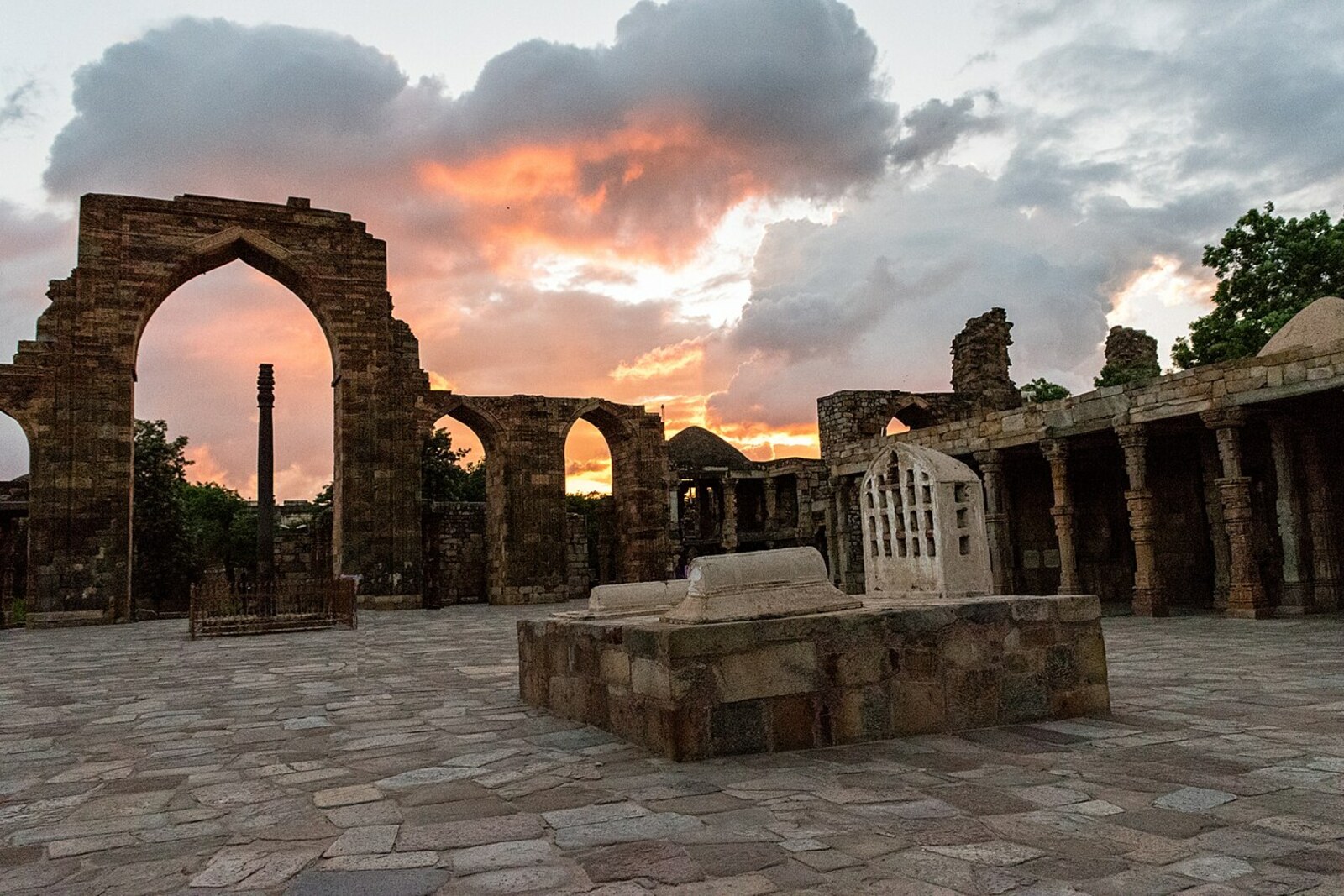
Look around first
What to notice
- The Iron Pillar
- The central arch of the prayer screen
- Temple columns with lotuses and bells
- Chiselled-away human figures
The story of the place
The Iron Pillar stands on the courtyard's main axis, before the central arch of the prayer hall. This position was chosen deliberately: the pillar supports nothing. When it was installed here, it had already served for many centuries as an emblem of royal authority.
The courtyard itself appeared at the end of the twelfth century. Qutb al-Din Aibak, the commander of Muhammad of Ghor and ruler of conquered Delhi, had to arrange a communal Friday prayer for the garrison and Muslim settlers. During it, the imam delivered the khutba—a sermon naming the sovereign. In a city occupied by a foreign army, that name had a very practical meaning: it told those assembled whom the judges, military commanders, and tax collectors now obeyed.
Aibak therefore assigned the mosque a site inside the former Rajput citadel. An inscription on the eastern gate claims that twenty-seven Hindu and Jain temples were dismantled for its construction. Scholars dispute whether this inscription was carved at the same time as the mosque, but the stone's origin is visible even without it. The galleries contain temple columns with lotuses, bells, vegetal ornament, and remains of human figures; many images were chiselled away. Communities lost their shrines, while Aibak's men gained Delhi's first Friday mosque.
The stones did not assemble themselves into a finished mosque. Local craftsmen set short temple columns in two and three tiers to raise the roof to the required height. They built the arches in their usual way: each successive course of stone projected slightly beyond the one below it, until the courses met at the top. In a true arch, wedge-shaped blocks support one another around a central keystone; here, there is none.
In eleven ninety-eight, Aibak commissioned an enormous screen with five pointed openings in front of the prayer hall. Its outlines recalled the congregational mosques of Iran and Afghanistan, while it was carved by the same Indian stonecutters. They covered its surface with Arabic calligraphy interwoven with stems and flowers. Aibak achieved the recognizable appearance of a Friday mosque, but the method by which the craftsmen formed its arches remained local. It is this screen that survives before the pillar.
The pillar itself originally had nothing to do with Islam. A Sanskrit inscription praises the victories of King Chandra and states that he dedicated this iron pillar to Vishnu on Vishnupada Hill. Chandra is often identified with the Gupta emperor Chandragupta the Second, who lived in the fourth to early fifth century, but the metal bears no full name. At the top, there was probably a figure of Garuda, Vishnu's bird; it has been lost.
Who first transported the multi-ton pillar to Delhi is unknown. A later inscription links it with the Rajput king Anangpal, but its reading and date are disputed. A Persian chronicle from the middle of the fourteenth century, however, attributes the installation of the pillar in its present location to Iltutmish. A former military slave who attained the throne, he placed the ancient royal emblem before the central arch while expanding Aibak's mosque. He repeated an Indian rulers' custom: an old pillar was moved and set up again to attach the memory of former kings to the name of a new one. Later, other Delhi sultans followed this example, transporting ancient stone pillars to their capitals.
The pillar's iron really does rust, only extremely slowly. Ancient smiths welded it from many heated pieces, and its elevated phosphorus content helped form a thin protective layer. It preserved on the surface both Chandra's inscription and traces of later owners.
Medieval inscriptions at the mosque do not use the name “Quwwat-ul-Islam,” meaning “Might of Islam”: in them, it is called simply a mosque or a building. Most likely, the later name arose from the expression “Qubbat-ul-Islam”—“refuge of Islam” or “center of Islam”—used for Delhi in the thirteenth century. In eighteen forty-seven, the Delhi scholar and educator Sayyid Ahmad Khan included the variant “Quwwat-ul-Islam” in his authoritative compendium of the city's antiquities; archaeologists and guidebooks adopted it from there. This name does not appear on medieval stones. Before the central arch, another name remains—Chandra, carved into iron long before the mosque appeared.
Useful on site
Like the Qutb Minar complex: ASI lists hours from sunrise to 20:00; check the current e-ticket.
Checked: June 28, 2026. Check the official source before visiting.Examine the supports one at a time and from different sides: important differences are lost if you take the colonnade in as a single backdrop.