 Guide On Map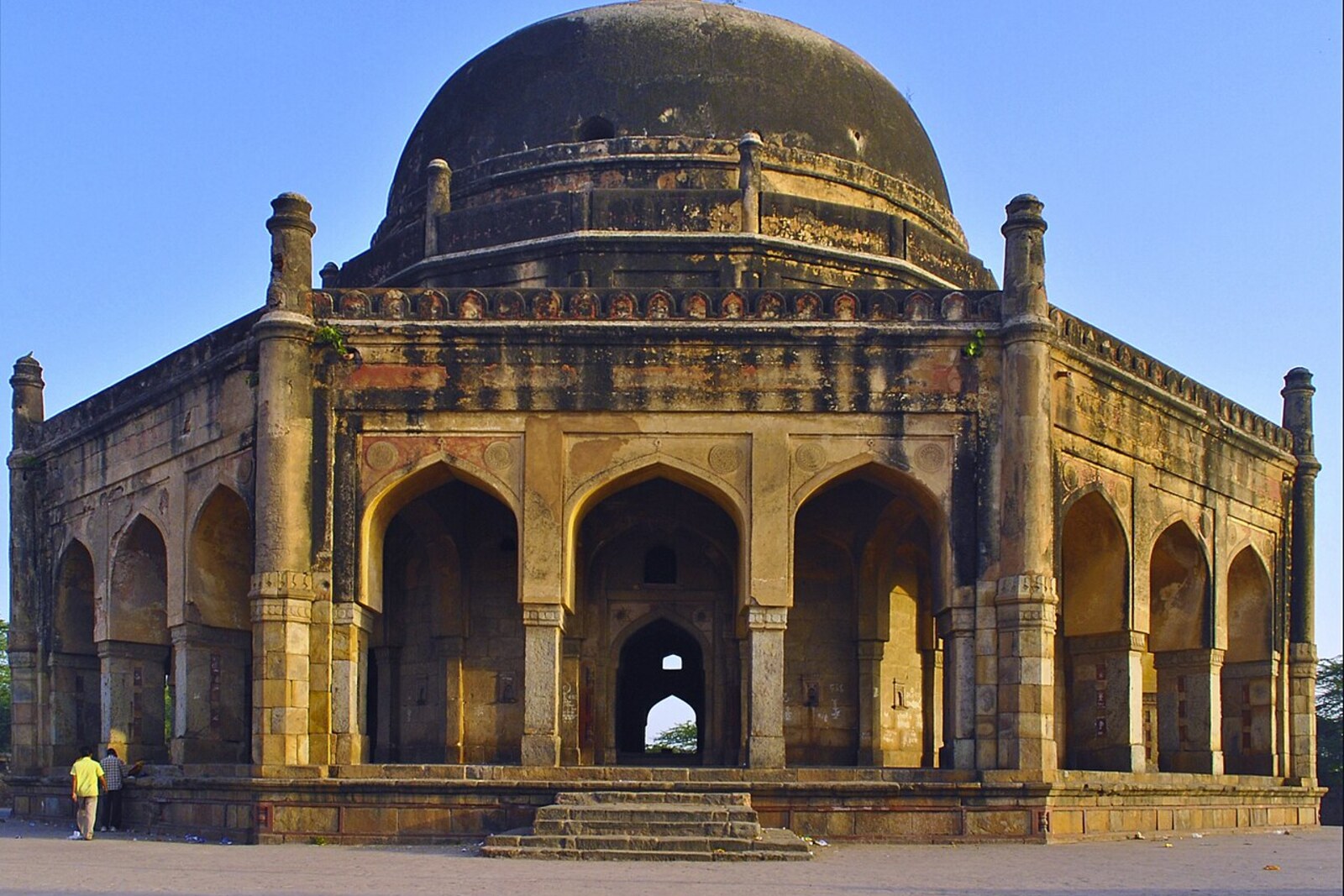
Look around first
What to notice
- High dome
- One stone tombstone
- Massive octagonal walls
- Intersecting narrow passages
The story of the place
Beneath the high dome stands a single stone tombstone. It marks the burial of Adham Khan, a military commander and milk brother of the young emperor Akbar. Narrow passages intersect within the thick octagonal walls, so locals call the tomb Bhool Bhulaiya—the labyrinth. But its construction is explained by a different arrangement of the place: Akbar buried Adham Khan away from Delhi's most honored graves.
Adham Khan's mother was Maham Anga, one of the women who raised Akbar and then sought to retain influence at his court. Her son received a high military rank, commanded the campaign in Malwa, and depended on imperial appointments. After Akbar removed him from governing the conquered province, Adham Khan's position became precarious.
Meanwhile, Akbar appointed Shams al-Din Muhammad Ataga Khan as his chief minister, an old servant of the family whom he entrusted with managing state affairs. Ataga Khan's rise pushed Maham Anga's people away from the principal appointments. For Adham Khan, this meant a further loss of income, military standing, and access to the emperor.
On May sixteenth, fifteen sixty-two, Adham Khan and his accomplices entered the hall where Ataga Khan was reviewing matters with courtiers. Adham Khan put his hand on his dagger and ordered his men to act. They wounded the minister, caught up with him in the courtyard, and killed him.
After that, Adham Khan headed for the inner chambers of the palace. Akbar came out to meet him. Adham Khan seized the emperor by the hands, but Akbar struck him down and ordered him bound. Adham Khan was thrown from a palace terrace. He survived the fall; servants carried the badly injured man back up and, on a new order from Akbar, threw him down headfirst. This time, Adham Khan died.
Maham Anga acknowledged that the punishment was just and died forty days later. Akbar himself accompanied her funeral bier for part of the way from Agra. He pardoned several supporters of her circle who had fled after the murder and took the children of both families under his personal protection. Ataga Khan's relatives did not continue the blood feud.
The bodies were sent to Delhi. The court chronicler Abu'l-Fazl wrote that Akbar ordered tombs built to soothe the relatives of the dead. Historian Anthony Welch offers another explanation: the emperor moved the graves from Agra so that they would not become gathering places for two hostile court factions. Ataga Khan was buried beside the revered Sufi sanctuary of Nizamuddin Dargah, next to people celebrated for their service to Akbar. This site on the wall of the old Lal Kot was chosen for Adham Khan and Maham Anga.
The reason for this choice is not stated in the order. Yet the tomb was built about six hundred meters from Quwwat-ul-Islam Mosque and the honored burial place of Shams al-Din Iltutmish, but it was not included in the Mehrauli necropolis. The builders repeated the heavy octagonal form of the Lodi dynasty, already old-fashioned in Akbar's time, left almost no inscriptions, and surrounded the burial chamber with massive passageways. According to one scholarly interpretation, Akbar gave his milk brother a large tomb but assigned him a place between established burial grounds.
Originally, two tombstones lay beneath the dome: those of Adham Khan and Maham Anga. In the nineteenth century, the British official Blake turned the tomb into a residence and removed both stones to make room for a dining room. Later, the building housed a rest house for officials, a police station, and a post office. On the orders of Viceroy Curzon, the rooms were cleared and Adham Khan's tombstone was returned. Maham Anga's tombstone could not be restored: only one name remained beneath the dome.
Useful on site
Delhi Tourism lists 05:00-18:00 daily for Mehrauli Archaeological Park; individual interiors may be closed.
Checked: June 28, 2026. Check the official source before visiting.Do not enter closed stairways and dark galleries: the layout of the “labyrinth” is clearly visible from the thickness of the walls and the accessible passages.