 Guide On Map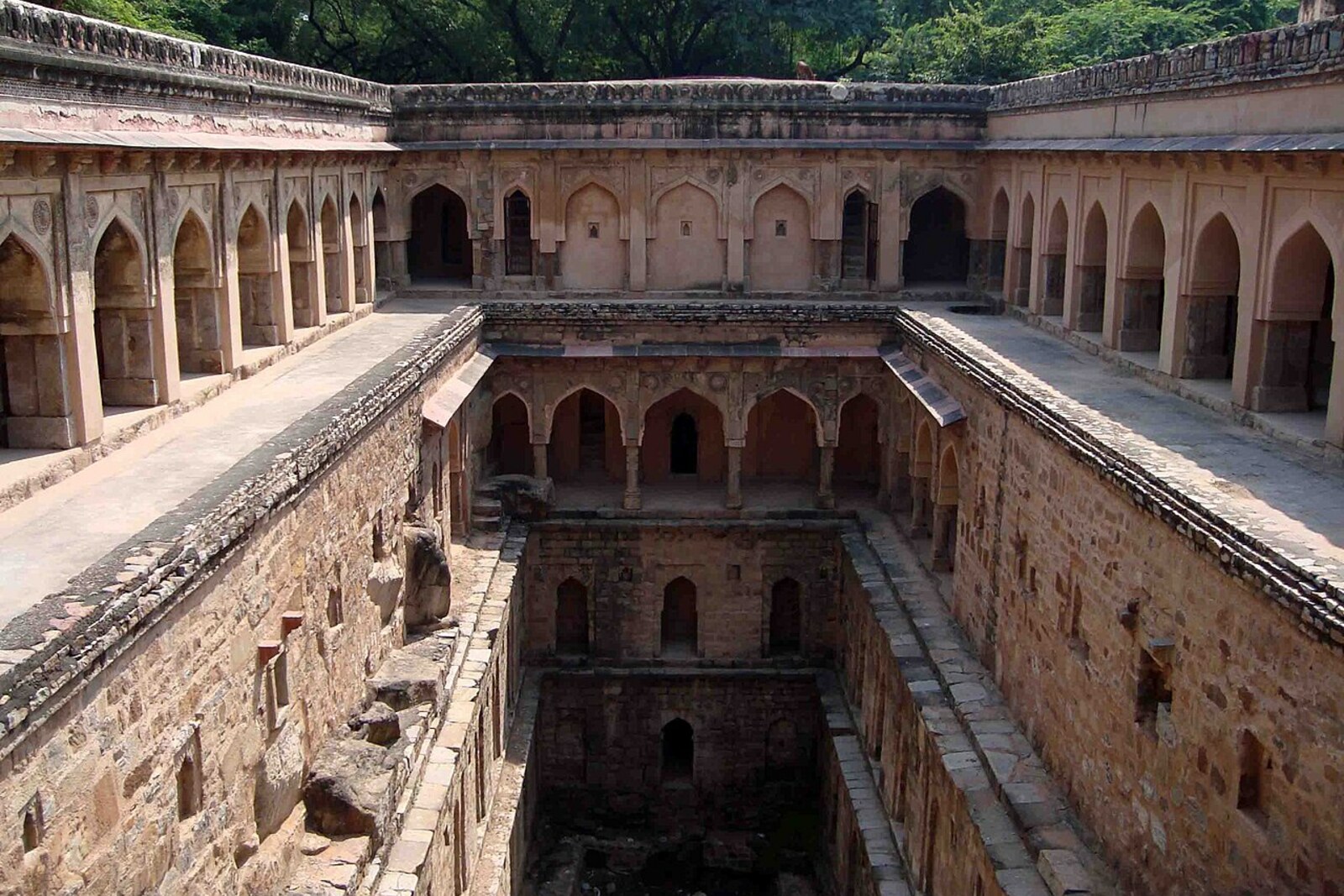
Look around first
What to notice
- Stepped reservoir
- Vertical well
- Covered arched galleries
- Pavilion and mosque
The story of the place
Covered arched galleries run along the stepped reservoir, with a vertical well arranged beside it. Together they collected groundwater: when its level was high, it flowed into the basin; when it was low, people went down the steps to reach it. The ensemble included places for rest, a small mosque, and a pavilion; the identical decoration of these structures allows researchers to link them to a single patron. Now the cleared water from here goes to irrigate the gardens of the archaeological park.
In the late nineteenth or early twentieth century, a group of masons moved in here. They earned their living through masonry; locally, such craftsmen were called raj mistris. At the time, people from nearby and distant villages were moving to Mehrauli, and abandoned old structures offered them ready shelter. The masons occupied the rooms by the baoli and the empty mosque.
They chose this complex because of the water. A baoli is a stepped reservoir connected to an ordinary vertical well. When the groundwater rose, it flowed into the basin; when it fell, people went down the steps to reach it. Covered galleries and small rooms ran along the reservoir. Here, people could live, draw water for drinking and cooking, and then leave to earn a living.
The names of these masons did not enter the sources. Their stay proved brief, and what became of them afterward is unknown. But the residents' profession gave the complex its present name: Rajon Ki Baoli means “the masons' baoli.” There is no connection in this name to rajahs or kings.
The masons themselves arrived here about four centuries after its construction. An inscription on the pavilion says that in fifteen oh six it was built by Khan Daulat, son of Khwaja Muhammad, a courtier of Sultan Sikandar Lodi. Strictly speaking, the inscription dates the pavilion, not the entire well. However, the identical decoration of the baoli, mosque, and tomb allows researchers to link the whole ensemble to a single patron. Daulat's men arranged access to groundwater, sheltered places for rest, and a small mosque—this very layout later allowed the craftsmen to turn the abandoned complex into a home.
By the early twenty-first century, the water had risen almost to the upper steps, but it was polluted; the channels were clogged with silt, trash, and construction debris. During the restoration, landscape architect Mohan Rao sought to restore the water system itself. Restorers diverted wastewater, cleared the well, and left gaps between the old stones through which rain seeps into the ground. In May two thousand twenty-five, the baoli reopened, and water from it began to be used to irrigate the gardens of the archaeological park.
The masons are no longer here. They left behind the word “Rajon,” while the water for which they settled among these arches now goes to the gardens of Mehrauli.
Useful on site
Delhi Tourism lists 05:00-18:00 daily for Mehrauli Archaeological Park; access down into the baoli depends on the condition of the steps and the water.
Checked: June 28, 2026. Check the official source before visiting.Go down only on accessible dry steps, stay away from the water's edge, and do not descend after rain or when there is trash on the stairs.