 Guide On Map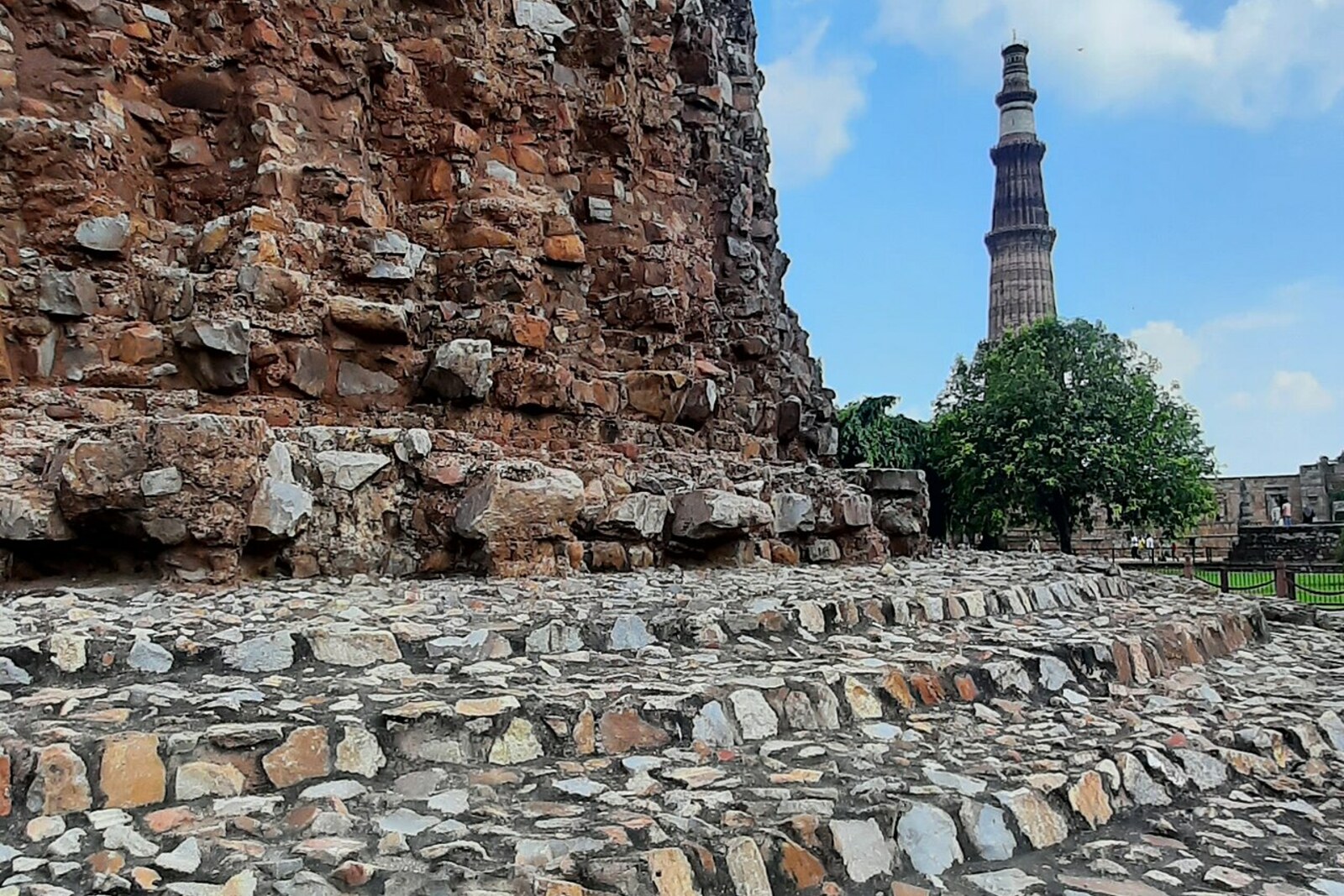
Look around first
What to notice
- The round base
- Rough stone masonry
- The unfinished surface
- Qutb Minar opposite
The story of the place
In the courtyard of the old congregational mosque, opposite Qutb Minar, a second minaret was planned here. Alauddin Khalji enlarged the courtyard and ordered it built in this very spot, although he was raising his own capital, Siri, in another part of Delhi. The base was intended to be twice as wide as the neighboring tower, and the height was meant to reach roughly twice as much. Now a rough circle of stone masonry darkens the grass, while Qutb Minar nearby shows balconies and inscriptions from several rulers.
The round mass of rough stone, about twenty-five meters high, is the core of the first level of a tower that was never faced. Stonemasons were meant to cover this uneven masonry with dressed stone and continue the levels upward. No completed tower was demolished here: the work stopped at exactly this stage.
The tower is called Alai Minar after its patron, Alauddin Khalji, the sultan of Delhi who wanted to surpass Qutb Minar. He chose the old congregational mosque for the new structure, although he was building his own capital, Siri, in another part of Delhi. The famous tower of earlier sultans already stood here. Alauddin expanded the mosque courtyard and ordered a second minaret to be raised opposite it, designed on an entirely different scale.
The court poet Amir Khusrau, who compiled a chronicle of his patron's victories, recorded the plan with little modesty: the old tower was to have a counterpart above which nothing could ever be built. The circumference of its base was to be doubled, and its height increased in the same proportion. Qutb Minar rose more than seventy meters; Alauddin's tower was meant to be about twice as high.
By then, the sultan's commanders had brought tribute and booty to Delhi from campaigns in the south. Alauddin intended to set these victories beside the monument of his predecessors and give the new minaret his own name. The stonemasons managed to raise the enormous base and the core of the first level.
In early thirteen sixteen, the sultan died without seeing even the first faced level. His commander Malik Kafur placed the dead sultan's young son on the throne and began to rule in his name, but was killed a few weeks later. Another of Alauddin's sons, Qutb al-Din Mubarak Shah, then seized the throne. He too was killed in thirteen twenty, and the Khalji dynasty came to an end. None of the heirs returned to the construction.
Qutb Minar beside it acquired facing, balconies, and inscriptions bearing the names of several rulers. Alai Minar stopped short of its finishing work. Alauddin's name remained in its title, and all that remains of the tower he planned is a twenty-five-meter stone core of the first level.
Useful on site
As at the Qutb Minar Complex: ASI lists hours from sunrise to 20:00; check the current e-ticket.
Checked: June 28, 2026. Check the official source before visiting.Do not climb on the masonry. Walk around the base along the accessible perimeter and compare its width with the silhouette of Qutb Minar.