 Guide On Map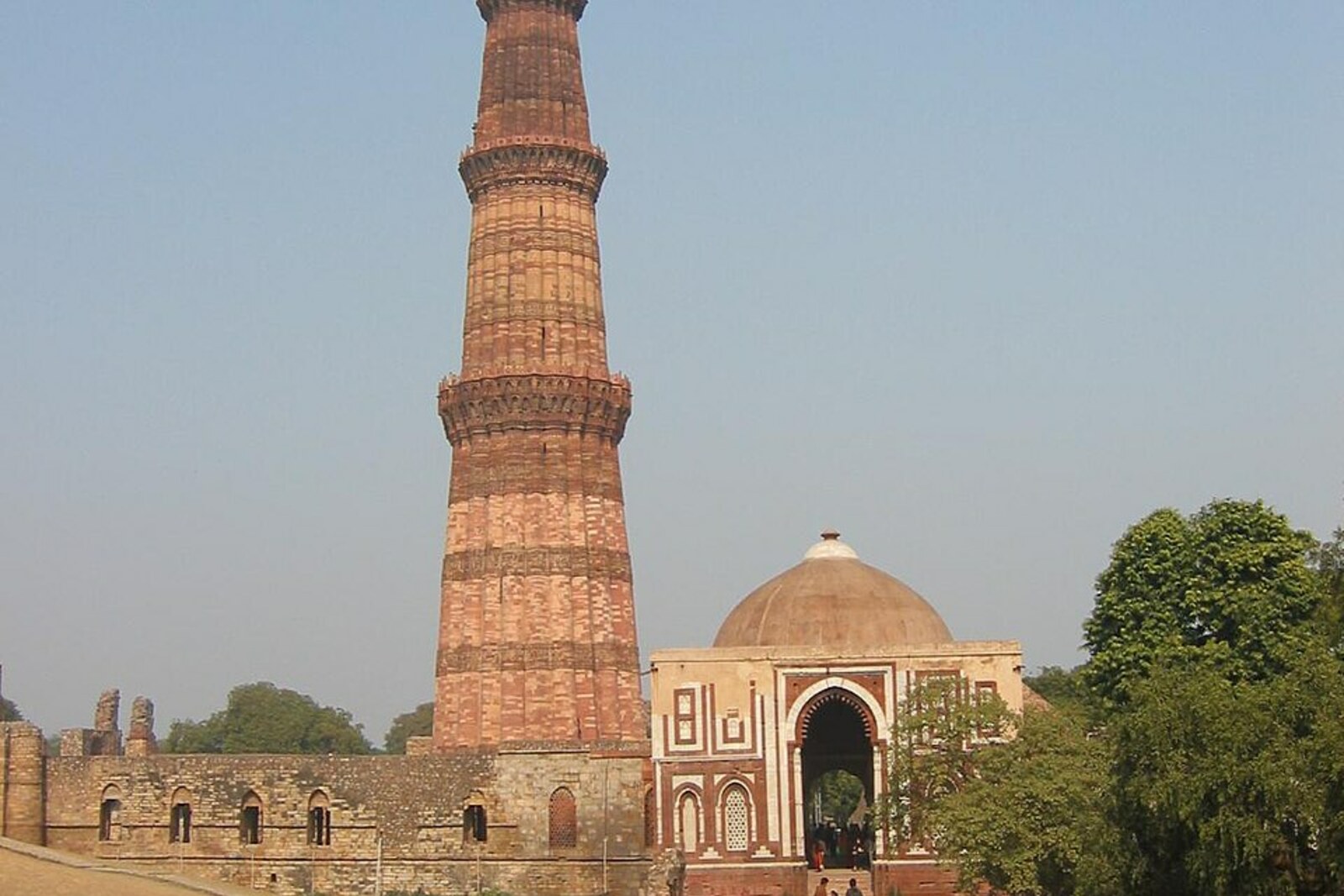
Look around first
What to notice
- The lower level up to the first gallery
- Stone bands with inscriptions
- The pale upper levels
- Projecting balconies
The story of the place
The titles carved on the lower level of Qutb Minar belong not to its builder, but to his master. When Qutb al-Din Aibak began this tower, he was still serving the Ghurid sultan Muhammad of Ghor. Aibak was a purchased soldier: as a boy, he was sold in Nishapur, trained in riding and the use of weapons, then sold again—to Muhammad of Ghor. He lived by military service and depended on his master's trust. On campaign, Aibak rose from a man whose fate was decided by others to a commander who directed armies.
In eleven ninety-two, Muhammad of Ghor defeated the Rajput king Prithviraj Chauhan. Aibak occupied Delhi and established the principal Friday mosque of the new Muslim community here. Around eleven ninety-nine, he ordered a minaret added to its southeastern corner. From its balconies, a muezzin was to call the faithful to prayer. A height of seventy-two meters was excessive for a human voice alone. Aibak was reproducing Ghurid towers familiar from Afghanistan and expected that a sign of his sultan's victory would be visible from afar above the former Chauhan fortress. That is why the stone bands of the first level glorify Muhammad of Ghor. Aibak himself is identified there as commander of the army.
In twelve oh six, Muhammad of Ghor was killed. His military commanders began dividing the Indian possessions, and Aibak proclaimed himself ruler. The completion of the tower could now acquire another meaning: the former slave was building for his own dynasty. But four years later, he fell from a horse during a polo game and died in Lahore. Above Delhi, only a single completed level remained, ending in the first projecting gallery.
Shams al-Din Iltutmish continued the work—another man brought to India as a slave. Aibak himself bought him, then brought him close, married him to his daughter, and appointed him to govern Badaun. Their kinship did not make Iltutmish an undisputed heir. After Aibak's death, the nobles of Lahore placed Aram Shah on the throne, while the nobles of Delhi summoned Iltutmish. In twelve eleven, the two claimants met near the city. Iltutmish won; Aram Shah was killed.
Even after this, many of Aibak's former companions did not recognize the new sultan. Iltutmish needed years to defeat his rivals and hold Delhi. At the same time, he raised several more levels above the level of his former master. In his inscriptions, the tower now glorified Iltutmish himself as an independent sovereign. Around twelve twenty-nine, construction was completed; at the same time, the Abbasid caliph sent Iltutmish a document recognizing him as sultan. The monument to Ghurid conquest that had been begun was completed by a man who defended a separate Delhi Sultanate.
There is no unambiguous answer as to whom the tower's present name honors. Most often, it is linked to Qutb al-Din Aibak. An old local tradition named another Qutb: Qutb al-Din Bakhtiyar Kaki, Iltutmish's Sufi mentor, who lived in Mehrauli. His followers called the minaret the staff of the saint Qutb. This association took hold after construction, so historians cannot confidently choose between the soldier and the Sufi.
The first level up to the lower gallery belongs to Aibak's design. Above it survive the levels raised by Iltutmish; later sultans added the two pale upper levels after a lightning strike. On the lower stone bands remain the names of Aibak's master, and above them are the titles of Aibak's former slave, who completed the tower and buried his former master in Lahore.
Useful on site
ASI lists the Qutb Minar Complex hours as from sunrise to 20:00; check the official e-ticket before your visit.
Checked: June 28, 2026. Check the official source before visiting.There is no access inside. To see the silhouette in full and make out the upper levels, step away from the base and do not stand right beside the tower.