 Guide On Map
Córdoba of Caliphs and Monarchs: From the Bridge to the Alcázar
From Calahorra Tower through the Roman Bridge and Judería to the Alcázar of the Christian Monarchs and Albolafia
Guide On Map on your phone
Open the walk like a regular app
It takes about 10 seconds to install. No app store needed.
The whole path
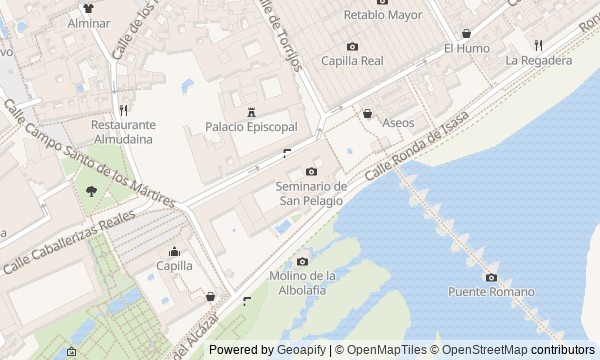
Route map
About the walk
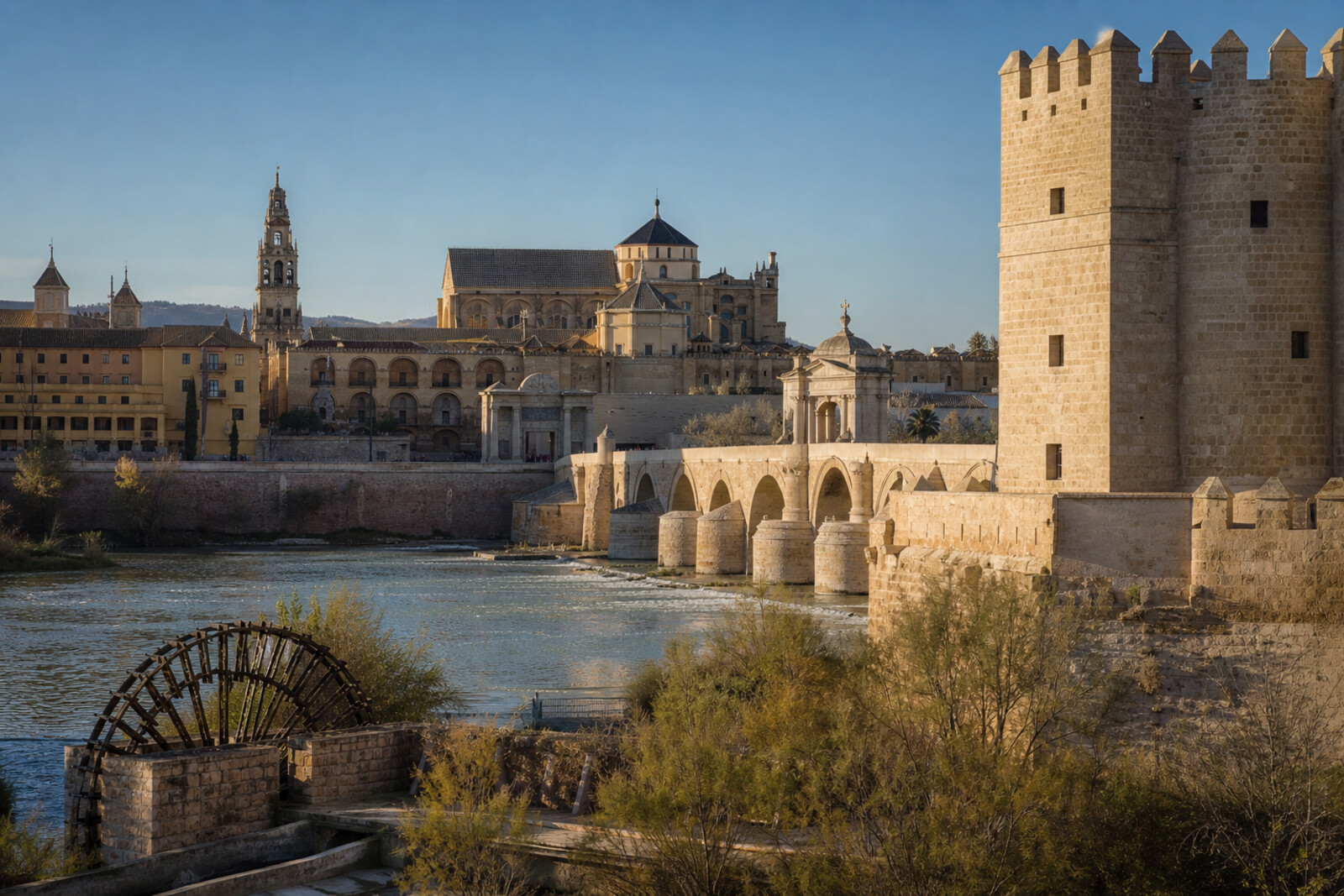
The route begins at Calahorra Tower, on the south bank of the Guadalquivir. You will cross the Roman Bridge, enter the old city through Puerta del Puente, then circle the Mosque-Cathedral of Córdoba and head into the narrow streets of Judería. After the synagogue, the route reaches the Alcázar of the Christian Monarchs and descends again to the river, to Albolafia.
This is a walk through a Córdoba governed again and again from a fortress, a palace, or a cathedral chapter. But those decisions appear in small things: a sealed-up arch, a ruler's oath, polished bronze shoes, a neighborhood gate kept shut, and a wooden wheel whose noise became unbearable.
The story follows documents and visible traces. A legend remains a legend, and a later copy remains a copy. By the end, you will be able to read Córdoba's riverbank as a chain of decisions: who was granted passage, a home, water, and the right to remain.
Why this order
Calahorra Tower poses the starting question: whoever holds the southern entrance controls the crossing. The next stop is therefore the Roman Bridge itself, where control becomes a matter of public spending and connection to the city. At the northern end, Puerta del Puente shows the other side of the same crossing: the bridge did not only admit people, it also funneled retreating rebels into a narrow passage. Beyond the gate rises the Mosque-Cathedral of Córdoba, and the dispute over the city's entrance becomes a dispute over the interior of its main house of worship. From there, the route moves into Judería: Plaza de Tiberíades reveals a personal response to coercion, while the nearby Córdoba Synagogue shows a collective effort to preserve homes and a prayer hall. After the tight-knit neighborhood, the Alcázar of the Christian Monarchs shifts the conversation to royal decisions about war. The final descent to Albolafia brings the theme to an everyday consequence: an order from the Alcázar changed the water supply to its own gardens.
Those who want to understand Córdoba through decisions and their consequences Those who value documents and the distinction between fact and legend Those ready to connect the bridge, the house of worship, Judería, and the Alcázar of the Christian Monarchs in one story
Those looking only for an overview of architectural styles Those who want an easy walk without stories of expulsion, coercion, and war Those who do not enjoy detailed historical storytelling
Before you go
Check in advance whether you can visit the museum at Calahorra Tower, the Mosque-Cathedral of Córdoba, Córdoba Synagogue, and the Alcázar of the Christian Monarchs separately. The outdoor route does not depend on this, but the interiors noticeably change the experience. Speak quietly in the Mosque-Cathedral and the synagogue, do not touch carved decoration, and keep the passage clear. Comfortable shoes will help on the bridge, old streets, and riverbank. Do not try to turn every stop into a full museum visit: the route works best when you keep moving from one form of control to the next.
When to go
It is best to start in the morning, before the bridge and the area around the Mosque-Cathedral become too crowded. Allow the largest amount of time for the Mosque-Cathedral itself; Maimonides Square and the exterior stop at the synagogue need less. If you plan to explore the museum at Calahorra Tower or the rooms of the Alcázar of the Christian Monarchs in depth, separate them from the main walk or allow extra time. The finish by the river is especially striking when you can look back at the bridge and palace walls without rushing.
Backup plan
If some interiors are unavailable, keep the original order. View Calahorra Tower from the riverbank, compare the shapes of the bridge arches, walk through the broad opening of the gate, and take in the Mosque-Cathedral through its exterior mass and wall line. At Maimonides Square, stop by the monument; at the synagogue, stand before the small entrance; at the Alcázar of the Christian Monarchs, face the towers and fortress outline. Then descend to Albolafia: the wheel, river, bridge, and palace walls still bring the story together. This version loses the close view of columns and ornament, but preserves the route's central drama.
Route conditions
Surface. Paved — 2.3 km; unpaved — 293 m (data covers 94% of the route)
Stairs. Flights: 6, 31 m in total
Access. Wheelchair — no; stroller — limited (stairs)
Facilities. Toilets — 9; drinking water — 15
Elevation. Ascent — 41 m; descent — 18 m
OpenStreetMap extract of July 2, 2026: database data, not a check on the ground. Data © OpenStreetMap contributors, ODbL licence
Walk plan
Open in maps ↗- 1
Calahorra Tower
Here it will become clear why the struggle for the crossing led to the city gate being turned into a separate castle. - 2
Roman Bridge
The ancient crossing becomes a story about the cost of connecting a city and distrust of its ruler. - 3
Puerta del Puente
This stop will show how a narrow crossing changed the course of an urban revolt. - 4
Mosque-Cathedral of Córdoba
Here, the dispute between the city and the church remains legible in the masonry itself. - 5
Plaza de Tiberíades
The monument helps connect the exile from Córdoba with a scholar’s response to forced conversion. - 6
Córdoba Synagogue
Here, the preserved prayer hall becomes evidence of the community's struggle for homes and the right to remain. - 7
Alcázar of the Christian Monarchs
The fortress will show why a prisoner could be given back his freedom precisely in order to continue the struggle. - 8
Albolafia and the Guadalquivir Bank
The finale will link the royal order to the water that was no longer enough for the neighboring gardens.
Route features
Everything you need stays in the browser
Progress, saves and your trip plan are stored on this device.
Add Guide On Map to your home screen so the walk opens outside the browser.
How we handle sources, maps and corrections: our editorial standards