 Guide On Map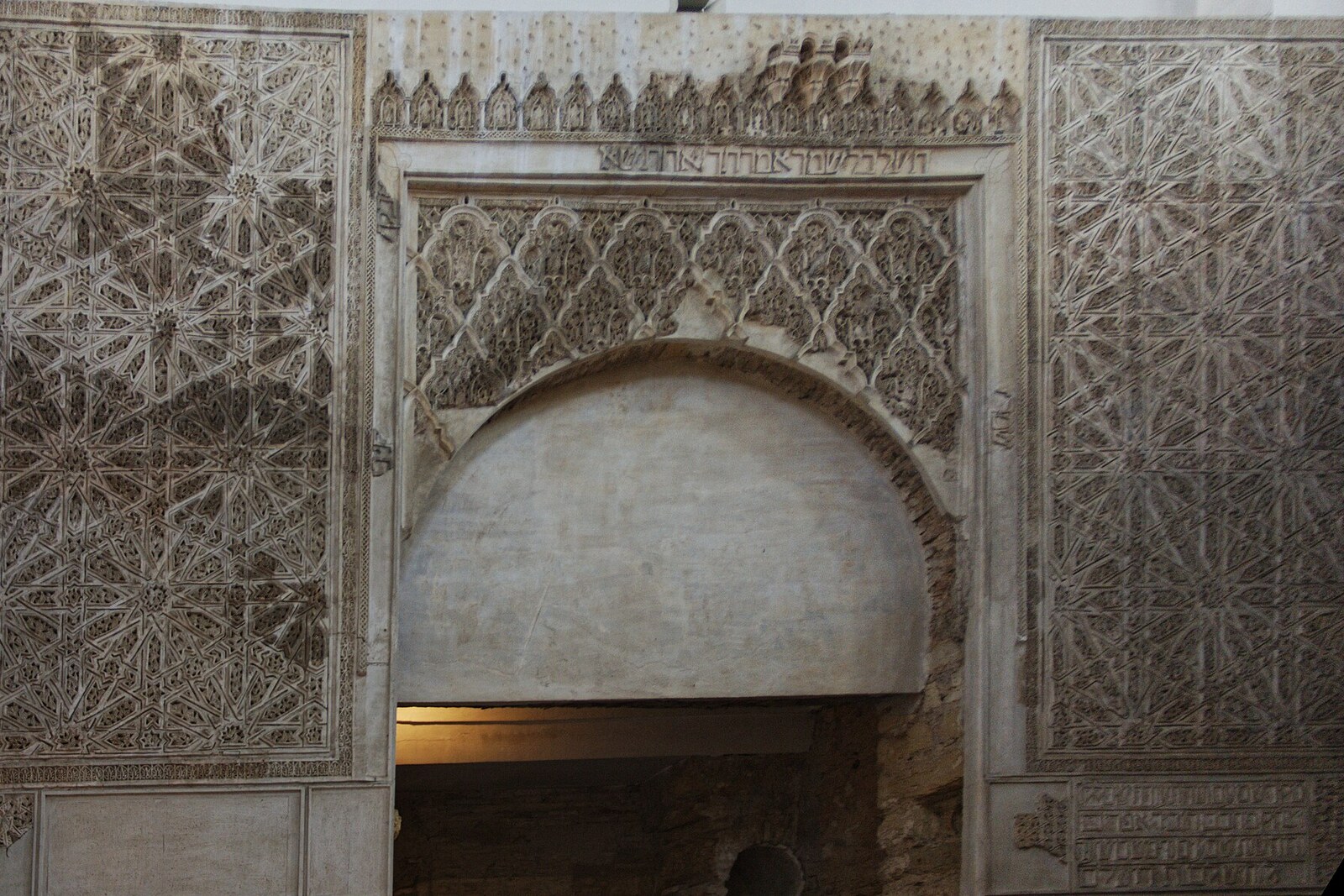
Look around first
What to notice
- The eastern wall with its inscription
- The niche for Torah scrolls
- Three openings of the women's gallery
The story of the place
The three openings above preserve the trace of a separate women's gallery, from which women watched the prayers during the service. Isaac Moheb's name remains on the eastern wall; he completed the small sanctuary in thirteen fifteen. Nearby was a niche for Torah scrolls. Later, this hall housed both a hospital for people bitten by rabid animals and the chapel of the Brotherhood of Shoemakers.
In the spring of fourteen seventy-nine, Córdoba's Jewish community submitted a petition to the king concerning this synagogue. Francisco de Valdés, the corregidor—a city administrator and judge appointed by the Crown—ordered the Jews to leave their homes, the Judería, that is, the Jewish quarter, and their prayer house. They were required to move to Alcázar Viejo, the quarter by the Old Alcázar.
Royal officials had already inspected the Judería and decided that fitting gates into two old arches would be enough to separate its residents. Valdés nevertheless ordered the community expelled under threat of punishment. In their petition, the Jews explained what they risked: by moving, they would lose all their property, have no means to support their families, buy new homes, or build another synagogue. Housing, livelihoods, and prayer were all contained within one quarter; it was impossible to move one without the rest.
Ferdinand II of Aragon, the co-ruling king of Castile, revoked the corregidor's order. He ordered gates to be hung in the old arches and the Jews to be left where they were. Christians were forbidden to settle inside the enclosed quarter, while Jews living outside were ordered to move behind the gates. Valdés carried out the order. The community kept its homes and synagogue, but found itself within a perimeter that could be locked.
The royal charter gives no modern address. Historians connect the synagogue mentioned in it with this building in the old Judería. An inscription left much earlier survives on the eastern wall: it names Isaac Moheb, son of Ephraim Wadawa, as the man who completed the small sanctuary here in thirteen fifteen. Nearby was a niche for Torah scrolls. Through three openings above, women watched the service from a separate gallery.
Permission to remain did not become permanent. In fourteen ninety-two, the same Ferdinand and Queen Isabella ordered those practicing Judaism to be baptized or leave their kingdoms. Those who refused departed, and the community no longer gathered in this room. The new administrators set up a hospital here for people bitten by rabid animals; later, the Brotherhood of Shoemakers turned the hall into a chapel for its patrons, Saints Crispin and Crispinian.
Today, people enter it as a historic monument. There is no permanent community attached to it, and there are no Torah scrolls in the eastern niche either. Isaac Moheb's name remains on the wall, and the prayer hall that Córdoba's Jews could not afford to replace with another has survived at its former address.
Useful on site
Usually Tuesday–Sunday 09:00–15:00, closed Monday; closed for restoration and conservation 13–24 July 2026.
Checked: date not specified. Check the official source before visiting.It is cramped inside: enter without rushing, speak quietly, and do not touch the fragile decoration. Check interior accessibility separately.