 Guide On Map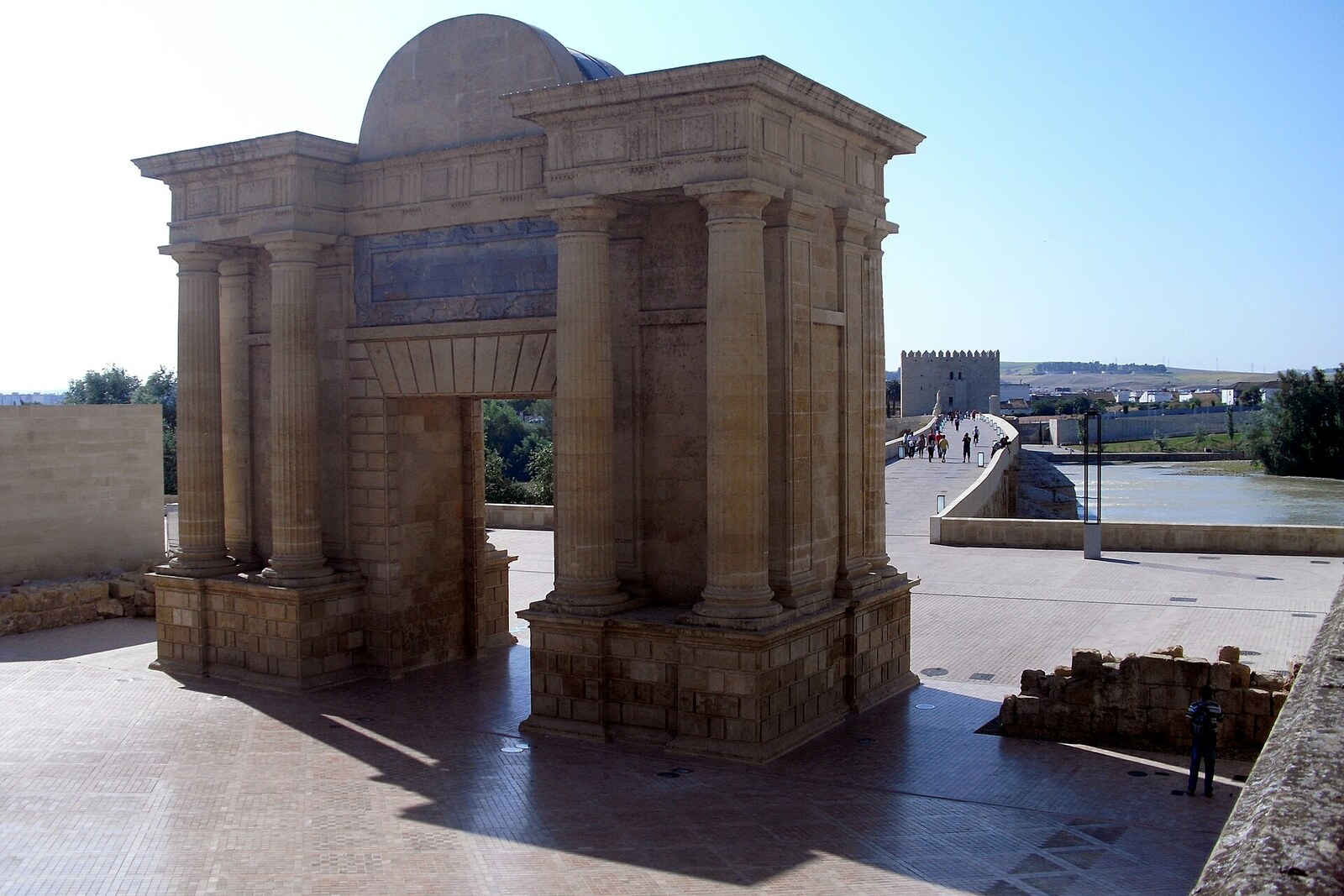
Look around first
What to notice
- A freestanding Renaissance arch
- The Roman Bridge aligned with the gate
- The line of the southern bank
- Miraflores Park across the river
The story of the place
In the spring of eight hundred eighteen, the people of Saqunda seized the bridge and reached the city gate at this spot. Their goal was the Alcázar of the Christian Monarchs of Emir Al-Hakam I, just beyond the wall. Saqunda lay on the opposite bank, where Miraflores Park now stands. The district was home to artisans, merchants, and experts in Muslim law. The bridge connected their homes and markets with the center of Córdoba, and at its northern end it led directly to Bab al-Qantara—Puerta del Puente. The wall continued on both sides of the passage: there was no freestanding arch here.
Al-Hakam I, emir of Córdoba, pressed for the payment of new taxes and dealt brutally with his opponents. The people of Saqunda wanted to depose him. A medieval chronicle preserves an incident after which the accumulated hostility turned into open revolt. One of the emir’s guards brought a rusty sword to a market polisher and paid in advance. The soldier hurried the craftsman: without a serviceable weapon, he faced punishment at inspection. The polisher delayed the work and replied with contempt. During another quarrel, the craftsman grabbed that sword and killed the guard.
The people of Saqunda moved toward the Alcázar of the Christian Monarchs. They took the bridge and approached the gate, while residents of other districts joined them only once inside the city. The defenders of the passage began to retreat. Then part of the emir’s cavalry left Córdoba through other gates, crossed the Guadalquivir at a ford, and entered Saqunda from the rear. The riders killed anyone they encountered and set houses on fire. The people at Puerta del Puente saw the fire on their bank and rushed back to save their families and property. On the narrow bridge, the advance turned into a crush and a retreat under attacks from both sides.
Al-Hakam kept the throne. For three days, his troops plundered Saqunda and pursued the rebels. According to the chronicles, three hundred surviving participants were executed on crosses. The others were spared on condition that they leave Córdoba immediately. The exiles scattered across Toledo and North Africa; some reached Fez and Alexandria. The emir ordered Saqunda’s homes and markets razed to the ground, the land turned into fields, and no building ever erected there again. His successors enforced the ban: when structures appeared again on the southern bank at the end of the tenth century, they were ordered demolished.
The rebels stormed other gates. Hernán Ruiz III erected the present Renaissance façade in the sixteenth century in connection with the visit of King Philip II of Spain. At the beginning of the twentieth century, the wall and adjoining buildings were demolished, and the passage became a freestanding monument. No visible masonry remains from Bab al-Qantara of eight hundred eighteen. Its alignment survives: the bridge still leads directly to the gate, and on the other bank, beneath Miraflores Park, archaeologists have found the streets and houses of Saqunda, abandoned after the revolt.
Useful on site
The square and exterior viewing are accessible; the interior exhibition space and balcony are temporarily closed.
Checked: date not specified. Check the official source before visiting.View the façade from beside the passage so as not to obstruct traffic; there is no need to go inside for this story.