 Guide On Map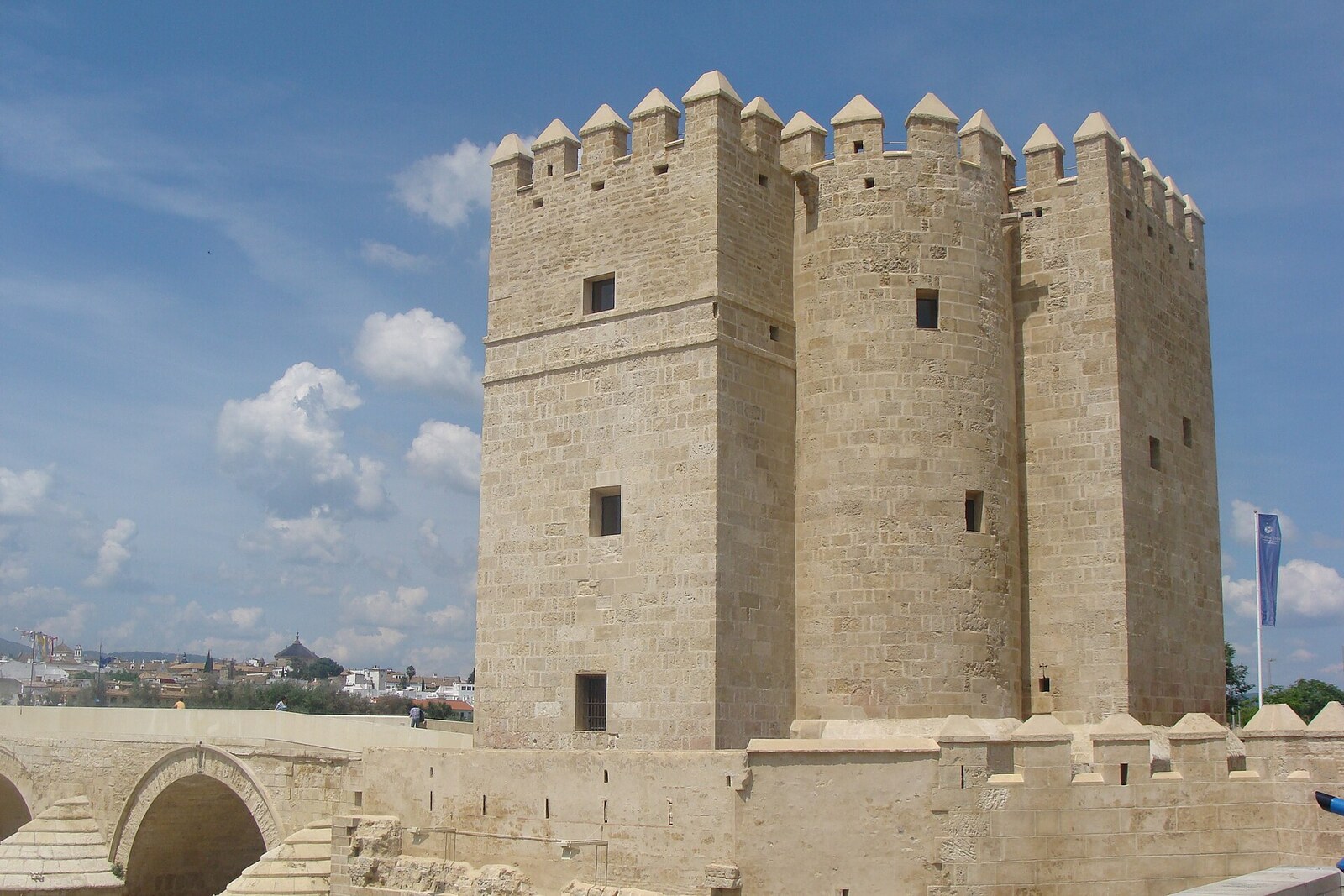
Look around first
What to notice
- The outline of the bricked-up horseshoe arch
- Side towers
- The coat of arms of Castile and León
- The bypass road by the east wall
The story of the place
Outside, side towers adjoin the old gate, and the whole structure looks like a separate fortress at the approach to the bridge. The entrance is raised above the ground: it was once reached by a drawbridge, and the road from the crossing was rerouted around the east wall. The facade still bears a coat of arms with two castles and two lions, while the Living al-Andalus Museum now operates inside.
In Calahorra Tower's north wall, on the bridge side, the outline of a bricked-up horseshoe arch survives. A road once passed directly through it. The tower served as a fortified gate: whoever held it decided who could get onto the bridge and reach the city. The origin of the word “calahorra” is disputed; in al-Andalus, it referred to an important freestanding tower.
In thirteen sixty-seven, Peter I of Castile ordered the execution in Córdoba of sixteen influential townsmen whom he considered supporters of his half brother. The brother, Henry II of Castile, was seeking the Castilian throne. After the executions, Córdoba took his side, and Peter decided to retake the city.
In May thirteen sixty-eight, Peter approached from the south with Muhammad V of Granada, emir of Granada and his military ally. The river left the attackers an obvious route—through Calahorra Tower and across the bridge. The people of Córdoba prepared to meet them at the city defenses and did not sufficiently protect the walls. A commander named Abenfalez led a large detachment of crossbowmen to the tower. They took Calahorra Tower, went on, and made six breaches in the fortifications of the old Alcázar of the Christian Monarchs. The gate performed its literal function, except that it was now controlled by the besiegers.
Later, a more heroic account of the tower's recapture took shape in Córdoba. According to local tradition, the defense was led by Alonso Fernández de Montemayor, a Córdoba military commander who was to prove that he would not surrender the city. He supposedly ordered two arches of the bridge destroyed behind his men, depriving them of a route of retreat. Fighting alongside the warriors were piconeros—charcoal burners who earned their living making fuel for kitchens and braziers. They supposedly went into battle with the sickles and billhooks they normally used to cut brush. This is where the encounter gets its other name: the Battle of the Piconeros.
In such detailed form, this is a tradition, not a reliable record. Accounts close to the events confirm the assault on Calahorra Tower and allow that the bridge may have been damaged, but they link the allied army's retreat to torrential rain and the flooding of the Guadalquivir. Peter and Muhammad withdrew from Córdoba. In March of the following year, Peter was killed at Montiel in a clash with Henry, and his brother became king of Castile as Henry II of Castile.
Later, while passing through Córdoba, the new king ordered the bridge repaired and the fortress enlarged. Builders walled up the former straight passage, added side towers to the old gate, and turned it into a separate castle. They raised the entrance above the ground and fitted it with a drawbridge, while rerouting the road around the east wall. There they also placed the coat of arms of Castile and León—two castles and two lions—which everyone entering the city saw.
Today, the Living al-Andalus Museum is housed inside. The bricked-up arch and the royal coat of arms remain outside: the first marks the route by which the attackers entered Calahorra Tower, the second marks the man under whom that route was closed.
Useful on site
Exterior viewing is unrestricted. The museum is open June–September 10:00–14:00 and 16:30–20:30.
Checked: date not specified. Check the official source before visiting.The main idea is easy to understand from outside; plan the museum inside as a separate visit.