 Guide On Map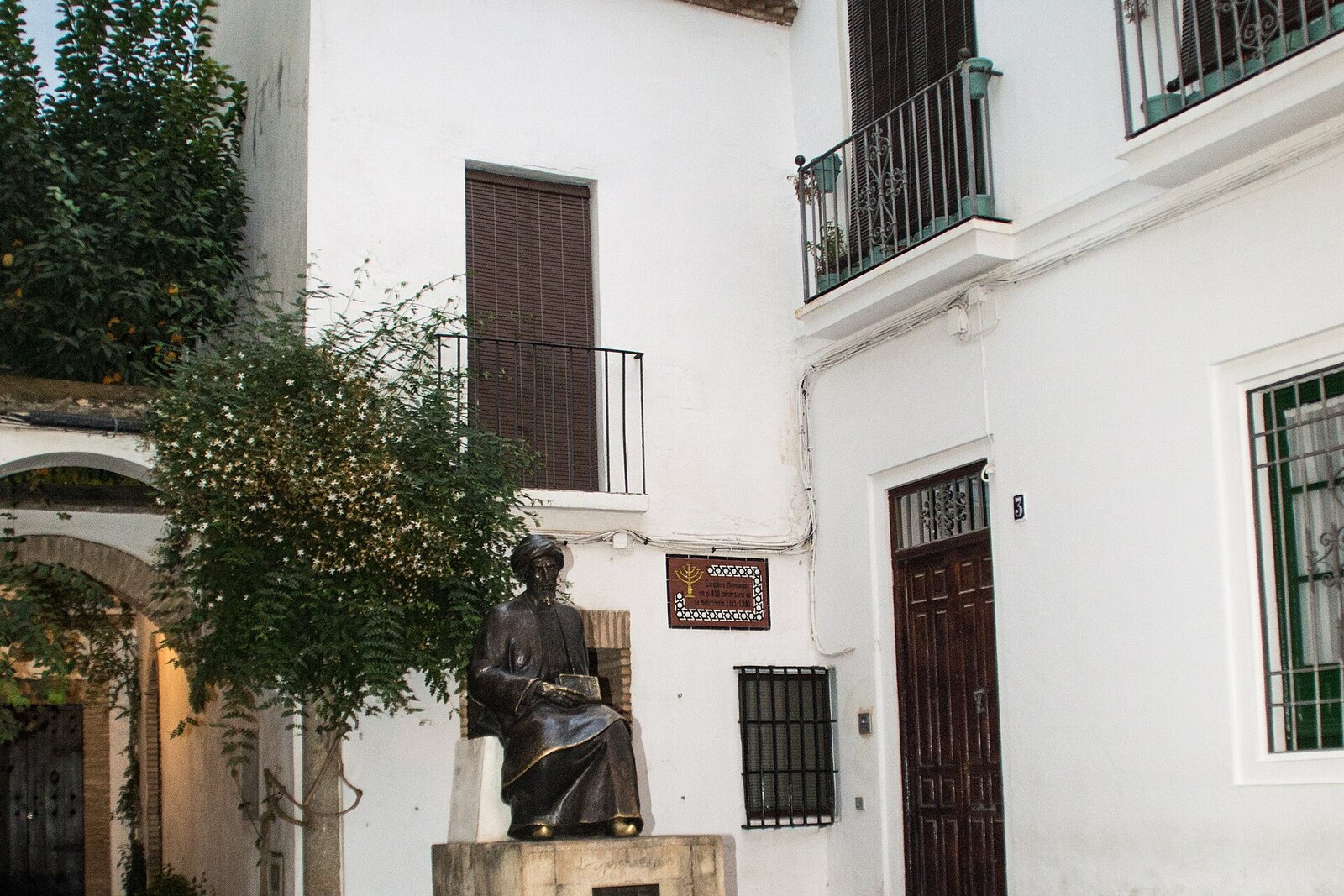
Look around first
What to notice
- Bronze figure with a book
- Polished shoes
- Stone block shaped like a tombstone
- Inscription on the plinth
The story of the place
The square’s name came here from Galilee: according to Jewish tradition, the venerated grave of the scholar from Córdoba is in Tiberias, although no evidence of the transfer of his remains has survived. This distant connection was assembled here quite literally: the city’s name remains on the wall, and the bronze figure with a book was seated on a stone block resembling a tombstone. The surrounding walls do not reveal a house that could reliably be connected with his life: his exact birthplace in Córdoba is unknown. The square preserves the memory of the city of his birth, not of a confirmed address.
The shoes of the bronze figure are especially shiny. Visitors constantly touch them: according to local belief, this can bring a share of Maimonides’s wisdom or ensure a return to Córdoba. The rest of the bronze has had time to darken, while the shoes have been polished by hands.
On June seventh, nineteen sixty-four, Amadeo Ruiz Olmos’s work was unveiled here. He was the sculptor commissioned to mark the seven hundred sixtieth anniversary of the death of the scholar from Córdoba. He seated Maimonides with a book on a stone block representing a tombstone. The inscription on the plinth calls him a theologian, philosopher, and physician, born in Córdoba in eleven thirty-five and dead in Cairo in twelve oh four.
The first date is now considered outdated: documents from a Cairo repository of Jewish manuscripts point to eleven thirty-eight. Maimonides’s exact house in Córdoba is also unknown. The square marks the city of his birth, but none of the surrounding walls has been confirmed as a wall of his home.
Maimonides (Moses ben Maimon), whom Europe called Maimonides, grew up in a family of Jewish judges. His father taught him to interpret religious law and prepared him for the same service. In eleven forty-eight, the Almohads, a North African dynasty, captured Córdoba. They required Christians and Jews to convert to Islam, leave their lands, or die. The family chose to leave. Historians dispute whether they departed at once and whether its members had to pass themselves off as Muslims for a time. One consequence is certain: Maimonides never returned to Córdoba.
In Fez, he encountered people who had done under threat of death what his own relatives had feared: they had pronounced the Islamic profession of faith while continuing to observe Jewish commandments in secret. One rabbi declared such people apostates. Maimonides replied with the Epistle on Forced Conversion. He allowed people to save their lives through the formal acknowledgment of another faith, preserve whatever commandments remained possible, and leave at the first opportunity for a place where they could live openly. Coercion, he wrote, did not deprive a person of a place in the Jewish community. The author himself acted on this advice: he left the Almohads’ domains and eventually settled in Egypt, where he became a physician and leader of the Jewish community.
Maimonides died in Fustat, old Cairo. According to Jewish tradition, his remains were then moved to the Galilean city of Tiberias; no evidence of the transfer contemporary with his death has survived, but the venerated grave is there. That is why the square in Córdoba was given Tiberias’s name, and why the sculptor seated Maimonides on a likeness of the distant tombstone.
On the square wall remains the name of the city of his supposed burial, beneath the bronze figure is an image of the grave, and on the shoes are light patches left by hands.
Useful on site
The open city square is accessible around the clock.
Checked: date not specified. Check the official source before visiting.Pause briefly and keep the narrow space around the monument clear.