 Guide On Map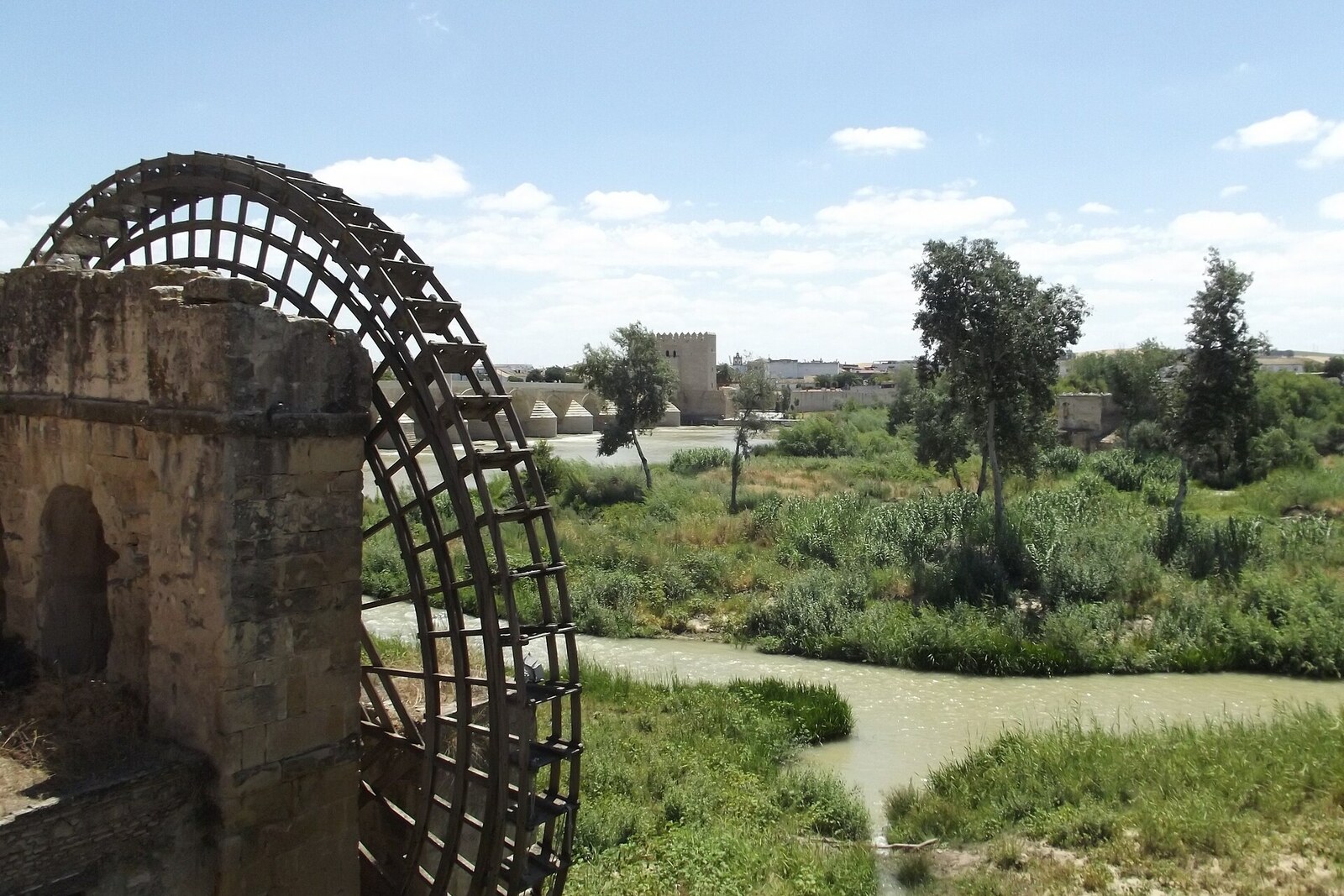
Look around first
What to notice
- Wooden wheel
- Medieval stone channel
- Stone supports
- Dam below the Roman Bridge
The story of the place
Below the Roman Bridge, a dam directed the current toward Albolafia, a water-lifting wheel for the neighboring Alcázar of the Christian Monarchs. Its stone bases support a large wooden rim; containers around the circle took up river water and emptied it into a channel above the city wall. The oldest masonry is dated to the time of the Almohads, although in the fourteenth century the supports were almost completely rebuilt. The medieval mechanism disappeared long ago, and the present circle was assembled by apprentices of the Alcázar workshop from traces of the former construction and from the model of working waterwheels in neighboring towns.
In June fourteen ninety-two, the ailing Isabella I of Castile was living in the neighboring Alcázar of the Christian Monarchs and seeking peace and quiet. The queen was disturbed by a huge wooden wheel on the Guadalquivir. She ordered it stopped.
The wheel was turned by river water. Containers fixed around its rim lifted the water into an upper channel; from there it ran along an aqueduct over the city wall, then through underground channels to the gardens and vegetable plots of the Alcázar of the Christian Monarchs. River water was used for irrigation: drinking water reached the city by other means. The site was chosen near a dam below the bridge, where the current could be directed onto the paddles, while the royal gardens lay very close by, but considerably higher than the river.
The antiquity of Albolafia itself was long exaggerated. It was attributed either to the Córdoba emirs of the ninth century or to the governor Tashfin, supposedly having built the wheel in the eleven thirties. A recent study of the masonry dated the oldest surviving part to the second half of the twelfth century, the time of the Almohads; in the fourteenth century, craftsmen almost completely rebuilt the support. By then, the wheel was already depicted on the city seal. The origin of the name also remains disputed: “Albolafia” is translated as “good health” or linked to the name Abu al-Afiya, “father of well-being.” There are no documents about such a craftsman.
Isabella’s order is known not only from legend. Sixteen years later, Francisco de Alcaraz, the keeper of the Alcázar of the Christian Monarchs, petitioned Joanna of Castile, Isabella’s daughter and heir. His duty was to maintain the royal residence, and without the wheel he had to answer for the gardens, which lacked water. In his petition, he explained that the loud noise disturbed the ailing Isabella, the wheel was stopped, and the abandoned wooden structure dried out and perished. After this, a severe shortage of water began in the Alcázar of the Christian Monarchs, and the staff had to arrange a new supply from mountain springs.
By the end of the fifteenth century, people were already speaking of the working waterwheel in the past tense. In fourteen ninety-nine, the court embroiderer Pedro de Hermosilla presented a royal charter and demanded that water be transferred to him from the channel where the wheel had formerly stood. He earned his living by needlework and court commissions, and received a share in a flour mill together with the right to the river current. The water lifted to the royal gardens now served mill wheels farther downstream. Hermosilla’s daughter later called Albolafia “the old waterwheel.”
The medieval wooden wheel disappeared completely. The architect Félix Hernández reconstructed its form in nineteen sixty-five from traces on the stone supports and from river wheels still operating in neighboring towns. His construction warped over time and was then damaged by fire. The present copy was made by apprentices of the Alcázar workshop and installed in nineteen ninety-four. The stone channel before it is medieval; the wooden circle whose creaking disturbed Isabella has been absent here for more than five centuries.
Useful on site
The exterior view from the embankment is available around the clock.
Checked: date not specified. Check the official source before visiting.The wheel may remain still, so reconstruct how it worked from its position in relation to the water and the palace. Do not go down to the water’s edge for a photograph.