 Guide On Map
Historic Charleston South: Homes, Labor, and Law
From Four Corners of Law through Legare Street and Tradd Street to Stoll's Alley
Guide On Map on your phone
Open the walk like a regular app
It takes about 10 seconds to install. No app store needed.
The whole path
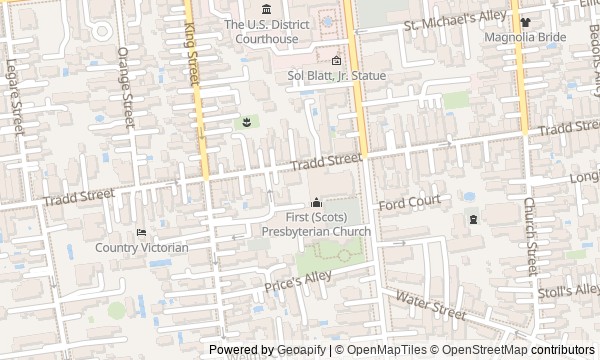
Route map
About the walk
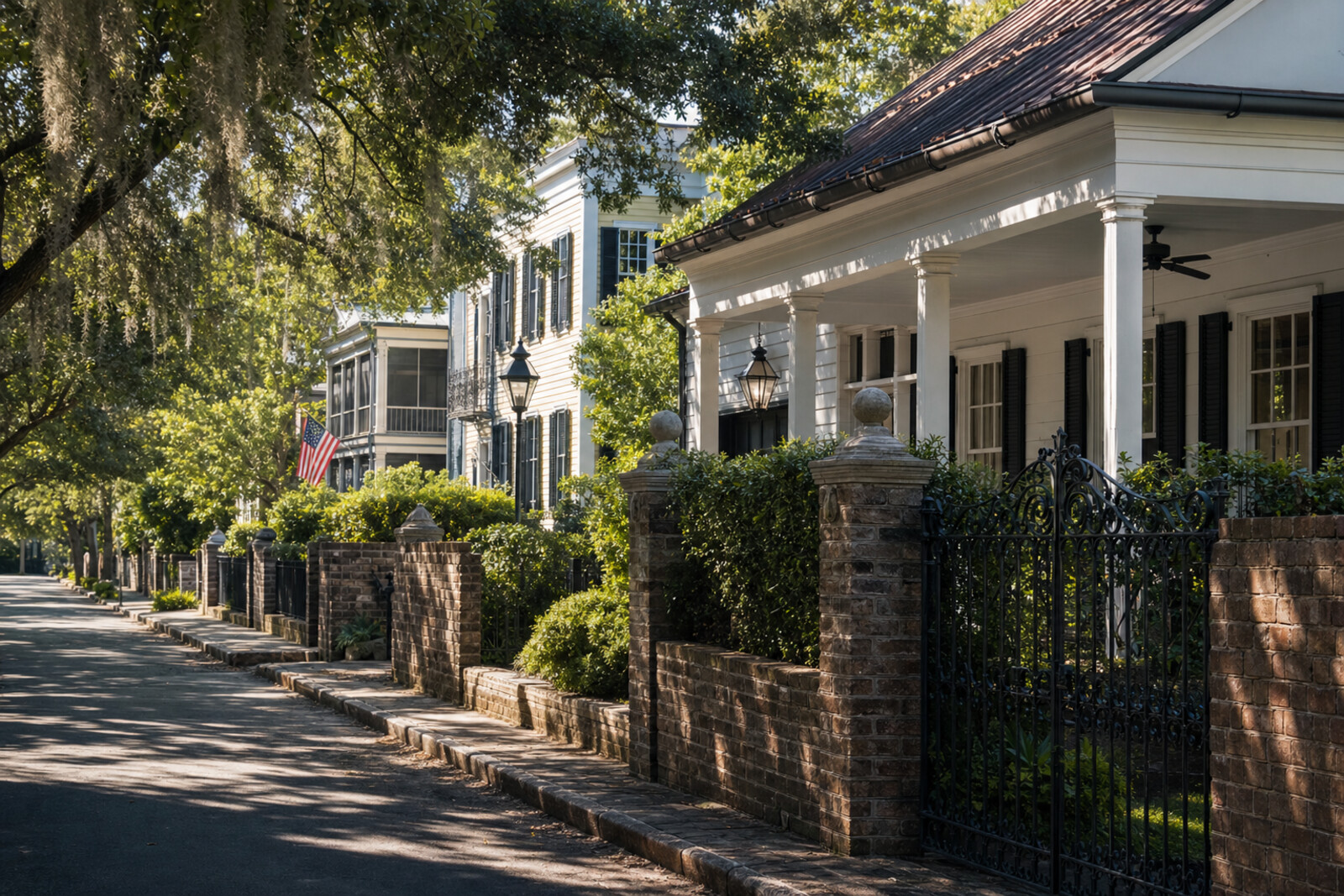
You will walk south from Four Corners of Law into the residential blocks of Legare Street and Tradd Street, then return to Meeting Street and finish in narrow Stoll's Alley. White porticos will give way to a church steeple, side piazzas, shuttered windows, iron swords, and a brick path between private homes.
The questions will emerge from small details. Why will the price of freedom, once paid, prove insufficient? For whom will the ringing of a bell mean they are forbidden to go out? Why will a front door lead not into rooms, but onto a gallery? Whose hands will build a staircase if the owner's name remains on the balcony while the maker's disappears?
The story will be calm and documentary. It will separate what is confirmed from family legend, and it will not hide slavery, coerced labor, or displacement behind the beauty of restoration. After the walk, you will read a Charleston single house by its narrow end, piazza, and shutters—and remember both the craftspeople who restored its carving and the residents for whom there was no longer room behind the renewed facades.
Why this order
The courthouse and church stand at the same intersection, so after a case of freedom that was not recognized, the bells will immediately show how law entered the city's daily movement. From the church steeple, the route turns to John Fullerton House: after public rules, Charleston's domestic grammar and its financial calculations come into view. The next house on Legare Street links a private fence to the gates of the city guard. On Tradd Street, the conversation expands from individual properties to the preservation of an entire street and the displacement of its residents. Then Nathaniel Russell House asks whose labor created the homes that would later be protected. The move to Church Street connects that question to domestic defiance during the occupation. The final descent to Stoll's Alley shows the same restoration at the scale of an entire lane.
Those who want to read architecture through people's lives Those who value an honest history of slavery and urban preservation Those who love residential streets, old homes, and facade details
Those looking only for grand mansions without difficult subjects Those who want an overview of all of Charleston's major sights Those expecting to go inside private homes throughout the walk
Before you go
Most of the route runs past active churches, museums, and private homes. View courtyards and piazzas only from public space; do not look into windows, put a camera through gates, or linger at residents' entrances. Visits to the interiors of St. Michael's Episcopal Church, Nathaniel Russell House, and Heyward-Washington House must be planned separately: the walk remains complete without going inside, and interior access depends on each institution's rules. Bring water and comfortable shoes—old sidewalks can be uneven, and there may be less shade between stops than you expect.
When to go
Choose the first half of the morning or a time after the afternoon heat: it will be easier to pause at the facades, and the angled light will better reveal the depth of galleries, brickwork, and ironwork.
Backup plan
If you need to shorten the walk, go straight to Legare Street after Four Corners of Law and St. Michael's Episcopal Church, look at the layout of a single house and the Sword Gates, then finish in Stoll's Alley. This preserves the story's 3 main scales: public authority, the boundary of the private home, and a street remade from the ground up. Leave the museum houses for another day, especially if you want to see the Russell staircase or the service spaces discussed in the stories.
Route conditions
Surface. Paved — 2.5 km; unpaved — 72 m (data covers 97% of the route)
Access. Wheelchair — limited; stroller — limited
Facilities. Toilets — 2; drinking water — 2
Elevation. Ascent — 2 m; descent — 7 m
OpenStreetMap extract of June 18, 2026: database data, not a check on the ground. Data © OpenStreetMap contributors, ODbL licence
Walk plan
Open in maps ↗- 1
Four Corners: freedom before the court
The court case will show the difference between the price paid for freedom and freedom recognized by law. - 2
St. Michael's: Materials of Memory
The story of a bell ringer will link the church bells to city time and to limits on freedom of movement. - 3
Legare: a house turned sideways to the street
The single-house layout will emerge as the result of a builder's work, undertaken at the risk of his own money. - 4
Sword Gate House
The school fence connects a family story of an escape with the documented history of the city gates. - 5
Tradd: Life Behind the Shutters
The story of the street's restoration shows who saved the old woodwork and who lost housing here. - 6
Nathaniel Russell House
The history of the estate will set the owner's name on the balcony alongside the anonymous labor of builders and domestic workers. - 7
Heyward-Washington: Two Doors of Independence
Two refusals to light the windows show how political defiance entered a private home. - 8
Stoll's Alley
The fate of the restored houses will conclude the discussion of how preservation changed both the buildings and the composition of their residents.
Route features
Everything you need stays in the browser
Progress, saves and your trip plan are stored on this device.
Add Guide On Map to your home screen so the walk opens outside the browser.
How we handle sources, maps and corrections: our editorial standards