 Guide On Map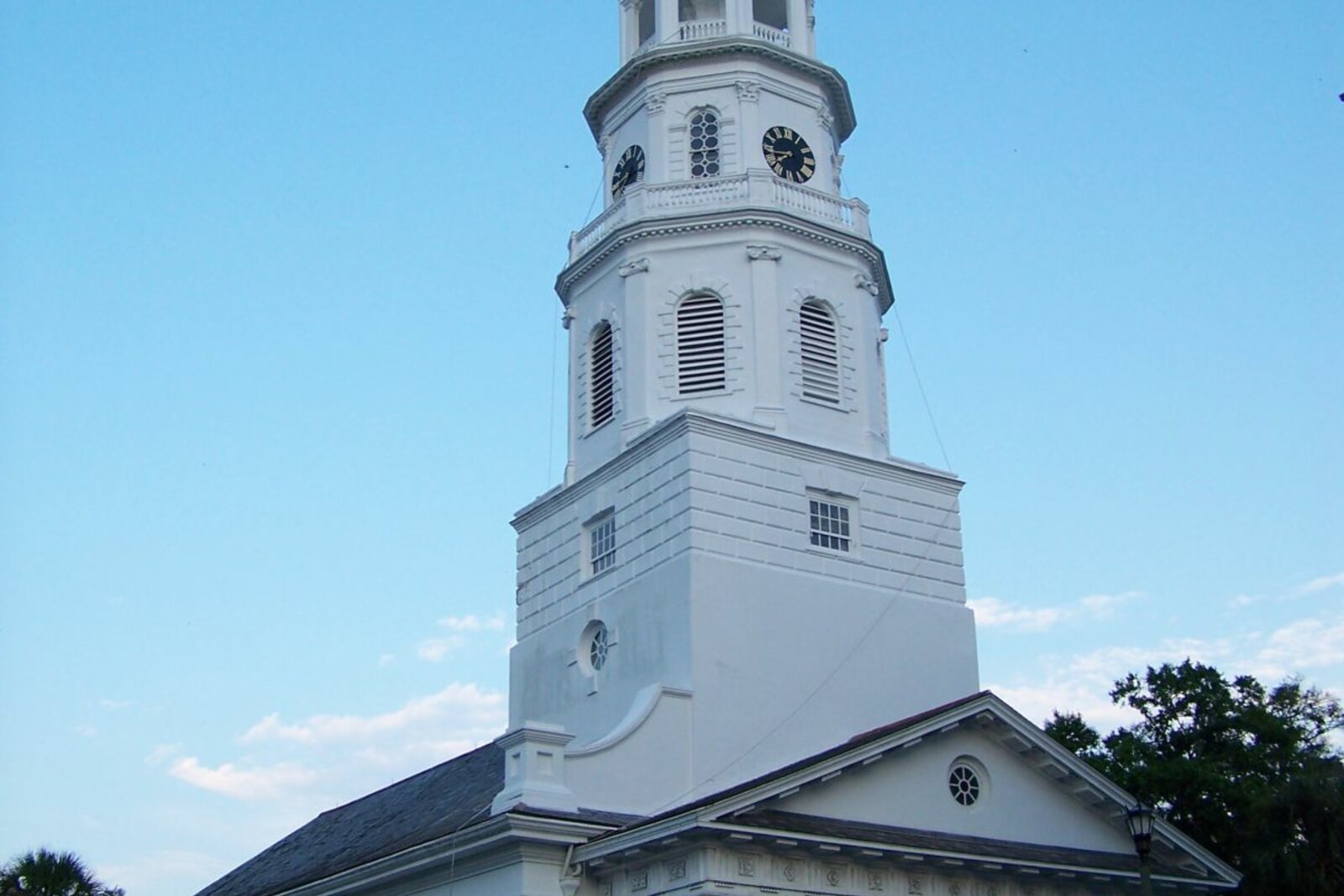
Look around first
What to notice
- White tower
- Four clock faces
- Church portico
The story of the place
Around eighteen thirty-seven, St. Michael's Episcopal Church began using the labor of Washington McLean Gadsden. He was about thirteen years old. He was born into slavery and, at the beginning of this service, could not control either his own work or the pay for it. His responsibility became the eight bells in the white tower above the intersection of Broad Street and Meeting Street.
The church opened here in seventeen sixty-one. The South Carolina Provincial Assembly divided the overcrowded parish of St. Philip's Church: residents south of Broad Street were assigned to the new St. Michael's Episcopal Church. English clocks and bells were installed in the tower, and the city hired an official timekeeper. Town residents set their clocks by these four faces; bell strikes marked the quarter hours.
In the evening, the same set controlled people's movements. The “first bells” warned of the beginning of the night watch—at seven in winter, at eight in summer. The “last bells” rang at nine and ten, respectively. After them, a Black resident of Charleston could remain on the street only with a written pass. For most, this meant people in slavery: without papers, they could be detained as curfew violators. In the years when Gadsden served in the tower, the bells told white residents the time for a visit or the end of the workday, and told him and other Black people the limit of permitted movement.
In June eighteen sixty-two, the parish removed the bells and sent them to Columbia. Other church bells were then being melted down for cannons; these were left in storage in a shed. During the burning of Columbia in eighteen sixty-five, they cracked and partly melted. After the war, the church wardens gathered the metal and sent it to the Whitechapel bell foundry in London, where the first set had been made. The fragments were mixed with new metal, and eight bells were cast again.
They returned to Charleston only after the abolition of slavery. Local craftsmen installed the wooden frame incorrectly: the heavy bells could not be swung. Gadsden continued his service as a free man and moved to the carillon keyboard—a wooden keyboard one floor below, connected by rods to the clappers of the stationary bells. One bell ringer could now play a melody on eight notes.
Gadsden worked here for sixty-one years. In eighteen ninety-eight, he resigned because of illness. The church wardens granted him a pension—five dollars every three months. Ten months later, he died.
Gadsden's carillon keyboard has remained in the tower, although it is no longer used. In nineteen ninety-three, Whitechapel craftsmen installed the proper frame, and now eight bell ringers again swing eight bells before services and on special occasions. The heaviest is named Michael; its bronze contains metal from the set that once marked the last hour Gadsden was allowed to be on the streets of his own city.
Useful on site
Church and churchyard Mon–Thu 09:00–16:00; Fri–Sat closed; closures due to events are possible.
Checked: June 28, 2026. Check the official source before visiting.The façade and tower are easy to view from outside; the bench and the shell mark are accessible only with permitted entry into the church.