 Guide On Map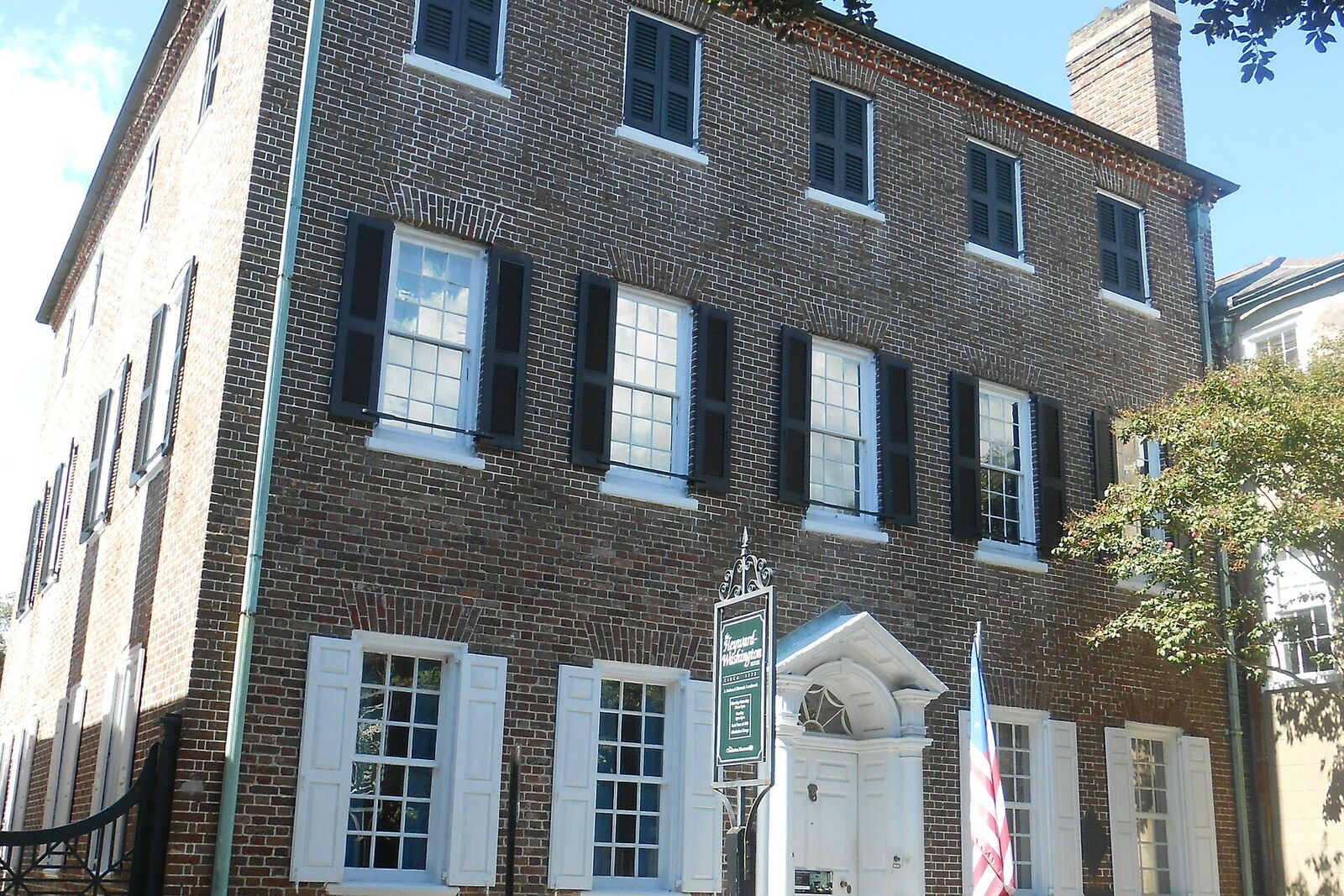
Look around first
What to notice
- Brick facade
- First-floor windows
- Plaque with two surnames
The story of the place
The brick house on Church Street served as a private residence; a house museum later opened in it. At the end of the nineteenth century, bakery owners lowered the first floor to street level and installed a display window, and the museum later restored the facade's former appearance. Two surnames remain on the plaque beside the windows: that of the owner and that of the first president of the United States, for whom the city rented this house for one week.
In March seventeen eighty-one, the windows of this house remained dark by decision of Elizabeth Matthews Heyward. The British command, which had occupied Charleston after the city's surrender, ordered residents to light candles in honor of its victory at Guilford Courthouse. Elizabeth refused to celebrate the victory of the people holding her husband captive.
Her husband was Thomas Heyward Jr.—a lawyer, owner of rice plantations worked by enslaved laborers, and one of the four South Carolina representatives who signed the Declaration of Independence. He also commanded an artillery company in the militia. After Charleston fell, the British allowed him to live at home on his word of honor that he would not take part in the resistance. Heyward continued meeting with other Patriot leaders and broke that condition. In August seventeen eighty, soldiers took him from here, placed him in the Old Exchange building, and then sent him to St. Augustine.
Elizabeth, the children, her sister Lois Hall, and Lois's children remained in the house: Lois's husband had been arrested together with Heyward. We know the scene at the dark windows from an account by Alexander Garden, published in eighteen twenty-eight, almost half a century later. According to his record, a British officer demanded an explanation for the absence of candles. Elizabeth replied that she would not allow a single light to be placed in the windows. The officer threatened to raze the house to the ground; she did not change her mind.
On May twelfth, the anniversary of Charleston's capture, residents were again ordered to light their windows. Elizabeth refused again. This time, supporters of the British Crown gathered on Church Street. They pelted the facade with pieces of brick and rubbish; the soldiers did not intervene. The women and children sheltered inside. According to the same later account, the shock proved fatal to Lois, who had recently given birth: she died soon afterward.
After the attack, British officers apologized and offered to repair the facade. Elizabeth refused. The damage was meant to remain as evidence of how soldiers had allowed a mob to wreck a house containing women and children. After about eleven months of captivity, Thomas was exchanged for British prisoners of war, but he was not permitted to return to occupied Charleston. He sailed to Philadelphia; Elizabeth and the children went there to join him. In seventeen eighty-two, George Washington, commander of the American army, publicly honored her at a celebratory ball. In August of that same year, Elizabeth died in Philadelphia.
Nine years later, Washington returned to this story as the first president of the United States. Heyward was then living mainly on his plantation, and the city council rented his furnished house for a week for sixty pounds. The council hired a housekeeper and servants and bought provisions. Washington slept, rested, and received city delegations here during his journey through the southern states. After this, the guest's surname was added to that of the owner.
There are no longer traces on the facade of the bricks thrown at the windows. At the end of the nineteenth century, bakery owners lowered the first floor to street level and installed a display window; later, The Charleston Museum restored the former appearance and opened a house museum here. Two surnames remained on the plaque: Heyward—the owner taken from here as a participant in the rebellion—and Washington—the president for whom the city rented this house for one week.
Useful on site
Mon–Sat 10:00–17:00, Sun 12:00–17:00; last audio tour 16:15.
Checked: June 28, 2026. Check the official source before visiting.You can listen to the story by the facade; the rooms and service spaces require a separate museum visit.