 Guide On Map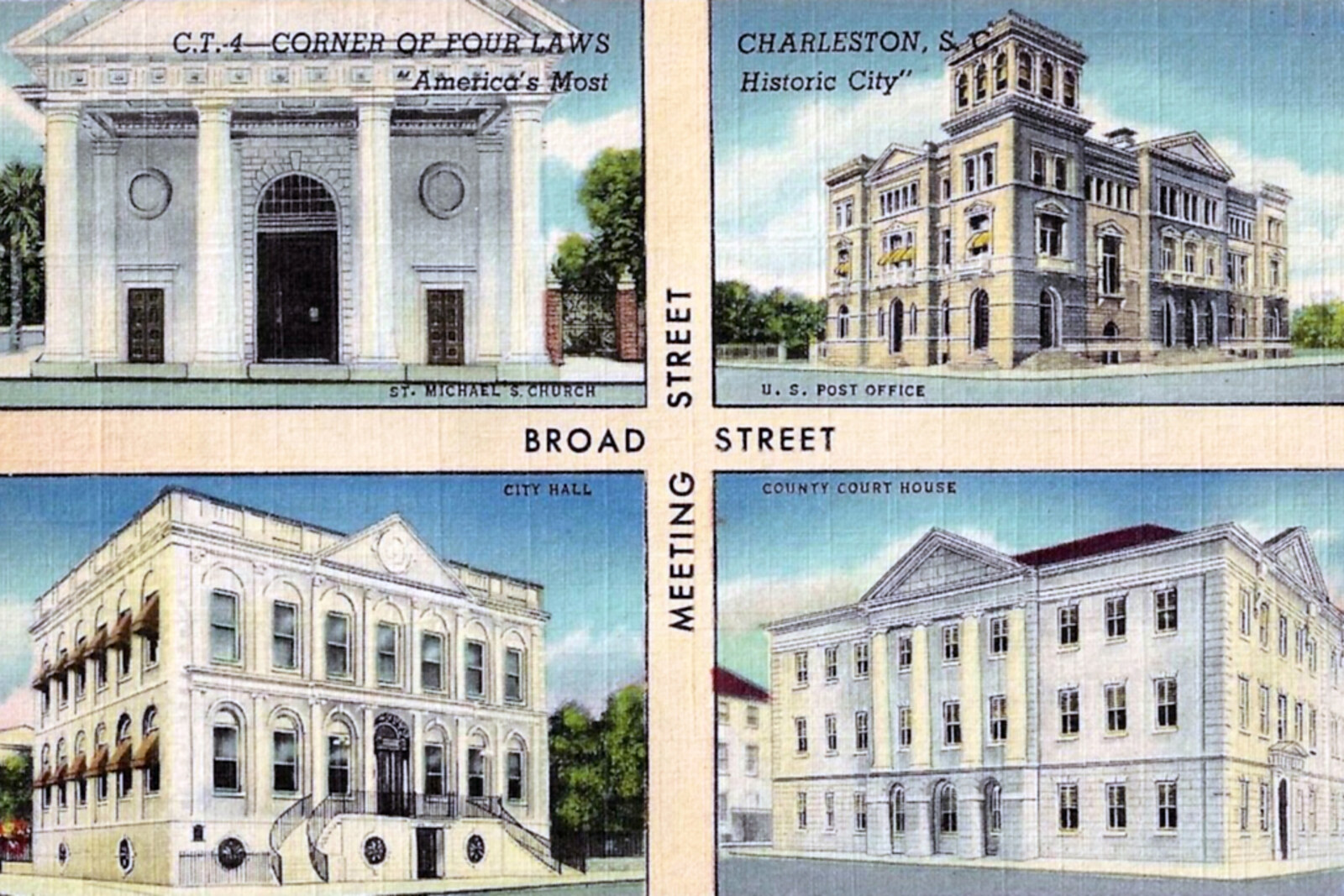
Look around first
What to notice
- The white portico of the Charleston County Courthouse
- Charleston City Hall
- United States Courthouse and Post Office
- The tower of St. Michael's Episcopal Church
The story of the place
At the intersection of Broad Street and Meeting Street stand Charleston City Hall, the state courthouse, the United States Courthouse and Post Office, and the tower of St. Michael's Episcopal Church; the white portico of the Charleston County Courthouse is the most noticeable among them. City authorities set aside this junction for public institutions in Charleston's first city plan, and the present courthouse took the site of the former Colonial State House. County offices still operate inside it today, so secular and church authority still stand side by side here.
In February eighteen twenty-one, Catherine's case was heard in the white building on the corner of Broad Street—a case brought by an enslaved woman who sought recognition that she was already free. The Court of Equity was sitting: that was the name for a court without a jury, where the chancellor, meaning the judge, could weigh the circumstances of a case and award equitable relief.
This intersection of Broad Street and Meeting Street is called the Four Corners of Law. Charleston City Hall stands on one corner; on another is the Charleston County Courthouse, where state laws are applied; across from it is the United States Courthouse and Post Office; and St. Michael's Episcopal Church occupies the fourth corner, included in this arrangement as the side representing church law. A civic center was planned here in the city's first layout. The Charleston County Courthouse was built on the site of the Colonial State House, and its reconstruction was completed in seventeen ninety-two. Catherine's case was heard there.
Around eighteen twelve, Catherine's former owners sold her to the merchant Antoine Plumet for three hundred dollars, although in court her value was assessed at no less than eight hundred. The concession was a condition of the sale: Plumet promised to free Catherine once she repaid him the three hundred dollars he had paid.
Catherine earned money outside his home and gave her earnings to Plumet. The records do not say exactly what work she did. Witnesses later confirmed that she had paid the full amount. Plumet acknowledged this to Catherine's former owner, but demanded interest as well. Catherine continued working; according to witness testimony, the money she had brought in would already have covered two such payments. Plumet nevertheless did not execute the emancipation.
After his death in eighteen sixteen, Catherine stopped giving her earnings to the administrator of the estate and lived independently for about two years. Then the heir, Pierre Francois Brisson, came to Charleston. He found no written agreement for her emancipation, tracked Catherine down, returned her to enslavement, and sold her to a baker for six hundred fifty dollars.
To go to court, Catherine first had to find a white representative: the law did not allow her to bring such a case in her own name. The young lawyer Isaac Edward Holmes agreed to become her formal guardian—in this case, that meant speaking for her before the judges. He argued that Catherine was asking not to be given freedom as a gift, but to have returned to her the freedom she had already paid for.
Brisson did not answer the lawsuit for almost a year. While the case awaited a hearing, the South Carolina General Assembly prohibited the private emancipation of enslaved people: a separate law was now required for each person. Before Chancellor Henry William DeSaussure, witnesses confirmed both the agreement and the payment of the money. The judge allowed that Plumet had deceived Catherine and called her situation extremely difficult. But Plumet had not executed the emancipation papers, and without them DeSaussure refused to recognize Catherine as free and dismissed the case.
Holmes then appealed to the South Carolina General Assembly. A committee agreed that Catherine and several other people had fulfilled their agreements before the prohibition took effect, but the proposed law was postponed and never passed. Catherine remained the property of other people. Surviving bills of sale show that from eighteen twenty-three through eighteen twenty-five, she was sold and bought back four more times; there is no reliable evidence of what became of her afterward.
Behind the present white portico, the court and county offices are still located. It was here that DeSaussure recorded that Catherine had earned the agreed price and could support herself—and left her recorded as someone else's property.
Useful on site
Busy city intersection; view from the sidewalk at any reasonable daytime hour.
Checked: June 28, 2026. Check the official source before visiting.Listen from the sidewalk without blocking the crosswalks; all the main landmarks are visible from the intersection.