 Guide On Map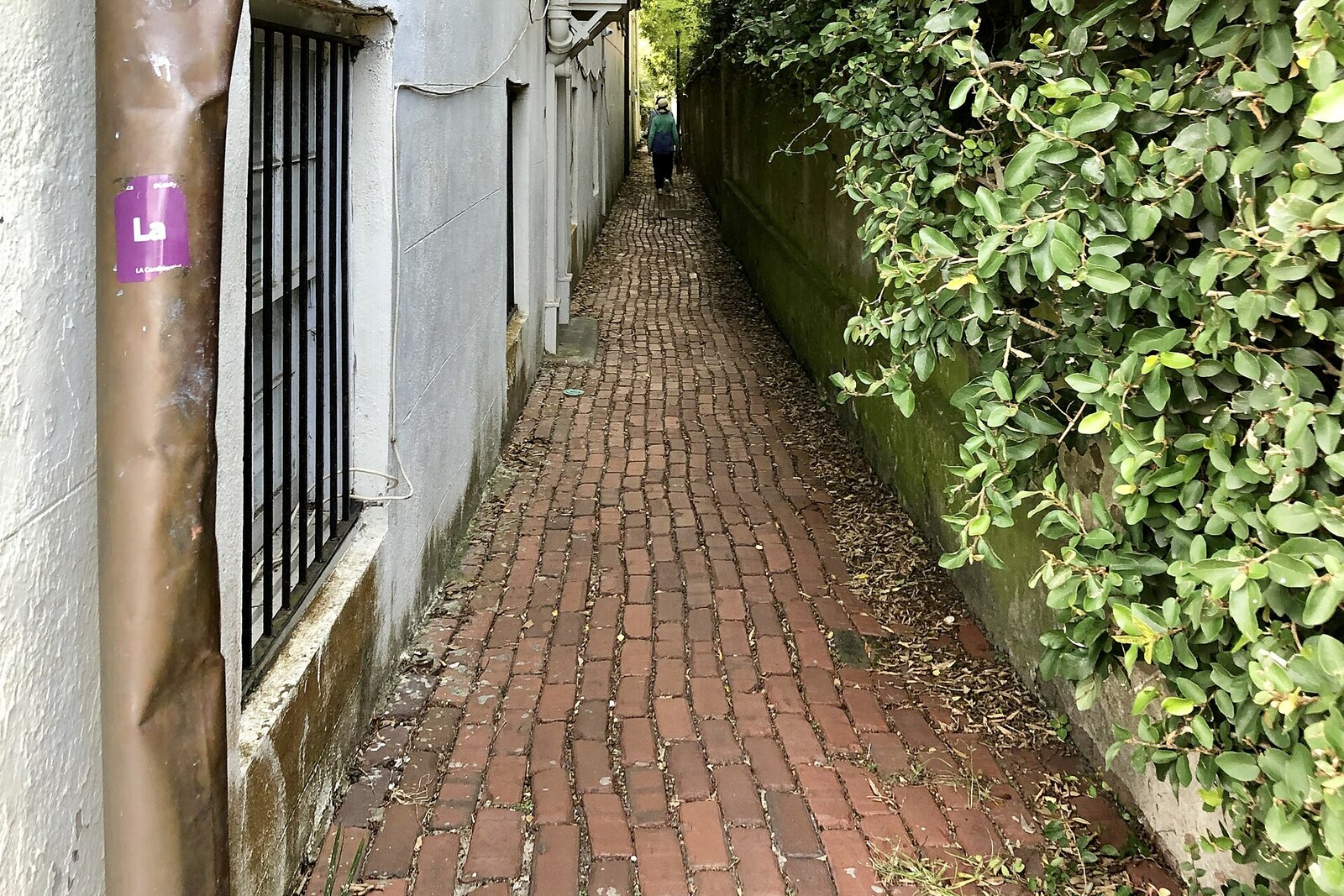
Look around first
What to notice
- Brick path
- House No. 7
- House No. 9
- Wrought-iron gates
The story of the place
Beyond the wrought-iron gates, a narrow passage runs between low houses, and the brick path leads to East Bay Street. At first it was called Pilot's Alley: according to an accepted, though not fully documented, version, harbor pilots walked here to their boats. In seventeen forty-seven, a blacksmith who worked nearby bought the plot on the south side of the passage; the present house at number seven is associated with his property. The blacksmith's surname gradually displaced the earlier name, and the brick beneath your feet replaced the old, undrained muddy road.
In the late nineteen twenties, Alida Canfield, the owner of the neighboring house on Church Street, took on the half-ruined house at number nine. Accounts differ about her first plan. According to one version, Canfield intended to demolish the house and extend her garden in its place; according to another, she was looking for premises for an antiques shop. One thing is certain: she preserved the house, opened the shop, and then began buying up neighboring buildings.
By nineteen thirty-eight, Canfield had acquired and restored eight houses on Stoll's Alley. They were brick and wooden dwellings that had long been turned into cheap rental apartments and were in places ready to collapse. Canfield moved into house number five and invested in the entire street: she needed to put the walls, roofs, and passage in order so that customers could reach the shop.
The wooden details were restored by Thomas Mayhem Pinckney, a craftsman she knew from Tradd Street. He carved the missing elements in the dimensions and forms of the appropriate period. It was later said of his work that, without a hint, it was difficult to tell which carving had survived from the eighteenth century and which Pinckney had made in the twentieth. Canfield also secured brick paving in place of the muddy, undrained road.
Customers began coming to the alley, and in nineteen thirty-eight Canfield's two daughters opened a sweater shop in house number ten. The small business grew into a well-known local women's clothing store and lasted until the aftermath of Hurricane Hugo in nineteen eighty-nine. Canfield bequeathed the restored houses themselves to her daughters; her descendants lived at number five for several more decades. For the former poor tenants, the change ended differently: as on Tradd Street, they gave way to shops and family residences.
The alley's name predates this transformation. At first, the passage to the wharves on East Bay Street was called Pilot's Alley: according to an accepted, though not fully documented, version, harbor pilots walked here to their boats. In seventeen forty-seven, the blacksmith Justinus Stoll bought land on the south side of the passage. His forge was nearby on East Bay Street, and the present house at number seven is associated with his property. The blacksmith's surname gradually displaced the earlier name.
Beyond the gates, there are now private homes again. Number seven has retained Stoll's name, number nine was preserved instead of becoming the proposed garden, and the brick path beneath your feet appeared at Canfield's insistence in the twentieth century.
Useful on site
A narrow residential alley; pass quietly and do not linger by private windows and gates.
Checked: June 28, 2026. Check the official source before visiting.The alley is residential again: pass quietly, do not occupy doorsteps, and do not treat private courtyards as museum exhibits.