 Guide On Map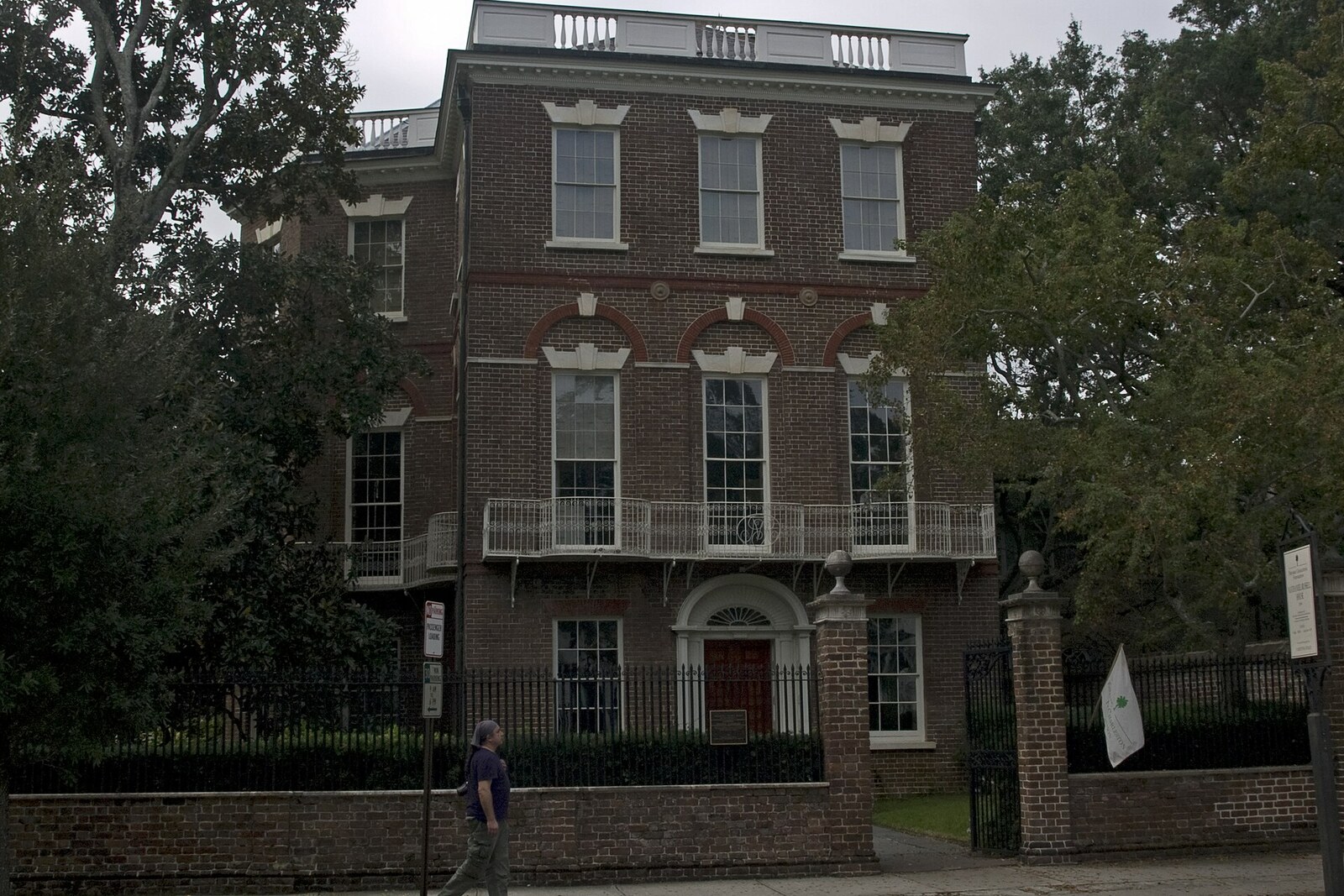
Look around first
What to notice
- Russell's initials on the balcony
- Elliptical staircase
- Steps without a central support
- Brick wing
The story of the place
In eighteen oh eight, Nathaniel Russell moved his wife, two daughters, and up to eighteen enslaved men and women here. The family settled in the three-story mansion, while the estate's other residents cooked, did laundry, and cared for the horses, garden, and work yard. Russell wanted the new house to show visitors the owner's wealth at once. Even the iron balcony bore his initials.
Russell earned his living through trade and brokerage. From the beginning of the seventeen seventies, he arranged in Charleston the sale of people brought from West Africa. In seventeen eighty-five, he directed the sale of captives from two ships. One hundred eighteen people began the voyage on the brig Gambia; ninety-six survived to reach Charleston. On the brig Industry, seventy out of one hundred fifty survived. Russell sold those who arrived to planters. The profits from this trade became part of the fortune from which he paid for the house on Meeting Street.
The staircase inside became the chief evidence of lavish spending. It rises in an ellipse through all three floors. There is no central support beneath it, nor are there visible supports below: each cantilevered step supports the next one. The load is distributed through the entire unbroken chain, making the staircase seem to hang in the air.
The documents do not allow a confident answer as to who exactly designed and assembled this structure. Even the name of the house's architect is unknown. Something else is known: most of the people employed in its construction were enslaved, from laborers to skilled carpenters and masons. To attribute the staircase to one unnamed craftsman would be speculation. It was created by a construction crew in which people who had control over neither their labor nor their earnings performed a substantial share of the complex work.
Coercion did not end after construction was completed. Enslaved adults and children lived in a separate brick wing behind the main house; the kitchen and laundry were downstairs, with living rooms upstairs. The people who kept the household in order remained almost invisible to guests climbing the grand staircase. On this estate, enslaved people worked under the Russell family and subsequent owners until eighteen sixty-five.
Nathaniel Russell died in eighteen twenty, and the house belonged to his descendants for several more decades. It is now a museum. Russell's initials can still be read on the balcony, and the staircase survives inside, where each step supports the next. The name of the craftsman does not appear beside it.
Useful on site
Mon 13:00-16:00, Tue-Sun 10:00-16:00; visitors may remain until 17:00.
Checked: June 28, 2026. Check the official source before visiting.From the street, only the house's exterior form is visible; the staircase, kitchen rooms, and finds can be seen only as part of a separate museum visit.