 Guide On Map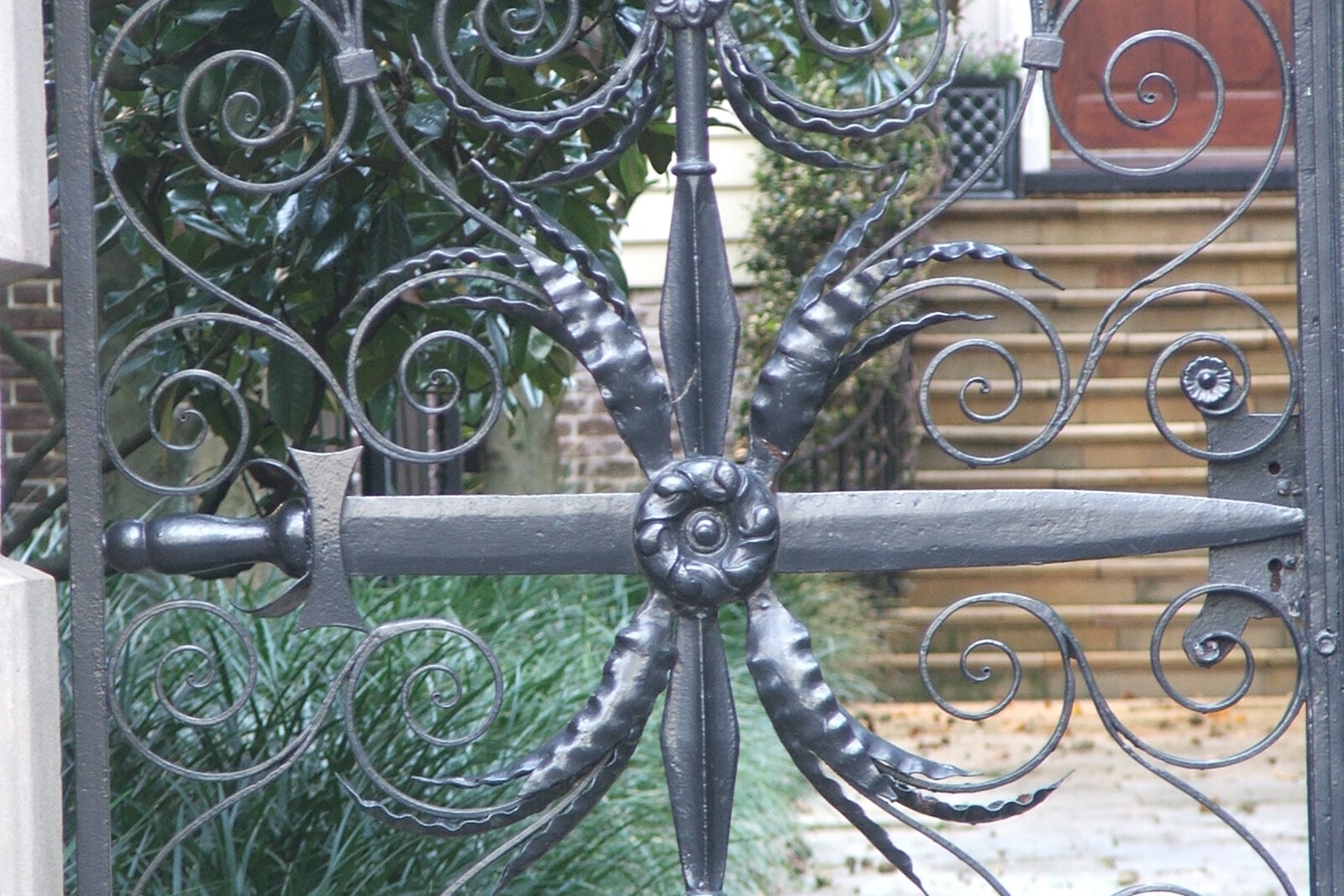
Look around first
What to notice
- High brick wall
- Two gate leaves
- Horizontal swords
- Vertical spears
The story of the place
Two heavy gate leaves survive in the high brick wall, where horizontal swords cross vertical spears. They were made for the gates of the city guardhouse at Four Corners of Law; an earthquake later destroyed the guardhouse itself, but the ironwork remained. The former schoolhouse behind the wall became a private residence, and the unwanted gates were moved here during the remodeling of the property. That is how a military design came to stand by a quiet house and gave it its present name.
The iron swords here are younger than the brick wall. From eighteen nineteen, this house was home to an expensive boarding school for daughters of wealthy families. It was run by Madame Talvande, a teacher whom parents paid for French, music, dancing, rhetoric, and natural sciences—and for supervision. For a school that did not even need enrollment advertisements, the conduct of its pupils was part of its reputation.
That is why planter Joseph Whaley brought his fifteen-year-old daughter Maria here from Edisto Island. He wanted to put an end to her meetings with George Washington Morris, a thirty-year-old native of New York. Morris was not some penniless suitor: he had established Grove Plantation, where the labor of more than one hundred enslaved people generated his income. Yet Whaley considered him an unsuitable husband for his daughter. According to the family story, the father even asked neighbors not to give Morris a place to stay overnight, but Morris pitched a tent nearby and continued seeing Maria. Whaley then entrusted his daughter to Madame Talvande and her high wall.
The details of the escape come down through a later family tradition; the marriage itself and the couple's later life are documented. On March eighth, eighteen twenty-nine, Maria climbed over the fence, walked to St. Michael's Episcopal Church, and married Morris. After the ceremony, she returned to the boarding school by the same route.
A few days later, a carriage stopped at the wooden gates. Morris announced that he had come for Mrs. Morris. Madame Talvande replied that there were no married women among her pupils and assembled the girls in the yard. Maria stepped out of the line and left with her husband. The school did not close after this: the Talvandes continued accepting pupils for about another twenty years. Maria and George had four children. Five years later, George died, leaving debts, and Maria ran Grove Plantation herself until the property passed to their son.
Maria climbed over a wall that contained wooden gates. The wrought-iron swords appeared here later. In eighteen thirty-eight, the city commissioned a new guardhouse for the city watch at Four Corners of Law. Architect Charles Reichardt designed the building, and the German blacksmith Christopher Werner made iron grilles and gates with spears and broad swords for it.
Here the sources diverge. According to an early report, the city refused the gates because Werner's work exceeded the agreed price. A popular Charleston tradition claims that the blacksmith misunderstood the phrase “a pair of gates” and made two sets. What is reliably known is what followed: in eighteen forty-nine, the British consul George Hopley bought the former school, set about remodeling it, and installed the unwanted gates in the old wall.
The earthquake of eighteen eighty-six destroyed the guardhouse. The house behind the wall became a private residence again. In each gate leaf, a horizontal sword and vertical spears still cross—gates intended for the city watch gave the former girls' boarding school the name Sword Gate House.
Useful on site
Private property; view from the street only, without entering.
Checked: June 28, 2026. Check the official source before visiting.This is a private home: view the ironwork from the street, without touching the gates or photographing the yard through them.