 Guide On Map
Pest’s Danube Bank: From Parliament to Vörösmarty Square
From Kossuth Lajos Square along the Danube to Vörösmarty Square

Guide On Map on your phone
Open the walk like a regular app
It takes about 10 seconds to install. No app store needed.
The whole path
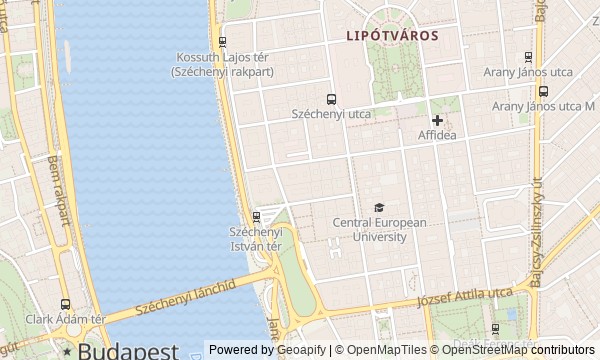
Route map
About the walk
You will walk along Pest’s bank of the Danube: from the square in front of the Hungarian Parliament Building to the bridge, then along the promenade and into the city, toward Vörösmarty Square.
The Danube will be close by almost the entire time. Along one stretch of the bank, you will encounter the central building of Hungarian politics, a memorial at the water’s edge, a palace of science, a former income-producing house, the first permanent crossing, and a concert-hall facade facing Buda Castle.
The stories will begin with small things: a pair of abandoned shoes, a room with a horseshoe-shaped table, a destroyed crossing, a newspaper crown, and a dark point in white marble. The answers will not be given in advance. The account will be calm and precise, without ceremonial rhetoric and with qualifications where the evidence diverges.
By the end, you will see Pest’s embankment not as a row of sights, but as a series of places where a private act became part of Hungary’s public history.
Why this order
The route begins at the Hungarian Parliament Building because public history appears here at its largest scale: a state building and a square of mass demonstration. The descent to Shoes on the Danube Bank moves the same question of state violence from the square to the water, and from the crowd to personal belongings left behind. Next comes the Hungarian Academy of Sciences as a sharp change of action: after the destruction of people and traces, the route shows the long preservation of folk melodies. Gresham Palace follows across the square: from official scholarly work, you move to a private basement stage where public speech was sustained through satire. At its doors begins the Széchenyi Chain Bridge, so the story of speech naturally yields to the story of linking the two banks. Farther south, Pesti Vigadó continues the same revolutionary chronology: the decision to raise an army and the shelling of the hall make more sense beside the crossing and the castle opposite. After the destroyed hall, a small figure on the railing returns art to a domestic gesture and direct touch. The turn from the Danube to Vörösmarty Square completes this line: there too, a private gift enters a public monument while remaining visible as a distinct point.
Those who want to understand Hungary’s history through concrete human acts Those looking for a connected walk along the Danube rather than an overview by era Those ready for difficult subjects without grandstanding
Those seeking an easy walk only for views and photographs Those who prefer an architectural overview without politics or military history Families with very young children: some stories concern mass violence
Before you go
The main part of the walk is outdoors, so check the weather and bring protection from wind or sun: both feel stronger by the Danube than within the city blocks.
A tour of the Hungarian Parliament Building requires separate planning and a check of current rules; security screening and official events may affect access. The route presents the Hungarian Academy of Sciences, Gresham Palace, and Pesti Vigadó from outside—the possibility of entering depends on their own operations, events, and room access.
At Shoes on the Danube Bank, keep your distance if a ceremony is taking place or people are leaving tokens of remembrance. Near the Széchenyi Chain Bridge, watch for bicycles and traffic, and remain in the pedestrian zone.
When to go
The full route without visiting interiors takes about 2 hours. Allow extra time if you want to spend longer at the memorial, photograph the views, or take a break at Vörösmarty Square.
Backup plan
If Kossuth Lajos Square is closed off, begin at Shoes on the Danube Bank: the main line of the story will remain intact, though the introduction to the state facade will need to be seen from an accessible point.
In strong wind, shorten the outdoor pauses by the water and take a closer look at the facades of the Hungarian Academy of Sciences, Gresham Palace, and Pesti Vigadó from the adjoining streets. If access along one section of the promenade is restricted, go around it via the nearest parallel street and return at the next stop.
Treat crossing to Buda as a separate detour: to continue the route after the bridge, you will need to return to the Pest side.
Route conditions
Surface. Paved — 2 km; unpaved — 55 m (data covers 96% of the route)
Stairs. Flights: 3, 27 m in total
Access. Wheelchair — no; stroller — limited (stairs)
Facilities. Drinking water — 2
Elevation. Ascent — 59 m; descent — 29 m
OpenStreetMap extract of June 25, 2026: database data, not a check on the ground. Data © OpenStreetMap contributors, ODbL licence
Walk plan
Open in maps ↗- 1
Parliament and Kossuth Lajos Square
Here you will understand why an unarmed column came to Parliament and how the attempt at negotiations ended. - 2
Shoes on the Danube Bank
This stop will show how a crime without graves acquired a tangible form of remembrance. - 3
Hungarian Academy of Sciences
This stop shifts the route from political history to the long work of preserving folk music. - 4
Gresham Palace
Here, a respectable facade will make room for the story of a small stage, satire, and a ban on practicing a profession. - 5
Széchenyi Chain Bridge
The history of the bridge will explain which personal incident set the project for a permanent crossing in motion and why construction took seventeen years. - 6
Pesti Vigadó
Here you will see how a hall for balls became a parliament, and then a target of shelling from the opposite bank. - 7
Little Princess
This point shifts from a national scale to a domestic scene turned into an accessible urban sculpture. - 8
Vörösmarty Square
The finale will link the main song, the city monument, and one final personal donation.
Route features
Everything you need stays in the browser
Progress, saves and your trip plan are stored on this device.
Add Guide On Map to your home screen so the walk opens outside the browser.
How we handle sources, maps and corrections: our editorial standards