 Guide On Map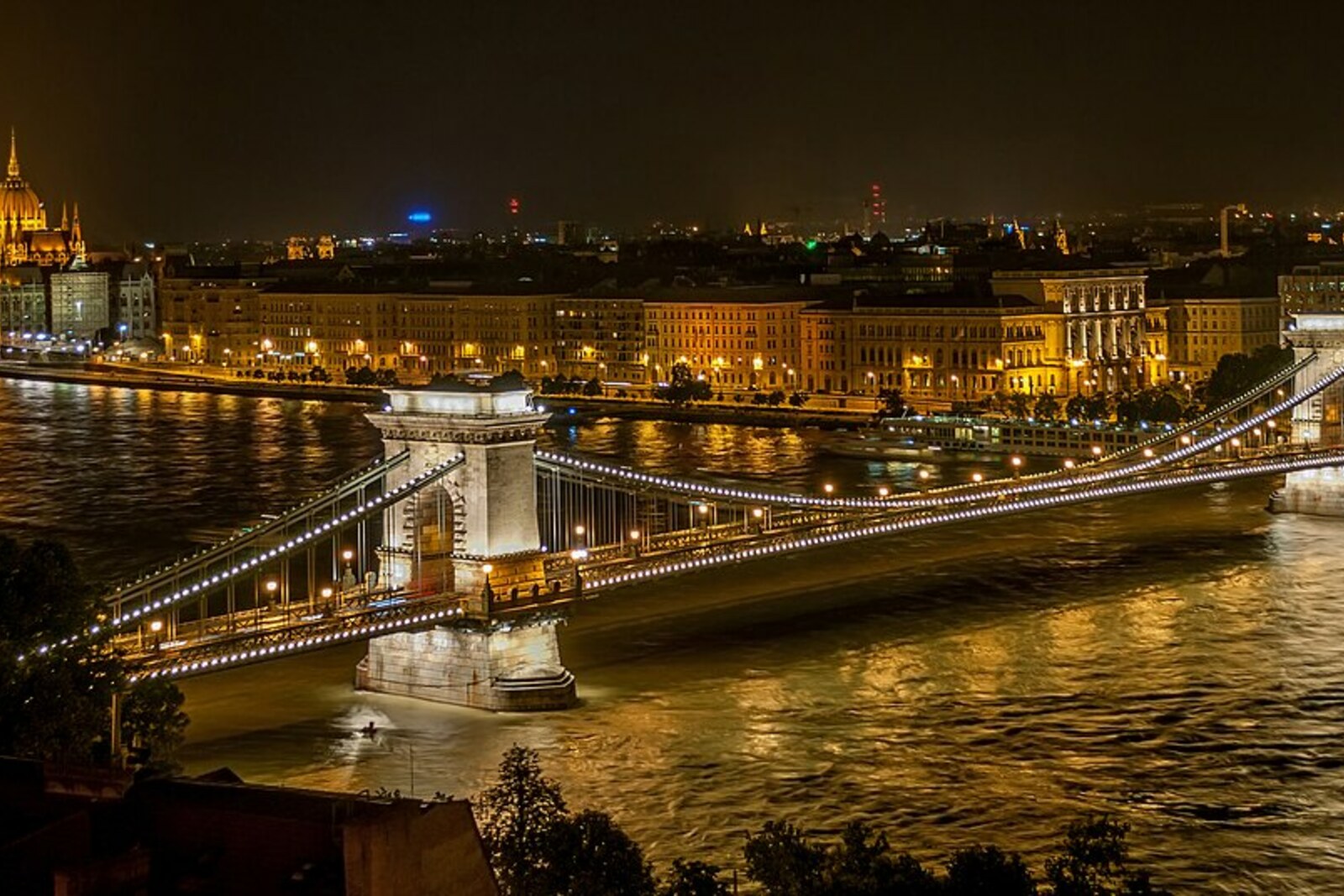
Look around first
What to notice
- Iron chains
- Stone pylons
- Suspended road deck
The story of the place
Chains stretched between stone pylons hold the suspended road deck above the Danube. The bridge gave Buda and Pest a permanent connection; they had previously existed as two cities, with boats joined into a crossing and a road laid over them in summer, then dismantled for winter. The foundations and lower parts of the stone supports survive from the original construction. The metal parts were replaced later, and after the war the bridge had to be rebuilt.
At the end of December eighteen twenty, twenty-nine-year-old hussar officer István Széchenyi arrived in Pest, hurrying to his father's funeral. He had only his uniform and travel clothes with him: he had left everything else in Vienna, expecting to stay here for half a day.
Pest and Buda were then two separate cities. In warm weather, they were linked by a pontoon bridge made of boats placed side by side, and it was dismantled for the winter. Sometimes the Danube froze over and a road was laid across the ice. Széchenyi arrived in the interval when the pontoon bridge had already been removed, while ice was drifting downstream instead of forming solid ice. The boatmen would not agree to take him across even for large sums of money. The officer spent almost a week in Pest.
On January fourth, eighteen twenty-one, Széchenyi told a friend that he was prepared to give up a year's income for a permanent bridge. It was an impulsive vow, not a finished construction plan. Széchenyi lived on income from family estates and could promise such a sum, but even a wealthy count could not pay for the whole bridge. Over the next seventeen years, he sought engineers, persuaded politicians, and gathered private investors.
The main obstacle was an old privilege of Széchenyi's own estate. Hungarian noblemen paid no road or bridge tolls. Private investors agreed to provide money only with guaranteed income from the crossing. Széchenyi secured a law under which everyone, including noblemen, had to pay to cross this bridge. Here he deprived his own estate of one of its long-standing privileges. After that, the joint-stock company was able to raise the funds, and the engineers began work.
The bridge is literally called a chain bridge: its road deck is suspended from iron chains strung over stone pylons. On July eighteenth, eighteen forty-eight, the builders were lifting the last, twelfth section of the load-bearing chains. Széchenyi was on the river with his two sons and the people directing the work. When only a little remained before the sections could be joined, the lifting mechanism burst. The section, weighing more than one hundred tons, crashed onto the temporary structure and threw the people nearby into the Danube.
One worker died. Széchenyi and his sons got out of the water; the count was saved by his ability to swim well. In his diary, he wrote that the bridge would never be completed and would remain a ruin. The builders lifted the fallen chain from the riverbed, repaired the mechanism, and a few weeks later secured it in place after all.
A little more than a year remained before the opening, but Széchenyi did not see it. In the autumn of eighteen forty-eight, he suffered a severe nervous breakdown and entered a clinic near Vienna. On November twentieth, eighteen forty-nine, the bridge opened as the first permanent crossing between Buda and Pest. Its initiator remained in the clinic and never crossed the completed bridge during the rest of his life.
The iron structure was later replaced, and after its destruction during the Second World War, the bridge was rebuilt. The foundations and lower parts of the stone supports remain from the first construction. Széchenyi's name was officially added to the name in nineteen fifteen: Széchenyi Chain Bridge is the name of the bridge to whose creation he gave seventeen years and which he did not live to use.
Useful on site
The bridge is accessible to pedestrians, cyclists, taxis, and public transport; private car traffic is not the usual arrangement.
Checked: June 25, 2026. Check the official source before visiting.You do not need to cross the river to continue. If you go onto the bridge for the view, stay in the pedestrian section and watch for bicycle and vehicle traffic.